I posted this a few years ago. It’s time to repeat it.
Growing up, my father insisted on a family tradition. Every year, my siblings and I were forced to watch “Miracle on 34th Street” on Christmas day. Not just any version, the old black and white version with Natalie Wood. Every Christmas. By the time I was 18 years old, my brother and I would roll our eyes and make a face every time we were forced to watch it.
Then, I had children of my own. The tradition lived on with my own kids.
The day eventually came when dad passed away. My kids are grown and have lives and families of their own. I still watch that movie every Christmas, and it brings back memories of childhood days spent with my family: the one I had as a child, and the one I had as a young parent.
Suddenly, that tradition didn’t seem so senseless. Dad would have been 82 years old this week had he not passed away 19 years ago. I still miss him, but he still gives me a Christmas gift every year when I watch that movie.
Cherish the senseless traditions. They become some of the best memories you will ever have.
The hose that runs from the fire hydrant to the fire truck is called supply line. Most supply line is 3 inches or more in diameter, and in Central Florida, it’s usually 5 inches. (Orlando uses 4 inch, but that is because they typically have fire hydrants that are close together).
First, a bit of engineering.
The reason for this is hydrodynamics and friction loss. The average water main pressure is about 65 psi. At 1,000 gallons per minute, a 3 inch hose loses 80 pounds of pressure every 100 feet of hose length due to friction between the moving water and the hose itself, while a 4 inch diameter hose loses 20 pounds of pressure, and a 5 inch hose loses only 8 pounds. That means, if you want longer hose lays with high flow, the larger the diameter of your supply line, the better.
There is a lot of math involved in being the driver of a fire engine. You need to be able to calculate your friction losses in your head, rapidly, and remember that the lives of the guys in the burning building depend on you getting it correct. When you are flowing 2,000 gallons per minute through half a dozen different hose lines a 2 in the morning at a burning strip mall isn’t the time to realize that you are math deficient.
5 inch supply line has what is called a “sexless coupling” meaning that there is no male or female end, the couplings are interchangeable. This allows you to start laying from either the fire to the hydrant, called a reverse lay, or from the hydrant to the fire, called a forward lay. There are advantages and disadvantages to both, but we won’t talk about that in this post.
My fire truck carried 1200 feet of 5 inch diameter supply line. That means with standard hydrant pressure, I could get a bit more than 800 gallons per minute into my engine without having to put another fire engine at the hydrant to boost pressure.
The problem with this is twofold:
5 inch hose is heavy. Each 100 foot section weighs a bit more than 100 pounds without water in it. Filled with water, that increases to over 1,000 pounds.
5 inch hose is bulky. The hose itself lays flat, but the couplings are a pain. The hose has to be loaded on the truck in a specific way, or it won’t come out of the truck correctly.
In Practice:
Both of these issues mean that 5 inch is a pain in the ass. It’s worth it, but that is not much consolation when you have to lay and reload 1200 feet of it. Anyhow, if loaded correctly, that hose comes out of the truck like a scalded dog. Like so:
I sympathize with the guys that this happened to. I once laid all 1200 feet of my supply line without meaning to when I was on the way to a large multi alarm fire. We hit a bump, the hose began laying out, and I dumped all 1200 feet in the middle of the road.
There was another time that the water department had removed a hydrant without telling the fire department. I arrived at a fire at 2 o’clock in the morning with the assignment of “secure the water supply.” I decided to do what is called a reverse lay.
So I began laying my supply hose at the fire, and headed to where I thought the closest hydrant was. 1,000 feet later, I arrived at where the hydrant was (or so I thought) and it was no longer there. After the fire was out, the other guys on the engine were not happy with me at all as we loaded all thousand pounds of hose back onto the truck.
The reason for that, is the hose is loaded by the driver backing over the hose as firefighters standing on the back of the truck lift it and load it back on the truck. The driver doesn’t do a thing but drive, the firefighters load the hose. I wasn’t a popular guy that night…
For those who are interested, the amount of hose and other equipment carried on the engine I was assigned to for the last six years of my career as a firefighter was pretty impressive. We had:
1200 feet of 5 inch supply line
300 feet of 3 inch supply line
a single 30 foot piece of 5 inch supply line in the side running board
a 250 foot length of 2 1/2 inch line preconnected to a smooth bore nozzle (cross lay)
a 300 foot piece of 2 1/2 inch line preconnected to a gated wye
a pair of 1 3/4 inch line that were 200 feet each, with nozzles connected to them (cross lays)
a 100 foot long 1 3/4 inch “trash line” on the front bumper
another 200 feet of 2 1/2 inch line, and 300 feet of 1 3/4 inch line in the storage compartments.
a “high rise pack” with another 200 feet of 1 3/4 inch hose in it.
That comes to 4,000 feet of hose. Plus all of the connectors, hose tools, breathing apparatus, spare air bottles, medical equipment, thermal cameras, 100 gallons of various types of foam, a set of hydraulic rescue tools, air tools, hand tools, flashlights, a gasoline powered fan, a power saw, extension cords, 2 chain saws, 6 axes, a set of pneumatic lift bags, 2 cases of Gatoraide, 2 boxes of energy bars, and a dozen other tools. The truck itself has a 1500 gallon per minute pump, a 10 kw generator, and 1,000 gallons of firefighting water onboard. In all, there were more than 10,000 pounds of equipment and supplies on that truck.
I loved driving and working off of that engine. I did everything on that truck- I rode as firefighter, paramedic, driver, and even as the officer in charge. There are times that I miss doing it. Life was easier and less complicated then. All I had to do was put the wet stuff on the red stuff.
I have been at my new job for 5 months now. I just got a 5% raise. Cool beans. That is more of a raise than I got after 3 years at my last job, and more than I got in 7 years as a teacher.
The best part is that I am also in line for a 7 percent raise in May. So that will be a 12% increase in pay in one year. At this rate, I might be able to keep pace with inflation.
My Dad was an engineer for Hewlett Packard. He worked in a division that did a lot of classified instrumentation work for government contractors. That’s how we wound up in Central Florida- he supported all sorts of secret missile technology over at Cape Canaveral and Martin Marietta’s Orlando test range. I never knew what he did- but he did bring home all sorts of cool pictures. I had one of an F-4 Phantom launching a missile, and another of a missile being launched by a submarine. My dad would bring my brother and I to work. We got to go to the space center and saw space launches firsthand. I watched history. I was there when the Apollo-Soyuz mission launched.
The first computer I ever had in my house was an HP-150– my dad brought it home from work. The fact that it had a touchscreen was amazing to me.
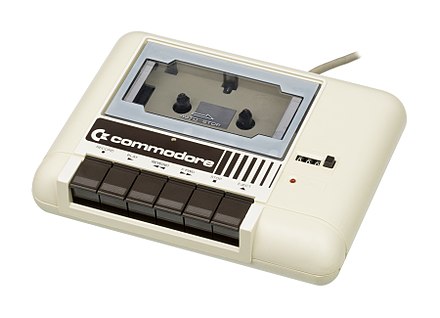
I had a Commodore 64 that I got as a Christmas gift after asking my parents for one in 1983. Unlike its competitor, the Tandy TRS-80, I thought that thing was amazing with its 64 kilobits of memory. When I got it, I also got a data storage device that looked like this:
A 60 minute cassette (30 minutes per side) would hold about 200kb of data. It would take a long time to load anything, because the stream rate from the device was around 3kb per minute.
My mighty C64. I once spent a weekend typing a word processor into it by hand. The program had been published in Hexadecimal in some computing magazine or another. Having it allowed me to type documents on a daisy wheel printer that my Dad gave me for my birthday. Man, that printer was loud.
I spent a lot of time learning how to program that computer. It ate up uncountable hours of my time, as I learned how to use sprites and other cool but relatively tame (by today’s standards) program features.
I eventually got a 5 1/4 inch floppy disk disk drive. It wasn’t long before I discovered that I could use a hole punch to make my floppies double sided and save a lot of money. I remember my Dad telling me that no one would ever need more than 10 megabytes of storage for personal use. He said, “Do you have any idea just how much data that is? The entire library of Congress can fit in 100 megabytes or so of memory.”
Just a few years later, I had a calculator that held 10 megabytes.
I didn’t just use it for programming and other geek stuff. My favorite game at the time was Raid On Bungeling Bay. It was designed by the same guy who would go on to develop Sim City, a game I learned to love on PC while I was in the military.
That’s how I grew up- my engineer dad and I doing stuff that, at times, was blatantly illegal. I remember spending weekends in the mid 70s using the company’s WYSIWYG editor (BRUNO) to copy Atari and Intellivision software cartridges and then burning our own ROM chips. (BRUNO is crunching, nom, nom, nom) I think that makes me one of the very first software pirates. Seriously, we used expensive mainframe computers during the weekends in the late 70s to play games. I remember playing text based drag racing games, text based games like Star Trek, Oregon Trail, and others. I remember working with some of the engineers at my dad’s workplace to build our own video games using our burned ROM chips.
I actually have pictures of me (as a child) with Bill Gates, David Packard, Bill Hewlett. I remember that my Dad didn’t like Bill Gates, calling him a “long haired hippy.” He didn’t particularly like MS-DOS (kids, ask your parents) when it came out, either.
I (as most of you have) seen things come about like Microwave ovens, pagers, car phones, bag phones, cell phones, then came texting, and finally smart phones. I saw the development of personal computing. I had a ringside seat to all of it.
I grew up in a world where so many things were being invented, and I was fortunate to meet the people who were doing it, and to play with million dollar machines that were changing the world.
My dad would be 82 years old this coming week, if he were still alive. He’s been gone for almost 20 years, and I still miss him every day. He was only 63 when he died. His father (my grandfather) died at the age of 54. My great-grandfather died at 47, and his mother died at 48. My family history, it seems, isn’t conducive to a long lifespan. My own health issues tell me that I a take after that side of the family.
As I get closer to the age of the deaths of the four generations before me, I admit that I spend more time thinking about that. I can trace my family back to the early 1700s. I wonder what changes they saw…
Because of a major data breach, I get free credit monitoring for the next 5 years. This morning, I got multiple alerts from the monitoring service that multiple banks are reporting that someone is using my identity to try and open bank accounts using my name and address. One of those banks is Bank of America. I tried calling them, but their automated systems won’t let you speak with a representative unless you enter your account number.
How am I supposed to know a fraudulent account number? So I am trying a number listed for their fraud department. As of the time of this post, I have been on hold for 12 minutes.
When the world gets to be a bit overwhelming, I like to sit and think about when things were different. Times weren’t necessarily easier then. This day, I’m thinking about this time of the year, but in 1987. It’s been 36 years and so much has changed since then.
Reagan was still President, I was in the military and also broke. I had an infant son. Still, I was young and the world was filled with the promise of things that could yet still be. Let’s listen to what was on my radio then and remember a time when things were different.
Sick and tired of being sick and tired, I finally caved in and went to the doctor. It turns out that the reason I am feeling so poorly is that I have a moderate case of bilateral pneumonia. No wonder I have felt like I am breathing through a straw.
I am still sick, though not as sick as I was. It began on Saturday the 20th, and by Tuesday the 24th I was seeing a fever that was as high as 102F and a resting heart rate in the 120s. I missed a week of work. The fever finally broke on Friday, but I have this lingering cough that I just can’t shake. Even now, I am sleeping in a chair at night because it’s just too taxing to breathe while lying down. I don’t know what this is, but it is kicking my ass. I’ve lost 15 pounds in the past ten days.
On top of that, there is a nurse where I work that for years has been such a pain in the hindquarters that everyone avoids her. Whenever anyone mentions her name, whoever is in earshot rolls their eyes. She routinely makes other nurses cry. I don’t know why admin puts up with her.
Well, guess who has to work with her for the next two months? Yesterday was our second day working together, and I snapped. I asked to be assigned with someone else, but the scheduler claims that’s all I have to work with. I am asking for a meeting with the department manager. That’s all of the details I can give on here, but let’s just say that the last week or so hasn’t been great.
The reason for all of the medical posts is that I have been under the weather for a few days, and I had those on deck in the event I couldn’t post anything. I have some kind of respiratory infection that has knocked me for a loop. I was working last night and had to leave work early because I just couldn’t do it. I’ve been sleeping for the past 14 hours, and now I am going to try to go to work again tonight, fortified with more drugs than Motley Crue.
Do you and your prepper friends have this kind of command and control? Drones for recon, fast reaction ATVs, radio coordination? These guys are effective because they are willing to do whatever it takes to win, and they are obviously getting training and equipment from somewhere. Look at the ambush tactics here. Even two years ago, they were well trained, funded, and equipped. They have a nationwide organization that is operating like a CIA led operation. Think about the implications.
Tons of people responding on both threads, complete with chest thumping about how “If that had been my car…” derp, derp. Watch the video. There is a woman in the crowd yelling “shoot him.” You can say that we have guns all you want, but most people are not willing to take the actions that will be required of them. Most don’t even understand just how savage they will have to be in such a conflict. Don’t underestimate these people. They’re not fucking around and they’re zealots. It’s time to stop with the chest thumping and bravado. They are preparing, while we are sitting around talking about how the war will be short.
Election season is underway. There will be more and more violence leading up to that. Know where the cells in your area are.
A little known fact outside of the nursing profession is that there is a lot of infighting and mudslinging in the nursing field. Nurses who work in different areas of the hospital have this “circle the wagons” mentality.
Each of the units in the hospital views themselves as being better than the rest: surgical, endoscopy, the ICU, all of them.
The medical floor is where many nurses get their start, and it is viewed as one of the areas of the hospital that require the lowest level of skill and proficiency. It’s for this reason that they struggle to be respected by other units.
Labor and delivery are seen by most of the hospital as simply wanting to play with babies. The ICU are seen as the neat freaks, the ones who have OCD and simply MUST have everything perfectly in place.
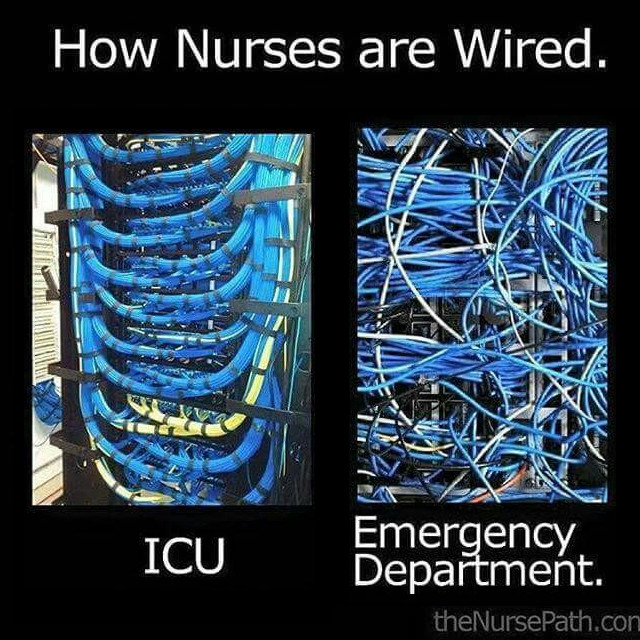
However, there is one almost universal truth- the Emergency department is seen as being the cowboys. They aren’t as methodical, often improvising, adapting, and overcoming obstacles with little regard for tradition or propriety in their quest to stabilize patients. That’s why this is funny:
To say that some nurses simply HATE nurses in the emergency department is an understatement. An even larger sin amongst those particular nurses is to have begun your career as a paramedic. The nurses who dislike the RNs in the ED reserve an all new level of hate for nurses who used to be paramedics. They (paramedics) are viewed by these nurses as being knuckle-dragging Neanderthals’ who have no business in a hospital.
The odd part is that many nurses (25% to 80%) in the ED originally started their careers as paramedics. It’s a natural progression for them, because the same skills that make them good paramedics also make them good nurses. These former medics are known as great critical thinkers, improvisers, and they usually excel at starting IV lines that other nurses can’t get. Beginning your career starting IVs in the back of a moving truck, it’s a skill that isn’t unlearned.
I had a nursing instructor tell me that REAL nurses start IV’s in the hand, and never in the crook of the elbow, because it’s uncomfortable for the patient, and movement of the elbow can cause issues with IV pumps. I pointed out to her that some drugs like IV contrast dye, and Adenocard must go into that location, so saying “never” is not correct. The unfortunate thing is that she was one of my nursing instructors, she’s a screaming liberal, and since I apparently have a biological inability to shut my mouth when I think I’m correct, it cost me some grief during RN school. The same issue is what chased me out of getting my masters degree a decade ago.
It didn’t help that we had to write a paper on this cartoon, microaggressions, and how vulnerable populations must feel in the face of white privilege. I hate it, but liberal professors are the gatekeepers. There were two things that made life hard for me. Being right, and not being able to back down when I know that I’m right. That’s why I am struggling to finish my BSN. I already have Seven college degrees, with two of them being Bachelor’s degrees. It’s the nitpicky BS that I struggle with.
Misplace a comma in ONE of the APA references in your bibliography, and you just handed them the excuse to take the paper you spend two weeks on down to an 88% ‘B’ grade. I just don’t have patience for that kind of ticky-tack BS. It doesn’t help that I am in classes where I am decades older than some of my instructors.
I will make it, because I learned my lesson ten years ago, but it still burns my ass that these professors make mouthing the commie line a required rite of passage to get a degree.