No post this morning because I was busy yesterday. It was time to fix the tripping breaker problem I was troubleshooting a few days ago. If you will recall, I had a problem with the breaker tripping repeatedly for the receptacles in two of our bedrooms: one was use as a guest room, and one that we use as an office/sitting room. It turned out the wire running from one receptacle to another, even though it was disconnected from everything, was only measuring 2 ohms between the neutral and ground wires. That will trip the breaker (GFI) every time. It was probably caused by a staple, nail, or nail plate rubbing through the insulation on the wire.
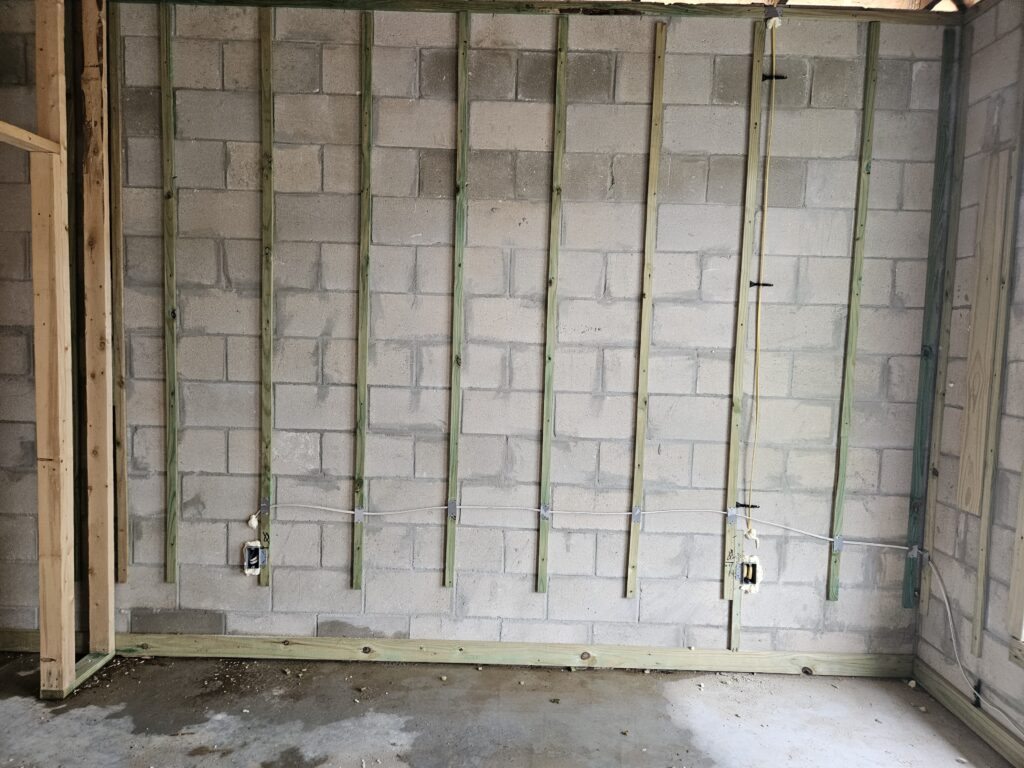
I isolated the bad section by cutting it out of the upstream box, which of course orphans the downstream box. The breaker reset once I did that, but now I have a dead receptacle. The dead plug is the one on the left. (I took pictures of my entire house while it was under construction, before they put the drywall, insulation, and vapor barriers in. That really comes in handy. I know where every stud, wire, pipe, and duct is)
There is no way to fix that shorted Romex, the wire must be replaced if we want that plug to ever work again. The bad news is the receptacle before the bad wire is on one wall, and the receptacle after the bad wire is on another: the Romex goes around a corner. That is going to be nearly impossible to do without tearing out a lot of drywall.
The good news is there is a dedicated receptacle on the same wall that I could tap into. You can see it on the right side of the above photo, it’s the one supplied by the yellow Romex. It’s the only receptacle on that 20 amp circuit, so I can just add the orphaned plug to that. Since it’s a 20 amp breaker, I can’t use 14 gauge wire, so I went to Lowe’s and got 25 feet of 12/2 wire bright and early in the morning.
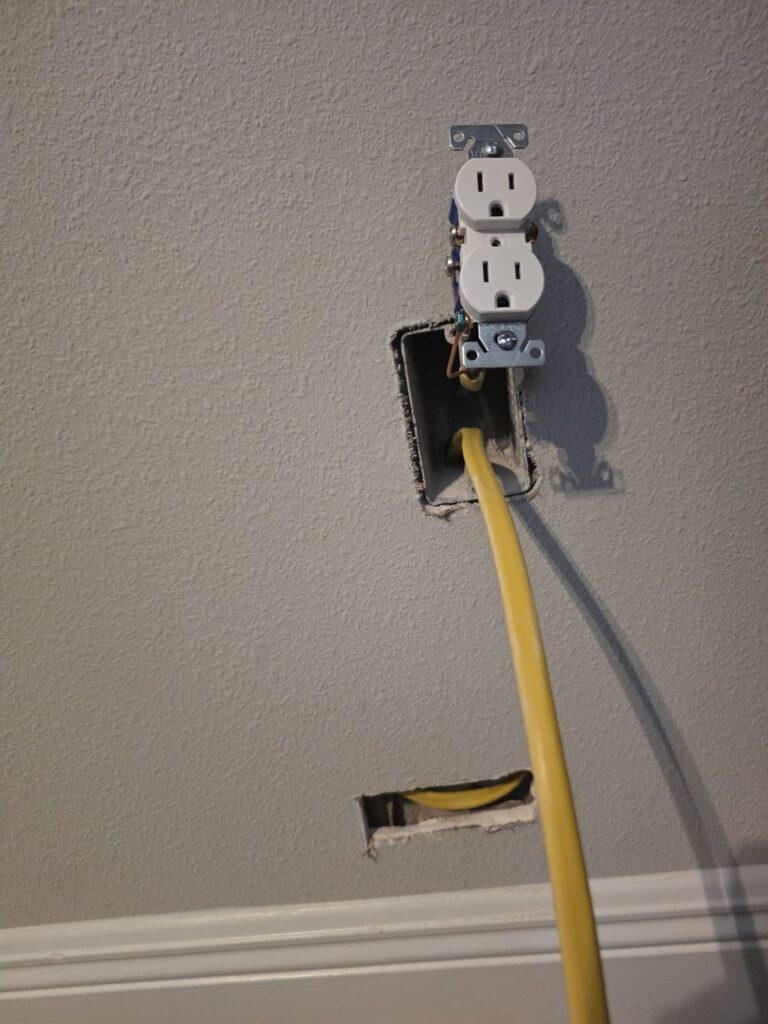
I cut two holes in the drywall, about 8 inches beneath each receptacle. I also had to notch out that furring strip you see on the right. Once I did that, you will note that there is a straight, unobstructed path between those two points and pulled Romex through the intervening space, because the only one of the furring strips goes all the way to the floor.
Now I have a wire running from one to the other, but the boxes are recessed into the concrete blocks. I fixed that with a hammer drill to put a 3/4 inch hole in the concrete block 8 inches below each box. Now it was a simple manner of pulling the ends of the wires through the hole, up through the bottom of the box, and wiring everything in.
I still needed to notch the furring strip in this photo:
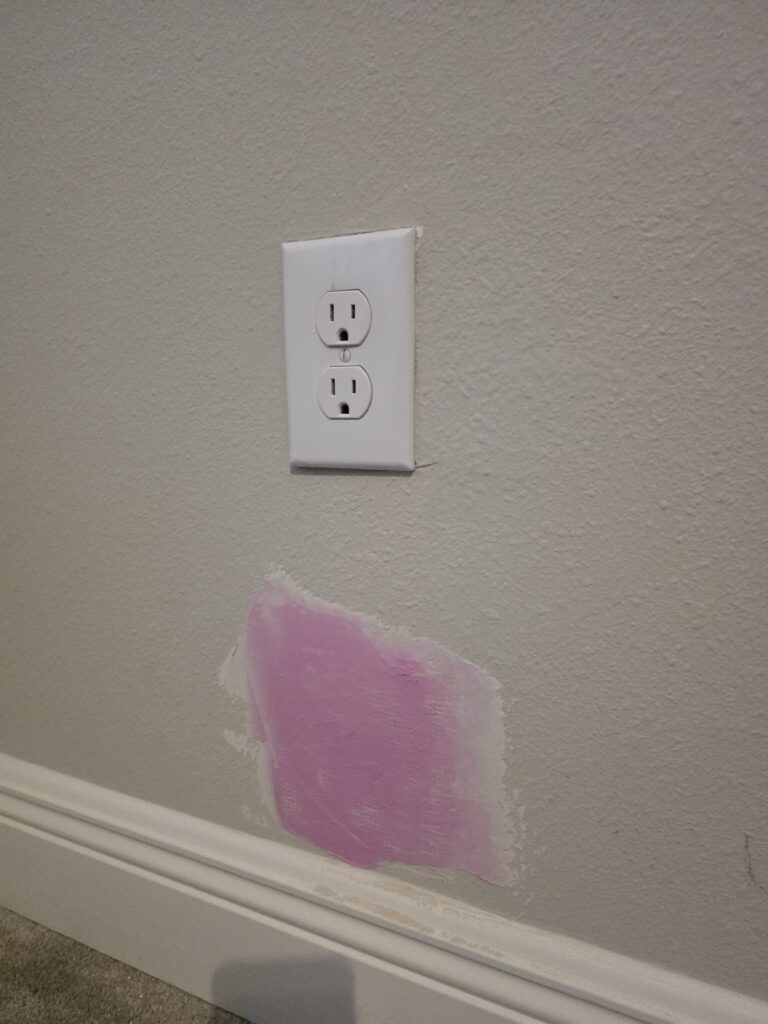
A bit of drywall patching. I like using the color changing mud, because it’s so much easier to tell when it’s dry. It leaves a flat looking spot on the wall that clashes with the orange peel finish, so once it dries, I sand it smooth before mixing some of the mud with some water to thin it to about the consistency of waffle batter. Then I roll it on with a foam roller, and it makes a pretty convincing orange peel surface.
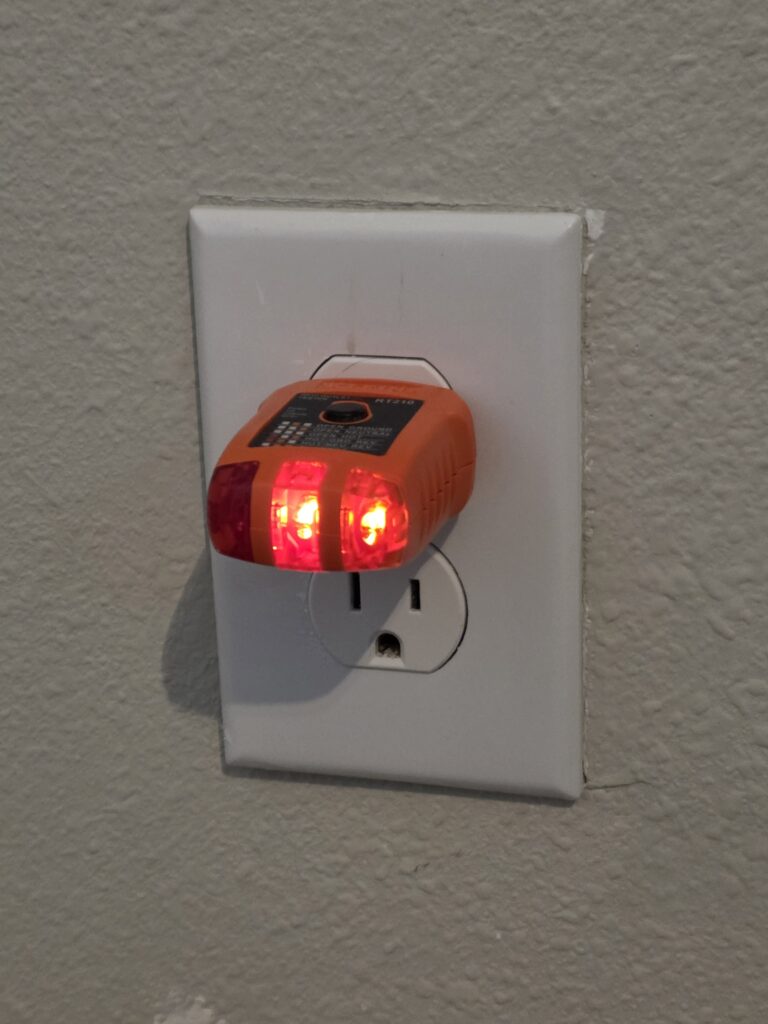
Then test the plugs. All done. The entire fix, including a 2 hour trip to Lowe’s ate up my Saturday. The wife will paint the patches, once the mud dries. Painting his her territory.
One thing the Social Media and Reddit posts on this get wrong is this is not a road rage incident. This is a crazed man who was going door to door and threatening those who lived there. The source of the video is here. It apparently happened in Miami in November 2021.
This morning this man started banging on my front door and making threats with some kind of weapon which he broke on my front pillars. We called the cops and he has apparently done this to other people and they are looking for him. We have no idea who he is but he is clearly dangerous – please be careful and avoid this man at all costs. Call the cops if you see him.
You are sitting at home and some moron is ringing your doorbell, screaming that he is going to enter your home and kill you. He is holding something that appears to be a crowbar, but claims he is going to come kill you, then brandishes it as though it was a long gun. This would create a reasonable fear that the man is armed and capable of carrying through on his threat.
We have seen this situation before. For some reason, people think that it’s entertaining or funny to create fear in the minds of people within their homes.
No matter what, do not open the door. There are a hundred things that can happen after the door opens, and most of them aren’t good for you. Maybe it IS a gun, maybe he has accomplices. Maybe those accomplices are using him as a distraction. In any case, you are in a secure perimeter and concealed or even behind cover. You have a clear view of this critter via camera. Advantage: you. Keep it that way.
If you have a gun, hearing protection, and body armor, get them. Take cover where you can keep a gun trained on the door while simultaneously watching him on the cameras. Do this before calling the cops. You don’t want to get killed while on hold.
Call 911. Tel the cops there is a man on your porch threatening to break in to kill you and has claimed to have a gun. Tell them you are armed, and locked in your home. The call containing the words “gun” and “armed” will not only place your call at the head of the queue, but will help establish a reasonable fear of death, bodily harm, and the imminent commission of a forcible felony. Those are important legal protections you can use later. Leave the phone on speaker so the 911 call taker can hear the unhinged maniac on the background, and more importantly, so can the recording of the call.
My front porch is screened in, with a screen door. That puts my front porch within the curtilage of my home. Even entering the porch with the stated intent to break down the front door to harm those inside provides me with important legal protections under Florida’s Castle Doctrine.
In Florida, you can use deadly force in your home if you reasonably believe you or another are facing imminent death or serious bodily harm, or a forcible felony is about to happen, and you are lawfully present in your home. Because the statute provides a presumption of reasonableness when an intruder is unlawfully and forcibly entering your home (or attempting to), the law strongly favors the occupant in that scenario.
So the questions that must be answered are:
Is it reasonable for you to believe the person is attempting to enter your home?
Are you lawfully in your home? (that is, are you breaking any laws, say by dealing drugs?)
Have they threatened to cause serious harm or death, and would a reasonable person believe them?
Is deadly force reasonably necessary to stop them?
Is the threat imminent?
I would say that the answers to 1, 2, and 3 are a definite yes. Question 4 is a yes. After all, he just told you what he is going to do: “I will break this shit down and blow your fucking head off.” That creates a reasonable fear that he is about to enter your home to harm you. Question 5 May not be a yes. A case could be made that that the threat isn’t imminent, right up until they entered the curtilage of your home or attempted to force their way through the door. Another good reason for not breaking perimeter. Leave those on the outside on the outside. Force him to come to you.
Curtilage refers to the immediate area surrounding and associated with your home — the space that is considered part of the home for purposes of privacy and legal protection. Florida courts and the U.S. Supreme Court have described it as the area that harbors the “intimate activity associated with the sanctity of a person’s home and the privacies of life.” That typically includes:
The front porch, back porch, and deck
Driveway and walkways immediately adjoining the home
Fenced yard areas directly around the home
Attached garage or carport
It does not usually include open fields, detached outbuildings far from the house, or unfenced areas that are visible and accessible to the public. Under both Florida criminal law and the Fourth Amendment, curtilage is defined as:
“The area immediately surrounding and associated with the home, which is considered part of the home itself for many legal purposes.” — Florida v. Jardines, 569 U.S. 1 (2013); Oliver v. United States, 466 U.S. 170 (1984)
Florida courts have consistently held that curtilage is an extension of the home for purposes of:
Fourth Amendment protections against unlawful search and seizure
Self-defense laws (e.g., the “Castle Doctrine” under § 776.013, Fla. Stat.)
Courts look at several factors to decide whether an area is part of the home’s curtilage:
Proximity — how close the area is to the actual dwelling
Enclosure — whether the area is within a fence, wall, or natural boundary that encloses the home
Use — whether the area is used for domestic purposes (e.g., sitting area, grill, kids’ play space, parking)
Visibility and steps taken to protect privacy — whether the resident has taken measures to shield the area from public view (such as fences or hedges)
(See: United States v. Dunn, 480 U.S. 294 (1987); State v. Hamilton, 660 So. 2d 1038 (Fla. 1995).)
Under Florida Statute § 776.013(1), the “dwelling” includes the building and its curtilage. Florida courts treat screened porches, lanais, or enclosed patios attached to the home as part of the dwelling. (See State v. Martinez, 700 So. 2d 142 (Fla. 2d DCA 1997)). This means:
The castle doctrine protections — the legal presumption that you are in reasonable fear of imminent harm — extend to the immediate area surrounding your home.
If someone unlawfully and forcibly enters your porch, attached garage, or fenced yard, you may be justified in using defensive force, including deadly force, under certain circumstances.
This means you can’t shoot someone for trying to open your door, standing on your porch, or walking up the driveway. Postal workers and Amazon delivery drivers are happy about this. However, if they kick in a fence or forcibly enter through a locked portal, such as slashing a screen, they have crossed over into breaking and entering.
At that moment, under § 776.013(2), Florida law presumes you have a reasonable fear of imminent death or great bodily harm, because:
The person has unlawfully and forcibly entered your dwelling’s curtilage.
You are lawfully present.
You are not engaged in criminal activity.
That presumption legally justifies deadly force, unless one of the exceptions in § 776.013(3) applies (for example, if the intruder is a lawful resident, or if you provoked the incident, etc.).
So back to this situation: I don’t breach my perimeter for idiots. I sit safely inside and call the cops. I would be wearing electronic hearing protection and body armor. I would be armed with a long gun that has lots of ammo. Why? Because we carry a handgun if we think we might be in a gunfight. If we think we WILL be in a gunfight, bring a long gun, and bring friends with long guns. My wife would be safely in the closet that is our safe room, also with hearing protection, body armor, and armed.
Once the visibly armed critters have threatened to forcibly enter my home, then enter perimeter, this threat becomes imminent, making both my fear of harm and my use of deadly force reasonable. In a case like this, there would be at least one dead body and perhaps some blood trails for the police to follow when they eventually arrived ten minutes after I called for them.
Florida appellate courts have repeatedly found deadly force justified when:
An intruder broke through a fence or gate and approached the home aggressively. (State v. Giles, 579 So. 2d 792 (Fla. 4th DCA 1991))
A homeowner shot someone who forced entry onto a porch or patio. (Martinez, 700 So. 2d 142 (Fla. 2d DCA 1997))
In such cases, the courts held that fenced yards, porches, and patios are part of the dwelling — the “castle” — so the presumption of reasonable fear applies. If the intruder crossed into your yard and made explicit death threats, the standard of “reasonable fear” would almost certainly be satisfied — even if the intruder had not yet crossed the threshold.
It’s a great reason to have a screened in porch with a locked door, even if the lock is flimsy like the ones found on a screen door. Once he begins trying to force your main door, I believe you are on rather firm self defense territory.
Relevant Cases
State v. Martinez, 700 So. 2d 142 (Fla. 2d DCA 1997) Martinez shot an intruder who broke through a screened porch attached to his home late at night. The state argued the porch was not part of the “dwelling,” so deadly force was not justified. The court held that the attached, screened porch was part of the dwelling’s curtilage. The homeowner was protected under the castle doctrine. The court reasoned that a porch “integrated with the home’s living space” and enclosed by screens “serves the same privacy and security functions as the interior.”
State v. Hamilton, 660 So. 2d 1038 (Fla. 1995) A man was shot in a fenced backyard after threatening and attempting to enter the home. The issue was whether the fenced yard counted as the home’s “curtilage.” The Florida Supreme Court held that a fenced backyard was part of the dwelling’s curtilage for self-defense and burglary statutes. The fence “manifested an intent to exclude the public and protect the area as part of the home.”
State v. Giles, 579 So. 2d 792 (Fla. 4th DCA 1991) A homeowner shot a man trying to break into the house after entering the yard aggressively and ignoring commands to leave. The court found that deadly force was justified because the intruder’s actions created a reasonable fear of imminent death or great bodily harm. The “no duty to retreat” principle applied — the homeowner was lawfully in his dwelling.
Weiand v. State, 732 So. 2d 1044 (Fla. 1999) A woman shot her abusive husband inside their shared home and was prosecuted for murder. The case helped establish Florida’s “no duty to retreat” inside one’s home rule (before Stand Your Ground). The Florida Supreme Court recognized the castle doctrine as firmly established: you are not required to retreat in your home before using deadly force against an aggressor posing imminent danger.
State v. Hill, 95 So. 3d 434 (Fla. 4th DCA 2012) A man shot someone outside his home during a violent confrontation. The court examined whether the shooter could claim immunity under § 776.032 (the Stand Your Ground immunity statute). The court reaffirmed that § 776.012(2) justifies deadly force when a person reasonably believes it’s necessary to prevent imminent death or great bodily harm — even outside the home, if the shooter has a right to be there and is not engaged in a crime.
There are people who keep claiming that lethal force shouldn’t be used on someone who is unarmed, or only armed with a knife, as if you can only use the exact same weapons as your attacker. The people commenting on the case in New York of the fat murdering cow who killed one, injured another, then shrugged off several Taser hits and charged the cops with her knives is a great example.
They could have subdued her without injury injury to cop or her. This is very very sloppy policing. The city will pay out millions for this one. https://t.co/2eAn7ahX9Q
Anyone who says anything like this has never done a force on force class. I suggest you try this:
Arm yourself with a paintball, airsoft, or BB gun.
Give your training partner a Sharpie. For safety, they should be wearing safety glasses.
Have them begin 5 feet away from you, then charge you with that sharpie.
The simulation ends under one of two conditions: you shoot the person twice in the chest or the person marks you once in the head, neck, chest, or the insides of your bicep or thighs.
Why is it so lopsided? Because that’s how self defense works.
Now repeat the test at 10 feet, then 15, then 20. I am betting you will end the day covered in sharpie marks, any one of which could have been fatal if delivered by a knife instead of a marker. As a person armed in a self defense situation, are you willing to roll those dice? With that in mind, how close will you let a person with murderous intent and armed with an edged weapon get before you shoot them?
Racial tensions are as high as I can recall. This is an attack by a man upon two unsuspecting women, and purely based on race.
It’s also why I carry. Note this happened in Charlotte, NC, where they can legally carry guns. Why didn’t someone punch that asshole’s ticket? This is the 23rd time he’s been arrested in the past 14 years.
Hunt was in 2020 convicted of shooting into a building or a vehicle with a person inside, Charlotte-Observer news partner WSOC first reported. He has been arrested on charges of assault against women and government officials, trespassing and violating probation and domestic violence orders eight times in the last three years, jail records show.
How many times before he actually gets caged or shot? Are the residents of Charlotte waiting for him to kill someone?
Avoid feral negros. Cross the street. Go a different way. Be prepared to kill them, because they will certainly kill you.
I have one duty in my life that supersedes all others: I will protect my wife from violence directed at her from any other, and that includes a heavyweight negress. Were I on a cruise and someone hit my wife like this, she would be on the receiving end of an entire can of whoop ass, and I don’t give a shit if it results in a lifetime ban. Touch my wife, and you have an ass kicking coming to you- woman or not. Pay close attention- at about the 36 second mark, she grabs a glass from behind the bar to use as a weapon.
She retained that glass until the 1:10 mark, when her own husband took it from her.
It was bad enough that she hit the first woman, but coming after the second woman who was just sitting there at the bar next to her husband. Since she was armed at the time she confronted the second woman, as her husband, I wouldn’t have hesitated to use maximum force. With that glass in her hand, she could easily have killed that woman or her husband. Once there is a weapon involved, this has escalated far beyond just bad behavior. This is aggravated battery and should be dealt with as severely and quickly as possible. There is no time for talking, posturing, or arguing.
Kill her if you must, but that she-boon has to be neutralized now, before she hits you in the head and you or your lady wind up with permanent brain damage.
If the cruise line, or any other business wants to punish you for that, get a lawyer. Sue. Force them to come out and support a criminal attack.
Oh, and stay away from blacks. They are dangerous and can’t be trusted not to chimp out.
Scientific knowledge evolves. As mankind discovers more information, the view of our world and how it works changes as well. The use of tourniquets, which I have discussed at length a couple of times on this very blog, are a great example. We were once taught that, once a tourniquet goes on, it stays on unless the patient is in the room with a trauma surgeon. That turns out to be only partially correct.
At the end of the day, trauma is a surgical emergency. What a trauma patient needs is access to that trauma surgeon. Getting a patient to the hospital within a rapid timeframe, often referred to as “the golden hour” greatly increases the patient’s chances of survival. Remember that serious trauma is first and foremost a surgical emergency. Trauma patients don’t need a tricked out first aid kit- they need a trauma surgeon. All they need you to do in the field is keep them alive and prevent them from furthering their injury until they can get on the operating table.
For that reason, tourniquet training for most Americans has followed simple, strict guidance: apply one high and tight to limbs to stop life-threatening bleeding, and leave removalto advanced medical care personnel. That is no longer the case.
So what changed? The war in Ukraine. In the US, and in US controlled battlefields, people who receive gunshot wounds are one helicopter ride away from a trauma surgeon, and the vast majority of the patients make it to the surgeon’s operating table within that hour and have good results. In Ukraine, the nature of the war there is such that almost no one gets a helicopter ride, and with killer drones circling everywhere, very few of those injured are transported by ground in anything resembling even the “golden day or two” and, if they are wearing a tourniquet, wind up wearing it for days. Casualty evacuation in Ukraine often exceeds 6 hours, and the liberal use of limb tourniquets may have increased morbidity.
That sets up a whole list of new problems.
Leaving a tourniquet on for hours or even days causes other issues. Once a tourniquet is in place, it stops blood from flowing to the affected limb. Once deprived of their blood supply, those cells begin taking measures to protect themselves, and after a period of time, those cells die. As they die, they release their contents into the surrounding tissue. When the tourniquet is removed, those contents make it to the kidneys and clog them up with all of that debris. The condition is called rhabdomyolysis. The longer a limb tourniquet is in place, the higher the risk of compartment syndrome, vascular thrombosis, rhabdomyolysis, and irreversible myonecrosis resulting in major tissue loss and often necessitating limb amputation, kidney failure, and death.
If bleeding is controlled with a tourniquet, attempts to remove the tourniquet as early as possible to avoid the negative consequences are essential. However, if the removal is not done correctly, there is a risk the bleeding that the tourniquet was supposed to stop will also kill the patient. The act of removing a tourniquet (called ‘tourniquet conversion’) is now changing the training being put out to US special forces troops, and is especially important to preppers here in the US.
What this means for you
In the US, we are usually a quick helicopter ride away from a trauma surgeon, but that may not always be the case. In a disaster or TEOTWAWKI situation, those helicopters aren’t coming. At the same time, a tourniquet left on for more than 2 hours can itself be a hazard. Before attempting this, please review my post on treating gunshot wounds that you can find here.
Important: Never attempt tourniquet conversion if the patient is in shock, the wound cannot be continuously monitored for re-bleeding, or if the tourniquet is applied above a traumatic amputation.
Shock being defined here as the loss of consciousness, or a blood pressure less than 90/xx.
The Conversion Steps (The “Plus-1” Method)
Prepare: Place a second, loose tourniquet on the bare limb just above the first one, but do not tighten it yet.
Pack: Firmly pack the wound cavity with hemostatic gauze (if available) or standard rolled gauze, maintaining direct digital pressure for at least 3 minutes.
Dress: Apply a pressure dressing securely over the packed wound.
Release: Slowly loosen the original tourniquet (over at least 1 minute) while meticulously observing the wound for bleeding.
Monitor: If bleeding is controlled, leave the primary tourniquet in place but fully loosened in case bleeding recurs.
Optimal conversion should be attempted within 2 hours of the initial application when conditions are safe and stable. If bleeding restarts upon release, re-tighten the primary tourniquet or utilize the newly placed backup tourniquet.
Since it’s private companies doing it, you have no Constitutional protections from the intrusion. It’s time to harden your digital signature to the greatest extent possible. Merely refusing to have any of this hardware is no longer good enough.
South Carolina Law Enforcement (SLED) released dashcam footage of a shooting that happened in April on I-85 in Anderson County.
Austin Robertson (32) fought the officers then reached into his vehicle and pulled out an AR15 pistol (no brace of course…) and shot Deputy Alex… pic.twitter.com/MVMgj0z1Nq
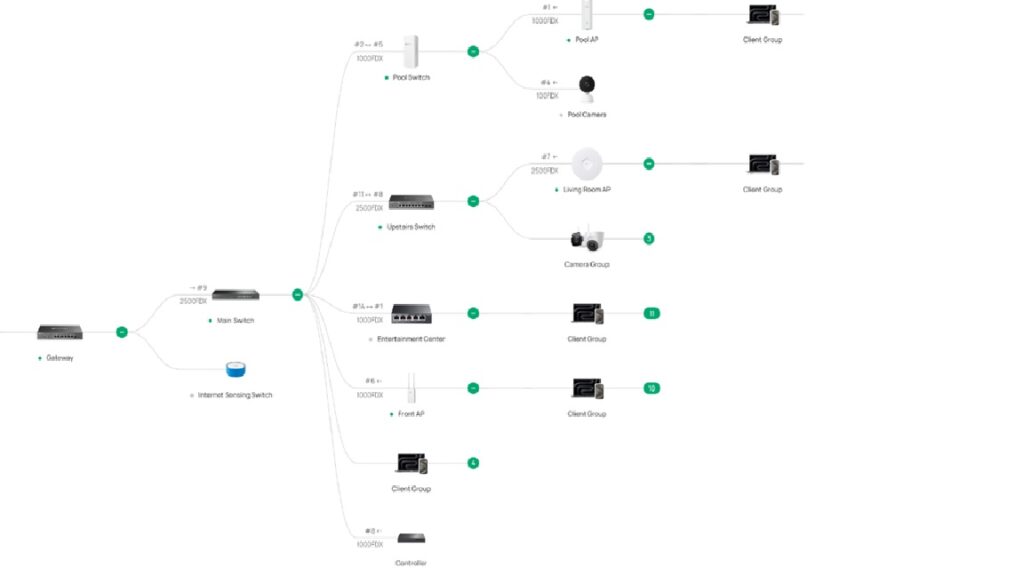
The hardware of the entire new network is in place. Some of you asked for a system diagram. Here is the wiring diagram for the new network:
Now that that is finished, we needed to install the ACL’s and rules. The VLANs are:
Trusted 10
IoT Devices 30
Servers 40
Guest 50
Cameras 60
Network Infrastructure 90
So the rules are simple. This controller handles rules higher in the list as being higher priority. For that reason, you list exceptions first, and general rules second. With that being said:
Permit Guest network clients to contact the printer
Allow my Zigbee hub to contact the server (TCP only)
Allow Trusted Devices to contact Infrastructure
Allow Cameras to contact Server
Allow Trusted Devices to call Server
Deny Guest network to all other networks
Dent IoT network to all other networks
Deny Cameras to other networks
Deny Cameras to Internet
Deny other networks to Infrastructure
That is the network. I set the network up like this, and everything seems to have been working well for the past week. I am sure that I will add other rules as things go on, but that is what I have for now. Once a week, the entire contents of the server are encrypted and sent to a backup server that’s stored in the house of a friend. That way, I have a copy of everything important in the event I lose access to all of my data here. Since it’s the Internet, that person and my backup data can literally be anywhere.
Then I installed AdGuard, which is my own private DNS running on the server. It allows me to control which clients on the network can interact with my network. It lets me block malware, spyware, and all sorts of advertising. About 30% of the DNS requests originating from my house are things I don’t want phoning home.
There is a VPN built into the system that allows me to hide my traffic from as many people who don’t have reason to see it as possible.
Then the surveillance software went in. The software was Surveillance Station and is running on the Synology rack server. It is recording a single PTZ and several fixed cameras, all in 8mp. It’s been running for ten days and I haven’t even used 2tb of my 7.8tb of storage so far. I think I have plenty of recording time. My goal was for 30 days’ retention, but it looks like I will get more than 60 days out of it.
Then there is physical security provided by Home Assistant. That includes sensors for motion, doors and windows, as well as a link to my smoke detectors. Different events cause different actions. Motion in a give area causes Home Assistant to take a snapshot of the area through the nearest security camera and send it to my cell phone as a text message. It can remind me that I forgot to close the door on the way out, other things like that.
The best part is that all of it, every piece, is owned by me. Amazon doesn’t decide to send my camera video to the cops. My ISP and their DNS server doesn’t need to know what websites I frequent. My devices don’t need to be reporting to data brokers what happens in my house.
Is it foolproof? Nope. Will it stop nearly all of the bullschnozzle? probably. Will it stop a determined, talented electronic wizard? Probably not.
It’s still far better than what I had three months ago. Now you know why I did all of the posts about data mining.