Cameras

As any of you who are regular readers here know, whenever I undertake a major project, I always debate, design, and document the dog doo-doo out of it. (Sorry, I just liked the alliteration in that sentence) Remember the solar project?

I had a cheap camera system in my old house. One of those where you run cables to the cameras and they save to a hard drive in a dedicated DVR. When I moved to this house two and a half years ago, we transitioned to Ring cameras. I regret that decision for the following reasons:

  • The cameras send their video to the cloud
  • The cloud is just a word meaning “someone else’s computer”
  • This means you don’t own the data, and Amazon does all sorts of stuff with it.
  • The quality of the pictures is only slightly better than filming with a potato

Even though none of the cameras were inside the house (when we went on vacation, we temporarily put cameras in the house), I still don’t like other people having my data or pictures of my house. Since I installed an entire network worthy of a small office building. Why not use that to increase surveillance?

Infrastructure

For those reasons, I wanted to get a new camera system that overcame these deficiencies. I wanted this system to have:

  • 4k video
  • Enough storage for 30 days of video retention
  • Wired cameras, no wifi

What I decided on:

  • Ethernet cameras
  • recorded on the Synology RS1221+ that’s my network storage. That server holds 8 HDDs. I have it set up with a pair of RAIDs, one for my data, and one for recording camera video.
  • The camera RAID is composed of three 10 TB HDDs giving me about 18TB of storage space
  • That 18tb of space is enough for six 4k cameras recording 24/7 for about 60 days
  • Software is Surveillance Station, which allows 2 cameras before licenses need to be purchased for more

My plan is to have six cameras covering the property.

  1. general surveillance camera covering the front of the house
  2. another on the back porch
  3. one viewing the back of the house and the pool
  4. one that views the kitchen/living room
  5. a PTZ camera on the front of the house. This camera will have a 25 or greater optical zoom to allow distance viewing without losing too much resolution.
  6. Doorbell camera (this one will have to be WiFi)

Two of the cameras already had Ethernet wires running to them: the one on the back porch went in quickly with no issues. The one covering the front of the house did as well, but even though it was receiving POE power, no connection. I thought it was a faulty cable. It turns out the construction workers who installed the wire got the RJ45 jacks installed wrong. That was quickly taken care of. That gave me two cameras right away.

I went into the attic to run more ethernet cables and discovered that isn’t going to be possible. The header for the wall where the server is just isn’t accessible from up there. I do have an Ethernet cable run to both the front and back of the house that was put there when the house was built. I realized the best way to do this is to use those cables as a trunk that feeds a managed switch. These two switches will allow me to branch those trunk lines into an AP and a camera.

That’s exactly what I did.

This involved expanding my network. My network became a server cabinet that carries most of the Internet, but also required several edge switches to serve other clients. It looks like this:

             Core Switch
                     │
    ┌────────────────┼────────────────┐
    │                │                │
    ▼                ▼                ▼

Entertainment Pool Switch Front Switch

From there, it is easy. Wire the cameras in, and instruct the local (edge) switch to place the camera in the surveillance VLAN, the AP in the management VLAN, etc.

The entire project of Internet and cameras has gotten larger and more expensive than I planned on. I’m going to sit here on just the two cameras until next month, then install the doorbell and pool cameras. The PTZ camera will be last, simply because it’s the most expensive of them. That means I am on sort of a hybrid system at the moment, with two of my own camera and several Ring cameras.

Work in progress.

EDITED TO ADD

In case you haven’t caught on, I try to do a major project each year to improve my position. The first summer we were in this house, we added solar and Powerwalls so we would have backup power. The second summer was the pool, screened in lanai, and hurricane hardening. This summer is a two-fer. One of the projects is the network/camera project, the other is one that makes me far less happy. More on that later.

Morning Intel Briefing

The goal of any color revolution is twofold: to convince the citizens that the government is powerless or unwilling to protect them, and that the insurgents ARE and WILL protect them. They need to create a failure of basic government services, like the rule of law. When enough people become restless and convinced that the rule of law has failed, that critical mass of people will look for a savior. That is when those who would overthrow the government step forward and offer to do what the people think the government cannot. The government is talking about increasing their security posture, and i recommended this morning that each of us do the same:

The threat landscape appears to look like this:

Political Orgs: The Democratic Socialists of America (DSA) is the primary political arm, with the Party for Socialism and Liberation (PSL) close behind. PSL is part of the Neville Roy Singham network and serves as their vehicle for running political candidates.

Militant Anarchists: A growing militant wing trains in weapons and self-defense, including groups such as Antifa, the Socialist Rifle Association, Armed Queers, Behind Enemy Lines, Code Pink, the ANSWER Coalition, The People’s Forum, BT News, and Unity of Fields.

Climate Activism: Billions have flowed into climate-activist organizations, many of which increasingly employ anarchists.

Social & Racial Justice Groups: Since the rise of BLM, billions—public funds included—have supported the social and racial justice groups that regularly advocate for burning down the country.

Civil-Rights & Legal Orgs: Legacy anti-Western activists (“movement lawyers”) staff these groups, suing governments, police, and schools while training allies to push limits without triggering terrorism charges.

Foreign Interest Groups: Beyond the Neville Roy Singham network, other foreign powers, including the CCP, maintain domestic footholds.

Funding: Much of the money for this revolutionary activity comes from the progressive NGO ecosystem—Open Society Foundations, Tides, Ford, Rockefeller Brothers, Arabella Advisors, and the broader dark-money network.

“We cannot be led by those who wish for America to be like it once was; instead, we must assert that America must be no more,” Armed Queers wrote in a Substack post. 

Armed Queers is affiliated with La Mecha. I have blogged about those assholes before- in 2007, in fact. I noted then that they had local chapters on many college campuses.

Here is one of the first lines of the group’s manifesto:

Chicano and Chicana students of Aztlan must take upon themselves the responsibilities to promote Chicanismo within the community, politicizing our Raza with an emphasis on indigenous consciousness to continue the struggle for the self-determination of the Chicano people for the purpose of liberating Aztlan.

There won’t just be two sides in the upcoming CW. There will be all sorts of factions fighting it out. That’s why I am opposed to the war that is coming- it will be a bloodbath.

Hurricane Upgrades

Hurricanes in Florida are one of the more likely situations that require prepping. In the past decade, we have gone through at least 4 Hurricanes, with 3 of them causing us to spend more than 24 hours without electrical power. Being prepared in Florida means being ready for Hurricanes.

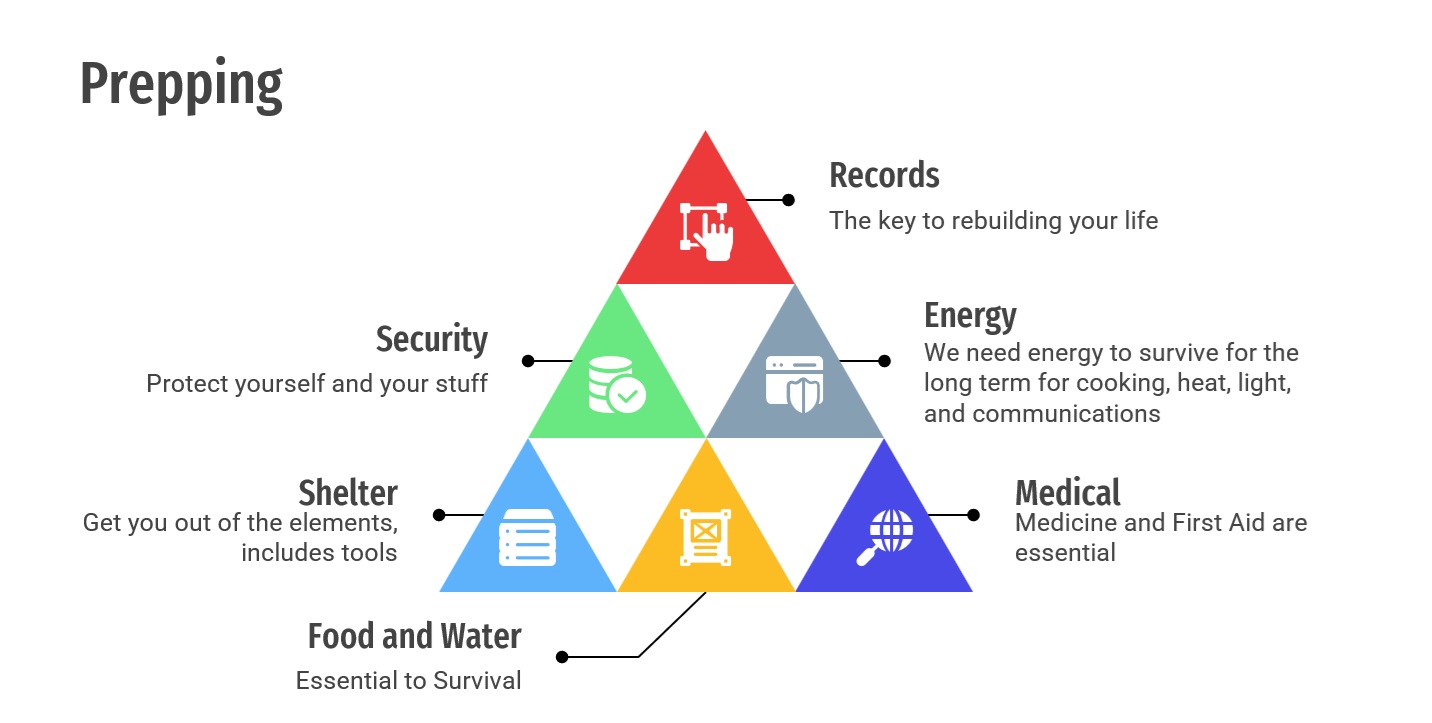
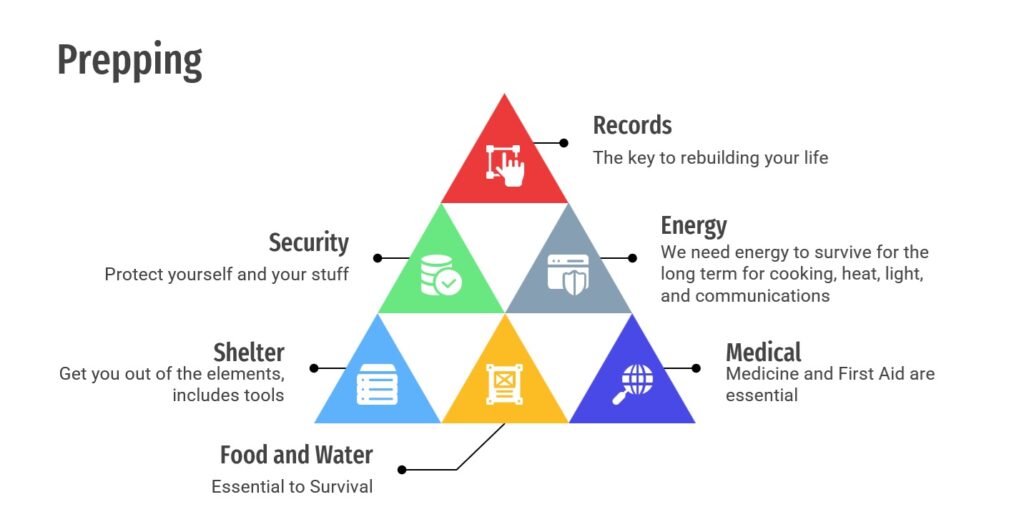
Hurricane Milton last year revealed to me some improvements that need to be made. Let’s take a look at our preparedness map.

One hole in our preps was revealed when we had high winds of 40-70 miles per hour pounding the back of our house for hours. It resulted in me sitting in my house watching my 12 foot wide, 8 foot high sliding glass door bow inwards from the pressure of the wind. Not good. So we needed to upgrade the security and shelter bricks of the prepping pyramid.

I decided to look into window fabric. It was expensive. I looked in to polycarbonate. One company wanted more than $2000 to cover my windows, and another $3200 to protect the sliding glass door. The issue is that the door is just too large for most products to cover.

I decided to find another solution. One came to me. I bought some of these panels from Lowe’s. I am attaching them to the house with 3M commercial fastening tape that’s kind of like Velcro on steroids. Two inch pieces placed 8 inches apart. I got it in white so it blends into the window frame when it isn’t in use. To make sure that it sticks, I am using a primer.

The total bill to cover 10 windows is $850.

Now on to the sliding glass door. It’s a monster at 12′ wide by 8′ high. I decided to turn the back porch into an emergency storage area by putting an electrically operated Kevlar curtain over the opening to the porch. (I did not use the company at the link.) The idea is that I will take everything that’s outside (like pool furniture and the like) place it on the porch, then close the Kevlar curtain. The cost of the curtain was about $4500.

So total cost to hurricane proof the house’s windows was just about $5300.

For Sneakers

Let’s say that there ARE people who want to approach your locale. Let’s say that you CAN’T be alert 100% of the time. One way to alert you that people are coming is to have mechanical devices that make noise when intruders approach from the nearby woods. You could place some of these on trails near your location, and anyone hitting the tripwire would alert you to their presence. If you hear it go off, you launch a drone to check out the noise.

Hey, lookie there, fifty people on the trail in the nearby woods trying to sneak up on your house.

Drone

This prepping topic is on security. Being able to keep an eye on your surroundings is a great way to assist in the security of your area. Not only can you quickly determine if a threat to your physical security is approaching, you need to be able to scout in advance of any movement that you are making, look at areas that may be hazardous (like flooded areas) and other things you may want to see at a distance.

One of the keys to security is not letting opponents surprise you. A person who is prepared needs to be familiar with the area where they live, and be able to monitor that area for the appearance of those who would endanger their safety. You never want an opponent to surprise you. Watching events, it is becoming obvious that a drone is a huge multiplier by allowing you to keep an eye on large areas of the territory surrounding your shelter, so I decided to get one.

Apparently, a 20 year old was able to thwart the Secret Service by using a drone, while the SS drone was not able to fly because of “connectivity issues.”

The drone I selected is a DJI Mini 4k. There are more capable drones out there, but the large advantage with this drone is that , at less than 249g, the drone is light enough that it doesn’t need to be registered with the government in order to be legal, and we all know that I am not registering shit. I got it as a Prime day deal for less than $400. That deal included the drone, three batteries, and the charger.

It was easy to fly, and I took it up for its first flight after watching the below video. I am posting it here, cued up to some elevated footage, so you can see how clear the video is.

The only thing different with mine is that I have it set for Imperial instead of metric units, and the lower left corner is a Google maps kind of display that shows you where the drone is on a map. I have found the drone to be intuitive and easy to fly. I have been taking it easy because I don’t want to lose it, but on the two days I have flown it, it has gone as high as 250 feet and flown as far away as 1,000 yards. The drone reaches a top speed of 20 mph, and the battery gives about 30 minutes of flight time. Following the rule of thirds (one third to go out, one third to return, and a third for contingency) that means the drone has the endurance to go out about 3 miles. I’m not yet comfortable flying it that far.

It’s capable of operating in winds of up to 15 miles per hour, but I won’t fly it in winds that high.

I recommend that you find your own drone to keep an eye on the area.

The disclaimer: I don’t advertise, and receive nothing for my reviews or articles. I have no relationship with any products, companies, or vendors that I review here, other than being a customer. If I ever *DO* have a financial interest, I will disclose it. Otherwise, I pay what you would pay. No discounts or other incentives here. I only post these things because I think that my readers would be interested.