Gambling

Because I can’t be blogging about bad news all the time

As I have said before, I like to gamble. My wife doesn’t have a problem with it, because there are a lot of vices I could have, and gambling is not the worst I could have. Sure, at first she had a problem with watching me play, but as time has gone on, not only has she accepted it, she will play herself. She just won’t play at a table with a minimum bet that is over $15, because it makes her nervous.

I have been doing this for about 15 years. I have always had some rules for playing, and I have found that following these rules means that I am about even in the casino. What are the rules? Easy:
1 Don’t gamble with money that you can’t afford to lose. If you find yourself gambling away your rent money, the kids’ college fund, or any other needed funds, you are out of control. 
2 If you ever find yourself in a situation that you are trying to win back what you already lost, stop. You are not in a position where you are making wise bets. 
3 Set an amount that you can afford to lose each day that you will be in the casino. When you hit that amount, walk away. 
4 Understand that the casino will win more often than you. If this weren’t the case, the casinos would all go out of business. You need to remember this and not plan on making yourself rich. Anyone who tells you that they “win most of the time” is lying. Yes, there are people who occasionally win a big jackpot. Casinos love this, because people who win big attract other gamblers to try their luck.
5 If you are having a good day, as soon as you have doubled the money you started with that day, put that starting amount in your pocket. Now you are gambling with the casino’s money and are guaranteed to at least break even for the day. 
Number 5 is very important. Let’s say that I set my limit at $300 a day and head out for a three day gambling trip. 
Day one, I lose $300. I walk away. 
Day two, I again enter the casino with $300. After two hours of play, I am on a lucky streak and find myself with $600. I put $300 in my pocket and continue playing with the other $300. An hour later, I have $700 in front of me. Then I have a bad couple of plays and leave the table with $250, plus the $300 I put in my pocket. 
Day three, I again lose my $300 and walk out. 
My total for three days? I have only lost $50. 
Sometimes I win big, sometimes I lose. I never lose big, because I follow my limits. My current limit is $500 a day. I usually win or lose less than $1,000 a week when I go to the casinos. The most I have won in a week is $4,000. I have done that three times. The most I have lost in a week? $2000. Unfortunately, that worst week ever was last week. I have only done that once. The runner up was $1,500 in a week, but that was in a two week trip, and the week before I had won $1,200. 
We just stayed in Las Vegas at the New York, New York casino. We were in a luxury suite at a highly discounted rate. The soft drinks in the mini bar were complimentary, and they gave us $100 food credit and $75 in free gambling credit. The total cost for the room, round trip airfare on nonstop flights from Fort Lauderdale, along with all food and drinks for the entire trip was $1200. 
My week went like this:
Day one: Lost $500.
Day two: Won $200. 
Day three: Lost $500
Day four: Lost $500
Day five: Lost $500
Like I said, this was the worst week I have ever had, but I think that was because we usually do other things while in Vegas. We usually go to shows, go hiking, or tour other attractions. This time, everything was closed except for the casinos. Still, even losing that much at the tables, the comps that I get for being a high level player made a 5 day 4 night vacation cost only $3,200. 
So how do you get comps like that? Remember that it isn’t on how much you win or lose, but how much you gamble. You can gamble quite a bit, and as long as you understand math and don’t vote like a complete moron, you can just about break even most of the time while betting thousands of dollars a night. More on that some other time. 

More attacks on vehicles

Protesters insurgents in Aurora, Colorado attacked a jeep on the highway, flattening one of its tires. Later, that same Jeep approached another set of protesters rioters insurgents and refused to stop. So the insurgents fired on the Jeep, striking several of their own. 

At this point, there is a reasonable expectation that any group that is blocking traffic is actively hostile. Anyone who stops for such a protest is likely to either become a victim or a combatant. 
We have seen insurgents use clubs, chemical weapons, energy weapons (LASERs), explosives, incendiaries, and other lethal weapons. We have seen them threaten the use of firearms.  
The police and other government officials are OK with ceding territory, abandoning buildings, and being the target of attacks by thrown objects, melee weapons, explosives, lasers, and incendiary devices. 
If you are taking fire from multiple people who are a part of a group of co-conspirators (combatants), at what point does this move from the standard civilian rules of engagement (only fire upon those who are an active threat) to rules more suited to combat. In other words, when is it appropriate to consider the entire group to be enemy combatants, and employ suppressive fire?
We have seen a few people respond to the violence by returning fire. Now we are seeing multiple people in the insurgent crowds fire at others. It’s only a matter of time before we move from there to a mag dump, or even to force on force engagements. 

Shooting at BLM march in Austin.

At the BLM march in Austin, there was a man by the name of Garrett Foster that was at the march carrying an AK clone. He was interviewed earlier in the evening by Ian Miles Cheong. You can click here to see the interview. During that interview, he made the following statement:

I think all the people who hate us and, you know, wanna say shit to us are too big of pussies to wanna stop and do anything about it.  

Later that night, as the march was stopping traffic, there was a gunfight that resulted Foster’s death. The sounds of the incident were caught on a livestream of the march that can be found here (sorry, it’s Facebook), just fast forward to 1:35:43. On the video, a horn can be heard honking, there is a pause of 8 seconds, and then five shots ring out. There is another pause of about 7 seconds, then three more shots from an obviously smaller firearm. 

Now that you have seen the video, here is what is being said about Foster in the press:

Mr. Foster, who had served in the military, was armed, but he was not seeking out trouble at the march, relatives and witnesses told reporters. At the time of the shooting, Mr. Foster was pushing his fiancée through an intersection in her wheelchair.

Considering the quote about counter protesters being too big of pussies to do anything, I doubt this last statement. Sounds like Foster was looking for trouble and found it. Now that doesn’t mean that the person who shot him was any less of an asshole, but we just don’t know at this point.
Police say that at least one other person besides the man who killed Foster fired shots, but are saying that Foster did not. That is all that is known at this point. I guess we will wait for more details before forming an opinion. 
 
However, this doesn’t do anything to disprove my theory that we are in the midst of an insurgency that is in the violent stage. 
__________________________________________________________________
EDITED TO ADD:
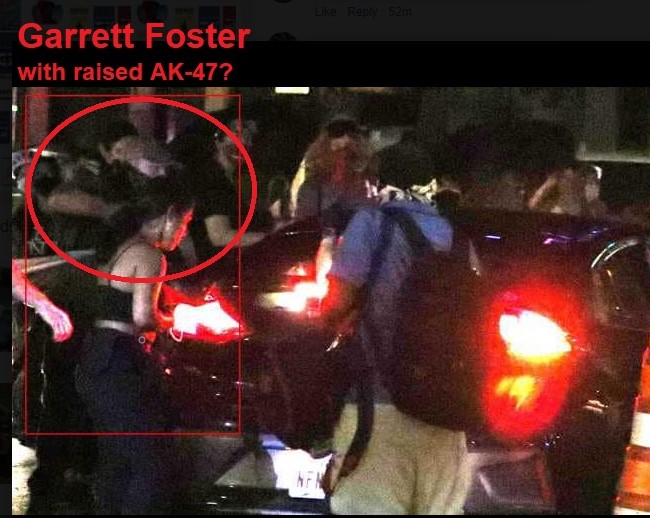
Here is a picture of Foster just before shots were fired. If you were the driver and saw this, would YOU shoot in self defense? I probably would. 

Attacking a military sentry

When I first joined the Navy, I went to boot camp in Orlando. The recruits there are assigned to various security watches at night and on the weekend. Each company had its own fire watch from Taps to Reveille, and each of the nine recruit divisions had a roving patrol and a quarterdeck watch. 

Recruit companies also provide security watches for various areas of the RTC. One of those watches, the one that was responsible for the damage control training center, had a bit of a run in with a local criminal. I will relate the story the way that it was told to me by the sentry, as accurately as I can remember after more than thirty years. 
__________________________________________________________________________________
The recruit reported for sentry duty. The sentry he was relieving handed over the helmet, flashlight, nightstick, and radio. The time was 2345, and the sentry would not be relived until his replacement came out at 0345. 
Now the layout of the RTC becomes important. The DC training area was right against the wall that surrounded the base. The wall in this area was 8 feet tall, made of concrete, and ran alongside of Corrine Drive. 
A local criminal had committed a robbery and was being chased by the Orlando Police Department and was attempting to flee on foot. He attempted to get away by hopping over the wall to the Navy Base, where he landed right in front of the recruit sentry. The sentry immediately challenged the intruder, who tried to attack the sentry. 
That sentry spent the next five minutes applying his nightstick to the criminal, until base security arrived to take him in custody. 
The intruder was arrested by NIS and charged with a list of crimes, the most serious of which was “attacking a military sentry” and subjected him to prosecution. 
________________________________________________________________________
I tried to search for the case, but since it happened in the early 80’s, I just couldn’t find it. The point is that the Federal Government follows a different set of rules and doesn’t need the permission of local government to protect its property and personnel. 

Risk and probabilty

Put things in perspective. Your odds of:
– being dealt a royal flush: 1 in 649,739
– dying in a car accident are 1 in 106
– dying from the flu: 1 in 6,500
– dying from COVID-19: 1 in 2,321
– dying from a heart attack: 1 in 4
– dying from a lightning strike: 1 in 1,200,000
– dying after being attacked by a dog: 1 in 118,776
– dying from a shark attack: 1 in 3,750,000
– a heterosexual man dying from HIV: 1 in 2,500
– a heterosexual woman dying from HIV: 1 in 1,250

People are very poor estimators of risk and probability. Watch people try to estimate probability. Ask them what the odds of this are:
Suppose you flip a coin 99 times in a row and each time it comes up heads. Now what are the chances that the 100th time you flip it, it will be heads again?
If they try to tell you that tails is “due” then they don’t understand math or probability well enough to discuss the subject.
That is why, nearly 50 years after the start of the HIV epidemic, many people still do not practice safe sex. Many still get in a car, or even eat unhealthy food. Yet they freak out when they see someone without a mask on, even though there is not one single study that shows masks worn by the public prevent the community transmission of COVID-19.

System failed

The suspect had 230 felony arrests, 15 felony convictions, and only went to prison twice. That is the problem right there. How can a 26 year old have 15 felony convictions and still be out on the street? We see people getting more prison time for being COVID positive than this guy has gotten.

I seriously think that a judge who lets a convicted felon walk out with little to no jail time after he is convicted for the 15th time in the past 10 years should face criminal charges when that felon murders someone.