Stupid point of view

This is the mindset that we are dealing with: A democrat that says we gun folks are approaching crime all wrong. They way to prevent rape, and presumably all crime, is simply to tell people not to do it:

This is the mindset. Why, if we just put up a sign that says “No guns” or “Rape free zone” or even “No robbing of this store allowed” then no one will do so.

This is why some people cannot be argued with or reasoned with on the gun debate. They simply do not have the mindset to have an intelligent conversation. I try to see things from their point of view, but I just can’t get my head that far up my ass.

Ignorance of the law is certain

There is a well known legal quote that “Ignorance of the law is no excuse.” Of course, that was once easier than it is now.

In 1925, all of the Federal Laws fit into this volume:

Now, the United States Code looks like this:

There is also the United States Code of Federal Regulations (CFR), which are administrative rules that have been adopted by Federal agencies like the BATFE, the FCC, FAA, EPA, and others. These rules have the force of law. That set of books looks like this:

Then there are the laws and administrative codes for your state, your county, and the city that you live in. On top of that are the hundreds of books of court cases that explain, modify, and expand on all of those laws.

In short, there is no way for anyone, even someone who has spent his life studying the law, to know and comply with the law.

Remember, the only power that governments have is the power to crack down on criminals. The more criminals, the more power the government has. When there are not enough criminals, one makes them by declaring so many things illegal that it becomes impossible for men to live without becoming criminals.

That is where we are today.

Obey me, says the cop

and So a friend posts this on Facebook:

and I comment that the cop was out of line, and a cop responds thusly:

^your an idiot! That cop had every right to stop him and ask for his ID and take is gun because of his (cop) investigation if the subject is carrying legally. Shame on the cop for letting a fool fluster him with mumble jumble that didn’t even make fucking sense… They should have arrested him for resisting I would have

I then ask her what law she would arrest him for. After all, in order to resist arrest, one must be subject to arrest in the first place.

If the subject is carrying legally or not. Your a fool to if your think we encounter joe blow and just because he says oh yeah I have a permit to carry we believe him! He is required to show ID anyway and PROVIDE it when asked by LEO.  The officer told him to investigate if he is a felon or not he should never have taken that guys word.

You get that? The cop here thinks that she has reasonable suspicion to detain him on the presumption that he is a felon, and it is up to him to prove that he is not. Under this presumed standard, a cop can detain anyone at any time, on the presumption that he is a felon. Then she says this:

And the officer received calls (again like the officer said)about the guy openly carrying that’s enough right there to stop and question him. We receive call and investigate, but that’s right officer only act on their arbitrary opinions when it comes to enforcing. I would like to know what you did for thanksgiving/Christmas/new years. I spent my with my squad protecting the streets but yet we still have people like you who have no respect for LEOs

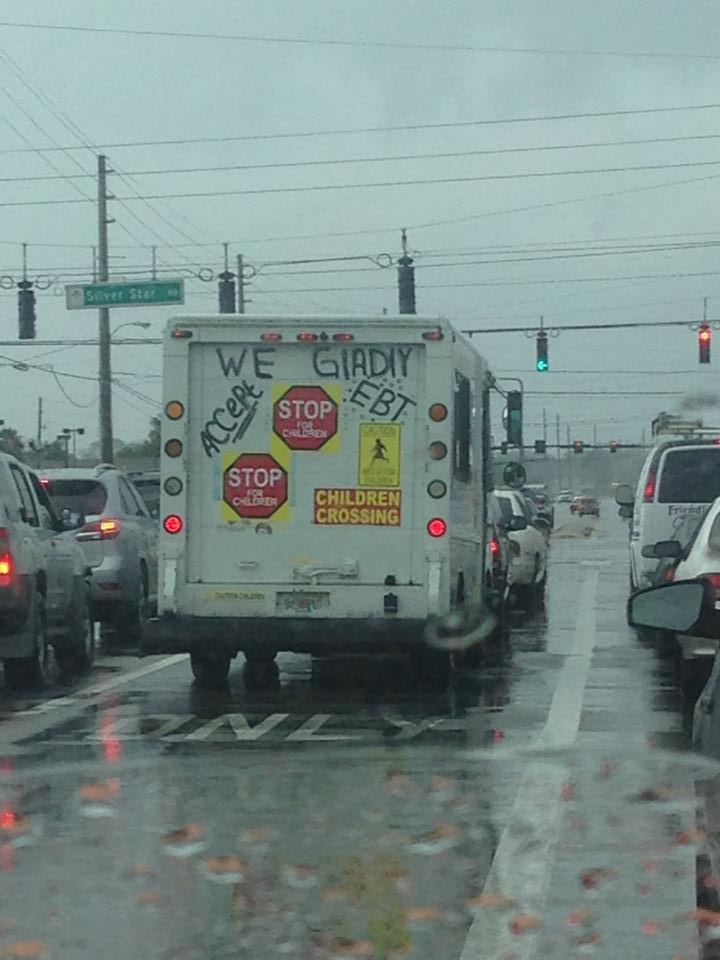
That is right, respect my AUTHORITAH, because I have to work holidays. Or something like that. Someone calls in and claims that they see you performing a LEGAL activity, and the cops will detain you. Oooh, look- a black woman sitting on the front seat of a bus.

Theme park carry and crime

There is a lot of misinformation about carrying weapons in theme parks.
Some say that no crime happens at the theme parks. Huh. Disney does a good job of keeping things quiet. For instance, the entire Disney complex is private property for miles around, and they use off duty deputies for security, which means that they can keep many stories out of the news, but a few leak out. Read on:
Car burglarized, computer and gun stolen. Disney says couple should not have called police.
Farmington man charged with groping girls at Disney World’s Typhoon Lagoon water park
Pennsylvania woman claimed a person in a Donald Duck costume groped her breast
A man took his 4-year-old son and a waiter hostage in a room at one of the resort’s upscale hotels.
The death of a man discovered near a Walt Disney World hotel remains under investigation
Two Connecticut tourists robbed, kidnapped in Disney World
Robbed at Disney World Florida
 Even more examples can be found in a post I did awhile back.
As a tourist, there is no law that states you cannot carry a weapon in the theme parks. However, if they find out that you have a weapon, they are free to ask you to leave. There are exceptions to this:
If you are in a hotel room with your weapon, the state says that “A hotel or motel room is considered a private dwelling if the occupant is there legally, has paid or arranged to pay, and has not been asked to leave.  Wassmer v. State, 565 So.2d 856, 857 (Fla. 2d DCA 1990).”

Now, what they can do is refuse to allow you to spend another night there.

The theme parks rarely use magnetometers to inspect incoming guests. In fact, in the past 20 years, I only know of one theme park that does this: Universal Studios, owned by NBC. However, due to the long lines created by this, the only times that I have seen this done is Halloween Horror Nights, and certain events in venues like the Hard Rock. Otherwise, the theme parks just perform a cursory bag inspection. Concealed carry easily slips by, and I know this because I do it several times a month in every Orlando area park.

As far as employees go, you are covered by the guns in parking lot law, as long as you have a concealed weapons permit and you leave the weapon secured in your vehicle. Universal has tried to claim that they are exempt because they have a school (an audio/visual arts school) located on their property, but this is smoke and mirrors. No court is going to rule that a theme park that is selling alcohol is a school. Likewise, Disney claims that they are exempt from the guns in parking lot rule because they have a license to manufacture explosives (for their fireworks show). That is also smoke and mirrors:

The law states that, among others, employers that perform certain activities on their property are exempt. Among these activities is:

(e) Property owned or leased by a public or private employer or the landlord of a public or private employer upon which the primary business conducted is the manufacture, use, storage, or transportation of combustible or explosive materials regulated under state or federal law, or property owned or leased by an employer who has obtained a permit required under 18 U.S.C. s. 842 to engage in the business of importing, manufacturing, or dealing in explosive materials on such property.

To understand why this is smoke and mirrors, you have to look at Orange County land records. The Disney complex is not one piece of property. It can’t be. A hotel can’t operate on property that is licensed to manufacture explosives, the fire code would never allow sleeping areas to be located in an explosives plant. The way Disney solves this is to break the property up into smaller plots of land. The land where Disney is licensed to manufacture explosives is a different piece of property than where the employee parking lot is located. The property where the employees park certainly does not have as its primary purpose the storage of explosives. That is why Disney is in the wrong here.

As a guest, you are not covered by the guns in parking lot law, because that portion of the law was struck down by the courts as being unconstitutionally vague.

Fifth Amendment, Haynes, and 922(o)

There is a Supreme Court decision involving the National firearms act that was decided in 1968. In that case, US v Haynes, Miles Edward Haynes appealed his conviction for unlawful possession of an unregistered short-barreled shotgun. His argument was ingenious: since he was a convicted felon at the time he was arrested on the shotgun charge, he could not legally possess a firearm. Haynes further argued that for a convicted felon to register a gun, especially a short-barreled shotgun, was effectively an announcement to the government that he was breaking the law. If he did register it, as 26 U.S.C. sec.5841 required, he was incriminating himself; but if he did not register it, the government would punish him for possessing an unregistered firearm — a violation of 26 U.S.C. sec.5851. Consequently, his Fifth Amendment protection against self- incrimination (“No person… shall be compelled in any criminal case to be a witness against himself”) was being violated — he would be punished if he registered it, and punished if he did not register it.

The Supreme Court agreed:

We hold that a proper claim of the constitutional privilege against self-incrimination provides a full defense to prosecutions either for failure to register a firearm under sec.5841 or for possession of an unregistered firearm under sec.5851.

Later that same year, in the Ohio case State v. Schutzler (1969), Gale Leroy Schutzler attempted to quash an indictment for failure to register a submachine gun in accordance with O.R.C. sec.2923.04, which required registration of automatic weapons. At the original trial, Schutzler argued that the registration requirement violated his Fifth Amendment rights, based on Haynes. On appeal, the Court of Common Pleas did not agree with any of Schutzler’s arguments, including his citation of the Fifth Amendment. Where the Haynes decision was based on the fact that Haynes was an ex-felon, and therefore his possession of a sawed-off shotgun was illegal, Schutzler was not breaking the law by possession; his only violation of the law was his failure to register the submachine gun and post a $5000 bond. Had he been an ex-felon, the Haynes decision would have protected him. Because he was not a convicted criminal, he did not receive the benefit of the Fifth Amendment’s protection.

The law in the United States (18 USC 922(o)) is that all machine guns (defined as any gun which fires more than one shot per operation of the trigger) must be registered with the Federal Government, and a $200 tax paid upon transferring it to a new owner. However, Congress has also refused to allow anyone to transfer a machine gun that was not already legally possessed prior to May 19, 1986.

How is this applicable today? Well, the courts ruled that Haynes had no way to legally escape his quandry: He was in possession of a sawed off shotgun, and whether her registered it or not, he would run afoul of the law. A person who was not a convicted felon could escape self incrimination merely by registering his weapon and paying the fee. The place where Haynes found himself is the exact position that a person who owns a machine gun manufactured after May 19, 1986 finds himself: If he registers the weapon, he incriminates himself, and if he fails to register the weapon, he is still guilty of a crime.

I wonder if any lawyers have looked at this one…

The seedy underside of ambulance billing

Obama made a statement during his state of the union address that he wanted to raise the minimum wage to $9 an hour. This is going to hurt many, and specifically will hurt people employed by ambulance services. Let me illustrate:

Section 4531 of the Balanced Budget Act, passed in 1997, added a section 1834 to the Social Security Act which mandated a national fee schedule for all ambulance services furnished by Medicare. This fee schedule applies to all ambulance services, including volunteer, municipal, private, independent, and institutional providers, i.e., hospitals, critical access hospitals (except when it is the only ambulance service within 35 miles), and skilled nursing facilities.

Section 1834 (l) also requires mandatory assignment for all ambulance services. Ambulance providers and suppliers must accept the Medicare allowed charge as payment in full and not bill or collect from the beneficiary any amount other than any unmet Part B deductible and the Part B coinsurance amounts.

There are three types of Ambulance Fees: basic Life Support (BLS), Advanced Life Support (ALS), and Specialty Care. BLS are calls where the patient basically needs a ride that is not possible with other means of transport like wheelchair vans, but there are no medications needed other than oxygen, and the patient does not need cardiac monitoring or anything else.

These fees are broken down by ZIP code. In the State of Florida, the allowable fee for BLS transport is $216, plus about $7 per mile. That is all that the ambulance company is allowed to charge, and from this amount of money, the company has to buy the ambulance, pay for supplies like oxygen, BP cuffs, bandages, sheets, insurance, license fees, employee salary, employee benefits (Obamacare), fuel, vehicle repairs, etc.

Now step up to ALS: The allowable fee is now $258, plus about $7 per mile. An ALS truck requires at least one paramedic, a host of additional drugs, a Cardiac Monitor, and other supplies in addition to the ones required by a BLS truck. The drugs can be quite expensive, with Glucagon costing over $100 per dose. The drugs cost the provider thousands of dollars per truck, and most of them expire each year and have to be replaced. The Cardiac monitor costs over $10,000. It costs a lot more money to operate an ALS ambulance, but the fee for an average 10 mile transport is only 10% more. You get $40  more for an ALS call, but to run that call, you must pay the medic more, buy more expensive drugs, buy more expensive equipment, pay a more expensive ambulance fee, and on and on.

The vast majority of ambulance calls are routine BLS transfers. There is not as much profit in running ALS units, because they are so expensive, and roughly 80% of ambulance calls are BLS, meaning that expensive ALS trucks wind up running BLS calls.

These fees are capping what an employer can pay employees, so many companies are cutting back on ALS units and employees, because there is much more profit in running a patient to a dialysis appointment from his home than there is in transporting a heart attack victim to where he can get appropriate care for his problem.

What does this have to do with minimum wage? Well, what this means is that an EMT, with less than 200 hours of training, is earning $9 an hour. A paramedic, with over 1200 hours of training, is earning somewhere in the neighborhood of $13 an hour. What is happening is that it is not profitable to run ALS calls.

Sure, all 911 calls are ALS, but the nationwide average is that only 40% of them pay. Now Obamacare will ensure that we get payment percentages that are much higher, but as long as those payments remain with the Medicare caps, 911 will not be sufficiently profitable to carry out. All of this means that private ambulances are going to go the way of the Dodo: the only way to perform ALS profitably is to be taxpayer subsidized, or commit fraud. More on that later.