Discussions With Communists

Some commie online was upset that lenders charge interest, claiming that it is usury. He feels that loans should be interest free. Being that I have completed the finance and economics courses for my MBA, this is where I decided to help educate him. I shouldn’t have bothered.

Lenders have expenses.

They have fixed administrative costs like accounting, clerks, and other things that they must pay for. Those costs are the same for every loan.

Then there are the variable costs, the cost of defaults. About 1 percent of those who have a 750 or higher credit score default, but this rises to more than 15% of those with a score of less than 600. This default rate means that interest rates must be higher for those who have a higher chance of default. If interest rates are capped, then lenders will simply refuse to lend to those whose likelihood of default makes it uneconomically feasible. That tends to mean minorities, who historically have much higher default rates.

The commie went on to handwave that point away, saying it is a bad approach to paying for things.

In response to this, I posed a question:

So what’s the alternative? It takes about 14,000 hours of labor to build a house, plus materials. Where does the money come from?

Here are the alternatives that he proposed. I answer each in turn.

1) We could eliminate the usury/interest rates system altogether. If it’s too expensive, we have no business buying it yet. If a low cost bought huge portions of America, we can restore that same value.

Much of that was when each person was building their own house, growing their own food, etc. Have you built your own car? House? Can you? Most people cannot. Money is what makes specialization possible. Sometimes, a transaction takes more money than you have on hand. The cost of waiting to save and pay cash isn’t practical. Try living in a carboard box while you save to buy a house.

2) We could have a fixed flat member fee. Nothing too small, nothing too big. Something that keeps a company in business, especially when factoring in multiple customers. We could cap the compounded debt.

How large would the membership fee go to buy a house or a car? What would be the terms? Imagine walking to work for 5 years while you make payments on a car that you don’t yet have.

3) We could simply cap the profit of compounded debt.

What would happen then would be that no one with bad credit would get a loan.

4) We can focus on reducing the root costs of resources (wood, etc.) after eliminating interest rates.

The largest expense in almost any business is the cost of labor. To build that house, you still need to fund those thousands of hours of labor. Who pays for that, and how?

5) The sellers could get monthly payments directly while cutting out the middleman. Extra cost could be minimal.

So you want the sellers to also be the lenders. That’s inefficient and actually increases costs. Now the seller’s funds are tied up in the products that haven’t yet been paid for. The time between selling the inventory and receiving payment is called the cash conversion cycle. Without financing, this could mean years of a company waiting to be paid for things like appliances, homes, and cars. There will still be defaults, meaning that those costs will be passed on to consumers. Also, only wealthy people and those with good credit will receive goods. Minorities need not even apply.

6) Sellers can start by asking for a lump sum in the beginning to give them a buffer before monthly payments.

Again, with sellers asked to also be lenders. This disrupts the seller’s cash conversion cycle. Funds that are tied up in inventory that has already been sold are not available for the company to continue operations, causing losses and delays. This is expensive. The term here is called “The Time Value of Money.”

7) The seller of resource materials can drop their prices for the seller of products.

So now you want the suppliers to bear the costs? The electrician drops prices for the home builder. Now how does that work?

8) Financial aid (if spending isn’t going to the people, why is it so much better for government money to go to the usury sin of lenders?) To eventually pay off the government in a fixed fee of profit. No fee. Failure to cover is taxed — last resort.

So the government will pay interest instead of consumers? This results in unsustainable debt, or in runaway inflation.

9) A non-profit source of assistance to fill in a time of struggle.

Where does this non-profit get their funding? Money is a material, just like steel, wood, or labor. It has to be paid for. Someone, somehow, someway will bear the costs of money. It will be the consumer who has to wait until he can get a house or car on layaway, the business that has paid for labor and materials and now can’t use those funds for the next project because they are awaiting payment, or the taxpayers who have to fund the government. It’s a cost, and someone will pay for it. You are expecting the government, who has famously paid $600 for a hammer, to control costs.

10) Pay as we go. A product might need to be covered completely, but duration of services could be ongoing payment. Instead of a government paying a lump sum of a project, they only shell out service cost totals as the project goes on, that way if there’s a cancelation, it basically freezes the pay where it is at, instead of being trapped a lump sum covered by loans and then owing the initial cost and a potentially unending debt with immeasurable interest rates, the costs of services are already covered.

So you pay for the land to be cleared. Then save for a few months before you have the money to pay for the underslab work like plumbing to be done. Three more months for the outside walls, ad nauseum, ad infinitum. Twenty years of being homeless later, you finally are ready to move into your house. This is just a repeat of your first point- and still won’t work.

11) Lay Away. Pay First. Receive after. No middleman.

Again with the point of paying for it before you get it.

12) A combination of these things..

None of which will work, for the reasons above.

His answer to all of this? He focused on the “Time Value of Money” and the cost of money.

“That’s the cost of money” ignores everything I just said. I know that my wages don’t satisfy my time. Time is not an objective value. Too bad. Your explanation is some weak sauce.

The base issue here is that young people (who make up the majority of useful idiots) have no concept of money, value, or economics. My son once asked me (when he was 4 years old) for some expensive toy. I told him that we don’t have money for that, and his reply was to tell me to go get more from the ATM. Communists display all of the economic knowledge of a 4 year old who wants a new toy.

Increase Equity Through Mediocrity

The proposal to eliminate anything that makes whites look good, or blacks look bad, is being carried forward by that communist Mamdani. His proposal is to eliminate gifted programs in the NYC school system due to the higher number of white and Asian students that gain entry through the exam. It’s racist to recognize that blacks are not as smart as whites, on average. This will increase equity through mediocrity. It doesn’t lift up the underachievers, it handicaps the talented.

I would suggest that this reminds me of a short story called “Harrison Bergeron” written by Kurt Vonnegut. This is how communism works- it cannot make those who have little talent or ambition into successes, so communism tears down the talented and successful to make everyone’s outcome the same.

That’s the essence of equity.

Morning Intel Briefing

The goal of any color revolution is twofold: to convince the citizens that the government is powerless or unwilling to protect them, and that the insurgents ARE and WILL protect them. They need to create a failure of basic government services, like the rule of law. When enough people become restless and convinced that the rule of law has failed, that critical mass of people will look for a savior. That is when those who would overthrow the government step forward and offer to do what the people think the government cannot. The government is talking about increasing their security posture, and i recommended this morning that each of us do the same:

The threat landscape appears to look like this:

Political Orgs: The Democratic Socialists of America (DSA) is the primary political arm, with the Party for Socialism and Liberation (PSL) close behind. PSL is part of the Neville Roy Singham network and serves as their vehicle for running political candidates.

Militant Anarchists: A growing militant wing trains in weapons and self-defense, including groups such as Antifa, the Socialist Rifle Association, Armed Queers, Behind Enemy Lines, Code Pink, the ANSWER Coalition, The People’s Forum, BT News, and Unity of Fields.

Climate Activism: Billions have flowed into climate-activist organizations, many of which increasingly employ anarchists.

Social & Racial Justice Groups: Since the rise of BLM, billions—public funds included—have supported the social and racial justice groups that regularly advocate for burning down the country.

Civil-Rights & Legal Orgs: Legacy anti-Western activists (“movement lawyers”) staff these groups, suing governments, police, and schools while training allies to push limits without triggering terrorism charges.

Foreign Interest Groups: Beyond the Neville Roy Singham network, other foreign powers, including the CCP, maintain domestic footholds.

Funding: Much of the money for this revolutionary activity comes from the progressive NGO ecosystem—Open Society Foundations, Tides, Ford, Rockefeller Brothers, Arabella Advisors, and the broader dark-money network.

“We cannot be led by those who wish for America to be like it once was; instead, we must assert that America must be no more,” Armed Queers wrote in a Substack post. 

Armed Queers is affiliated with La Mecha. I have blogged about those assholes before- in 2007, in fact. I noted then that they had local chapters on many college campuses.

Here is one of the first lines of the group’s manifesto:

Chicano and Chicana students of Aztlan must take upon themselves the responsibilities to promote Chicanismo within the community, politicizing our Raza with an emphasis on indigenous consciousness to continue the struggle for the self-determination of the Chicano people for the purpose of liberating Aztlan.

There won’t just be two sides in the upcoming CW. There will be all sorts of factions fighting it out. That’s why I am opposed to the war that is coming- it will be a bloodbath.

Just the Tip

Read this guy’s perspective on rights:

Ludwig believes that all rights come from government. That’s patently ridiculous. If I were alone on an island, I would have the right to speech. I could keep and bear arms. The only way that I can lose those rights is if someone takes them from me.

That’s why government morally exists- to keep others from taking your rights. This is why we have a Constitution that lays out the powers of government- what that government CAN do, and what it CAN NEVER do.

Not so in Mr. Ludwig’s world. He believes that, unless there is a government present that tells me I may speak, I simply don’t have the right to do so. That’s fundamentally out of line with the ideas of the Founders of this Nation, whose thoughts on this were based upon the philosophies of John Locke and Thomas Hobbes.

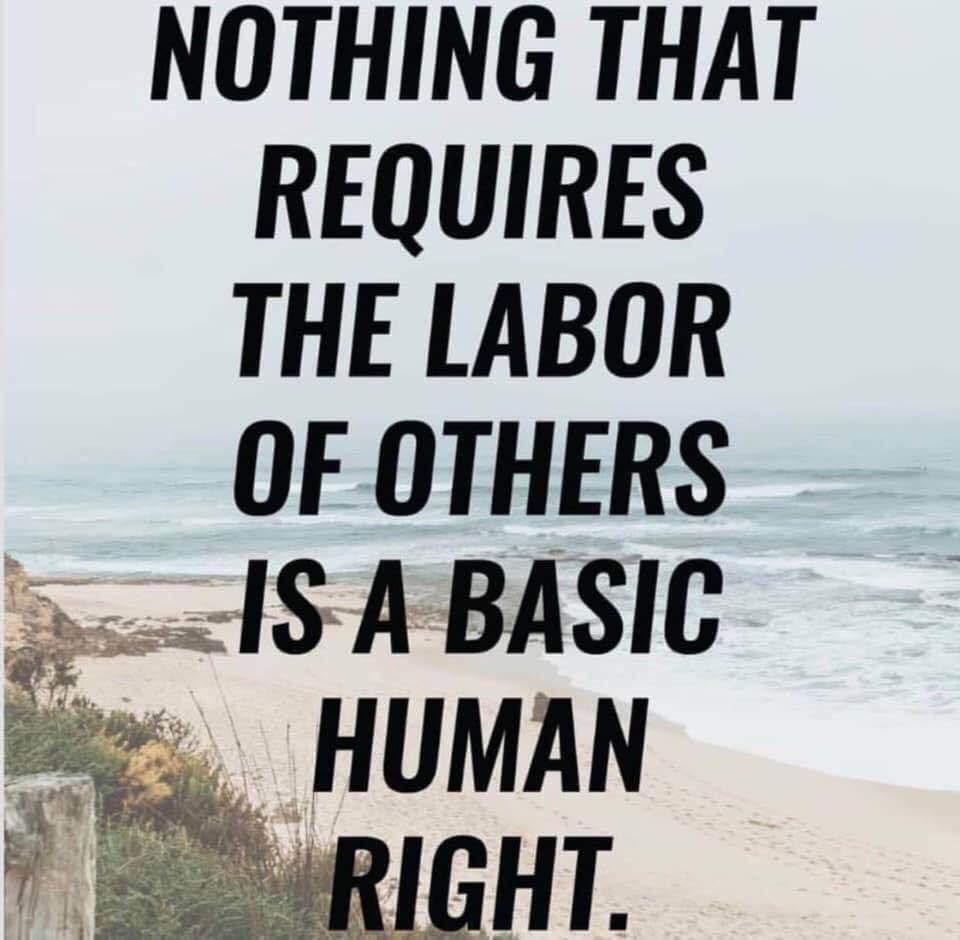
This is where the left gets the idea that food, shelter, clothing, and healthcare are human rights. They are not, and they never have been. If I have a human right to any of those things, it follows that I can force someone to provide it to me.

Enter a law forcing someone to pick my cotton, my oranges, build my houses, and perform free healthcare services. Even enacting price controls is a form of slavery, and to claim otherwise is exactly the same thing as saying “if I only put the tip in, it isn’t rape.”

The saddest part of this, is that Mr. Ludwig is an attorney. His college failed him when they failed to teach the basics of the Constitution and its underlying philosophy.

Class Warfare= Envy

There has been a plethora of stories talking about the privilege possessed by the upper middle class as of late. This article is typical of what the left is trying to do– they are saying that young people no longer have a chance at the American dream because they are being kept down by [insert here: “Boomers,” the upper middle class, banks, landlords, Donald Trump] because of privilege.

The things that supposedly prove that you are blind to your privilege are:

  1. Why don’t you move to a less expensive area, or one where jobs are more plentiful?
  2. I worked hard to make it, you can too.
  3. Money isn’t everything.
  4. We all have the same opportunities to succeed.
  5. I don’t worry about money.
  6. Why don’t they save more?
  7. Everyone should travel.

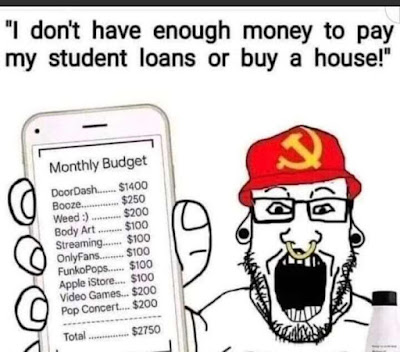
Numbers 1, 2, 4, 5, and 6 are all linked in my mind. It isn’t just about hard work, it’s about choices. The choices that we make directly affect the outcomes that we experience. If you pick a troublesome albatross for a mate, you decide to smoke weed all day instead of hustling to improve, or you waste all of your money on OnlyFans, Starbucks, and Door Dash, you are not making good choices. Your outcome will reflect that.

That isn’t to slam having some vices- I like to gamble, and ordering Door Dash when I am at work instead of clocking out for an hour to go eat is actually more cost effective. The thing is, you can’t be doing those things when you are poor. The importance of understanding when you can give up wants in order to afford your needs is something that many young people struggle with. Everyone, when they first move out of their parents’ house, is used to living a better lifestyle than they themselves can afford. My mother used to call it a “caviar and Champaign taste on a beer and bread budget.” Live within your means, save as much as you can, and then you will later enjoy a better life. Learn that sacrifices when you are young will pay off when you are older.

Once you realize that, you won’t have to worry about money and you will be able to travel. There is no secret to making it- so many people think that there is some magic or secret society to becoming wealthy, but it isn’t a secret and it isn’t magic.

The way to wealth is this:

Own your house. Renting just means that you are paying someone else’s mortgage.

Buy a house, preferably with a 15 year mortgage. Pay it off as quickly as you can- don’t just make the minimum payments. Look at four different choices (using West Orlando prices):

  • Rent a nice 2 bedroom apartment. Ten years ago, it was $1200 per month. Same apartments today are $2300 per month. If you did that for 15 or 30 years, it would cost you between $324,000 and $648,000 and you own nothing. The money is gone.
  • Buy a house with the roughly same square footage in the same area for $140,000 in 2002. A 5% down mortgage would mean a $7,000 down payment and monthly payments of $937 for 30 years. Total cost for 30 years: $344,320. A lot, but you also now own a house that is worth $425,000. Not bad. You are now $728,000 more wealthy than if you had rented.
  • Or buy the same house with a 15 year mortgage. Now the payments are $1281 per month, but you pay it off in half the time. Now the total cost is: $237,580. After 15 years, no payment at all. You are now $835,000 more wealthy than if you had rented.
  • Same 15 year mortgage, but make an extra $200 per month payment against your principal: you pay the house off 3.5 years early, and this saves you another $12,000 in interest payments. You are damned near to being a million bucks ahead of renting.

Don’t pick a spouse/significant other that spends you into the poorhouse.

I know that she (he) is fun- after all, spending money is fun and gives you instant gratification, but at the expense of your future well-being.

Know the difference between wants and needs.

Door Dash, Starbucks, and eating out are great, but you don’t NEED to do that, especially when you are poor. Wait until you can afford it before you waste money on these things. If you don’t own a house, are making extra payments on it, and can’t afford to pay all of your bills plus put at least 10% of your income aside as savings, then you can’t afford to any of those “Wants.” Learn to wait until you can.

Education is the key to financial well being.

That doesn’t necessarily mean college. The lack of a college degree doesn’t mean that you won’t get a good job. There are plenty of trades out there that make good money- welders, for example. I was a fire medic and making a pretty good living.

Having a college degree doesn’t guarantee you a good job. Taking out $200,000 in student loans for a degree in 14th Century French poetry is a bad idea.

The trick is to learn a valuable skill, then be good at it. Work hard, make wise choices. Save. Don’t waste money on stupid bullshit. Then be patient. It will take a while. It took me about 12 years to go from bankrupt to a million in net worth.

That’s my advice. I have learned all of these things the hard way. It wasn’t privilege that got me to be successful- remember, I have been poor and even homeless. It was the school of hard knocks. Doing the things I recommend here is hard. It takes discipline and sacrifice.

Or you can just stay poor and blame your landlord or Donald Trump for it.

Landlords

Democrat Maxwell Frost, US Congressman from Orlando, has called landlords “money hungry,” and has proposed two pieces of legislation to screw them over.

The first of these is the End Junk Fees for Renters Act. This proposed law would

  • banning application and screening fees;
  • require that late fees apply as credit to next month’s rent
  • Prohibits credit score screening in the rental application process
  • Requires that landlords disclose in the rental contract:
  • Past and present litigation with tenants
  • Ongoing pest and maintenance issues
  • Rent increase percentages year after year over the last ten years
  • The total amount that will be due each month, prohibiting surprise fees like utilities, bounced check fees, and late fees

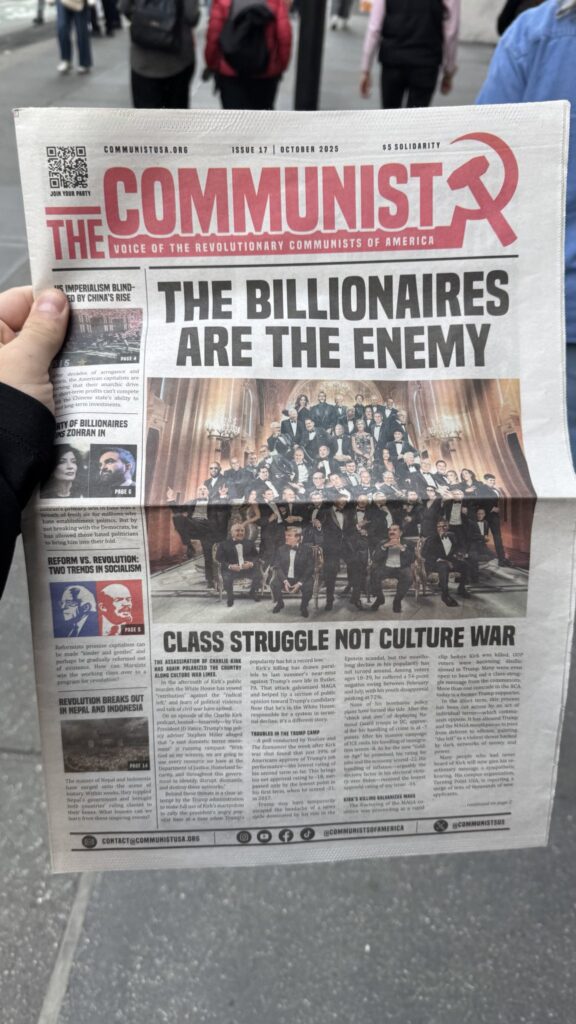
This is what the commies had to say:

Credit scores were never intended to gauge whether someone will be a good tenant. They’re designed to predict whether someone will be late paying a loan, not rent, which is a much higher-priority bill than a credit card. Given the current rental housing crisis, this practice makes a bad situation worse.

Renting a home IS a loan. I am lending you a quarter of a million dollars in real property in exchange for your paying rent on time. The rental business is risky enough, but not allowing me to minimize the risk of a tenant stiffing me, doing $20k in damages to my property, or both means that I have to raise rents for everyone in order to make up for that risk.

The good Congressman also has this to say:

 If we want a future where everyone has access to stable, secure housing, then we must end junk fees. We must end discriminatory credit screenings. We must make housing a right, not a luxury. 

Nothing that requires the labor or property of someone else is a right. My tenants just moved out. I grow weary of dealing with them. This last tenant was late four times and had a payment declined once. Under this law, there would be nothing I could do about that, and landlords would have no idea that they were coming.

Residential renting is a moderate to high risk. Two tenants ago, I had to repair nearly $10k in damages that the tenants had done. You mitigate some of that risk through screening your tenants, and penalties for late and dishonored payments. If those tools are taken away, you will see higher deposits and higher rents to offset that. Since you are asking me as a landlord to lend you a quarter million dollars when a mortgage bank won’t do so because it’s too risky, then I need to generate returns that are far higher than I can get in the stock market.

Over the past 5 years, I have earned an average return of 7 percent or so in the market. My rental properties need to beat that by a fair margin, or the risk simply isn’t worth it.

My prediction is that this bill won’t pass. If it does happen to become law, rents will have to rise to compensate for risk.

I would raise rents by at least 10 percent, and would have to at least ask for 2 months rent as security deposit. Or perhaps we would take a page from Disney and charge a 13 months rent up front, but let you finance it at 0% interest, with approved credit.

Socialism, It’s Coming

AOC is upset that rich people control large businesses. It’s better, according to her, that she and the rest of the government get to do it. Bartenders are so much better at running things, you see.

They want the power to pick who gets what. They want to determine through government fiat who is rich and who is poor.