No One Knows the Cost

We talked about the high cost of healthcare. When people talk about how the US healthcare system is “broken” they are mostly complaining about cost. Getting costs down is tricky, and it’s a problem that was caused by government interference.

The Medicare Physician Fee Schedule is a 1,348-page document, and the final rule for hospital inpatient payment systems is 773 pages long. For some services, it’s impossible to know how many pages of regulations and price controls there are. For example, The Centers for Medicare & Medicaid Services (CMS) does not condense the Medicare payment rules for ambulances into a single, definitive document. The regulations for ambulance charges are spread across multiple manuals and chapters, all of which are constantly being updated and revised. A definitive page count for the rules does not exist, because no one knows for sure what all of the rules are.

All of this adds to the cost, as medical providers have to hire entire departments just to take a guess at what they can and should charge you, and even then, they often get it wrong, because the rules are contradictory.

Every time the government steps in to fix it, they add pages and chapters to the manual, but instead of fixing things, they make it more complex with carve-outs, backdoor deals that kickback money to big donors, and the need for an even larger hospital billing department.


I do want to respond to one comment, where someone said that reading a CT scan shouldn’t cost $1500 because it only takes an experienced radiologist 30 minutes or so to do it. Remember that you aren’t just paying for the radiologist. You are also paying for his malpractice insurance, the costs of compliance with government electronic charting and recordkeeping, the costs of his staff to include the billing department, and other associated administrative overhead. That radiologist is only getting a small fraction of that money, in many cases, less than a fifth of it.

  • Malpractice insurance for a radiologist is around $25,000 per year
  • Costs for electronic health records: for a smaller practice, you are looking at around $400,000 for initial costs, plus another $50,000 per year. In the case of radiologists, it will be even more to integrate with the output of proprietary CT machines.
  • Plus staff and administrative costs
  • So a radiologist is paying $200k or so a year just to read those CT scans. If he isn’t charging that kind of money, he might as well go be a plumber.

Keep in mind that an hour’s work from a plumber costs about the same as that radiologist is going to cost you.

Costs of Care

I had a tough week recently. You wouldn’t believe how tiring it is to use your brain at a high level, with lives in the balance, for 12 hours straight. It’s a high stakes, high stress endeavor. When I work and the day is especially stressful, I am in bed asleep within an hour of getting home, and I sleep until it’s time to go back to work. Let’s look at one of the patients I had on one of those days:

A woman decided that she was going to kill herself by taking every pill she could find in her house. Three hours later, she changed her mind and called 911. She was a frequent visitor to the emergency room and had been placed on involuntary psych holds (called a Baker Act) a few times before, due to suicide threats that turned out to be cries for attention.

She was my patient.

EMS handed me a bag of empty pill bottles, all of which the woman claimed to have taken. A final count of the pills revealed that she had taken most of a 90 day supply of Digoxin, Wellbutrin, Sotalol, Xarelto, and a few other drugs. I think we finally estimated 50-60 pills of each were unaccounted for.

I asked the doctor if he wanted to do a gastric lavage. He said he didn’t want to, because it had already been 3 hours and any pills she had taken were likely digested by now. He also pointed out that her vital signs were unchanged, and this was a good sign that she was again acting out, but hadn’t actually taken anything.

I told him that, since the drugs she had claimed to have taken were mostly extended release, we would be looking at some real trouble in about another hour. He told me to watch her and call him if anything changed.

I had three other patients, including another Baker Act. Those involuntary admissions require a lot of paperwork, so I was busy.

About an hour later, I got a call from the telemetry operator that the woman’s heart rate had suddenly dropped from 62 to less than 35. I ran into the room and found her in a junctional escape rhythm at 32 beats per minute. I called the ED doc, who was on the other side of the department, and told him what I had. I recommended Atropine and Glucagon and asked for the order. He concurred and said he was on his way.

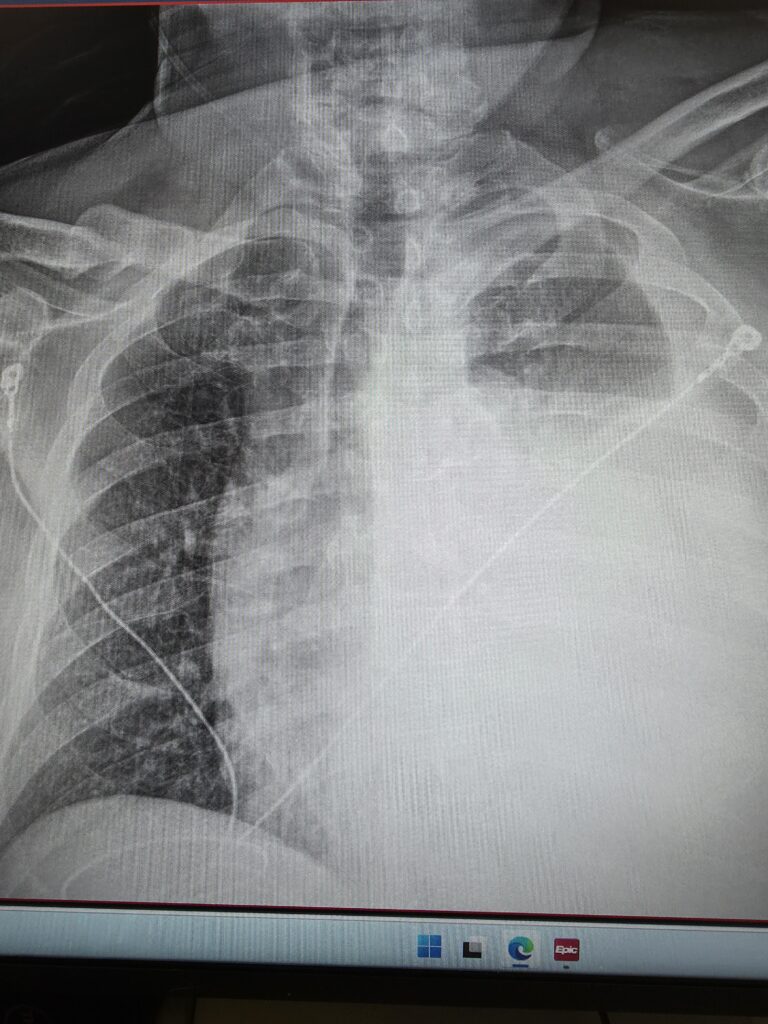
By the time he got to me, I had called a Resuscitative Medical Alert. That gets me the ED rapid response team, including a charge nurse, three other nurses, two techs, a respiratory therapist, and Xray tech with a portable Xray machine, and the ED doctor. I gave her two doses of Atropine and two of Glucagon. It didn’t do a bit of good.

I suggested that we start pacing immediately. He agreed, and we started external pacing. Her blood pressure was shit, so as the Dr prepared to intubate, we got orders for and hung an Epinephrine drip. Then it was Ketamine, Rocuronium, intubation, and a Ketamine infusion. By then the ICU doctor and a dose of Digifab had arrived. We got the Digifab running and took her to ICU.

She lived for 5 days in the ICU. That was 1 of the 22 patients that I had that day. She was also 1 of the 7 suicide patients I had that week, and the only one that didn’t survive. In fact, I had 81 patients that week and only 3 of them didn’t survive.

While she was there, she received over $300,000 in medication. The Digifab alone was almost $100,000 of it. They tried dialysis, it didn’t work because the Digitalis molecules were too large to dialyze out. Her total bill was well over a million bucks.

Some of the drugs she got were specialized and aren’t given to many people, so they are costly.

She isn’t going to pay that bill, because she is dead. So who pays it? We all do. The hospital spreads those costs out across every patient. It’s like going to a restaurant where everyone gets to eat whatever they want, they can order one of everything on the menu, and about a quarter of them don’t pay, so everyone else has to pony up the difference.

It’s an ethical conundrum. Who decides what treatments will be offered? If we leave it up to the hospital, does the patient get a choice? Does the insurance company? There are pitfalls to each answer, and trust me, it’s one that healthcare workers debate frequently.

Someone has to pay for all of the education and experience of the providers. Not only while they are actually providing care, but also for UHU reasons. Now UHU is a concept that originated with EMS, but applies to the ED as well. UHU stands for “Unit Hour Utilization” and symbolizes the amount of time in each hour, on average, that an asset is busy treating a patient.

If the UHU is too low, you are spending money to have expensive assets sitting around. If your UHU is too high, there is a chance that someone will need their help and it won’t be available because it’s being used elsewhere.

All of that must be paid for, and that’s the issue.

Americans demand the best of everything. They want to have top notch care, they want it available at a whim, they won’t tolerate errors, and that is expensive. Every one of the actions taken in that woman’s case were areas where mistakes could have been made. They have to be done every time, without error, and it must be the right thing at the right time, no exceptions.

Now multiply that by the 200-500 patients a day in that ED. That isn’t cheap.

That’s the issue- Americans want it perfect and they want it on demand. The best of everything. Cost is no object. Sure, Americans complain that healthcare is expensive, but mention a system where an official controls cost by denying your claim, or as in the case of Canada, recommending euthanasia, and see people howl.

So you could control costs by making it easier to be a medical professional, but that would mean lowering standards, more medical errors, worsened medication quality controls, and more frequent things like hospital acquired infections.

Or make it cheaper through rationing. You could wait 2 years for an MRI.

I’m not saying that there aren’t examples of waste and fraud. I know there are. I also have a problem with hospitals not disclosing their rates up front. You should know that it’s going to cost $20,000 for a CT scan, another $1500 for the radiologist to read it, etc. Trump tried to do that, and the hospital lobby shut it down through Congress.

However, how do you control that in a nation as large as ours? Anyone who says there is an easy answer is being childishly naive or doesn’t really understand what’s going on.

If you passed a law mandating that anyone could have dinner at any restaurant they wish, could order whatever they want, and the restaurant couldn’t demand payment up front, and people could buy “dinner insurance” to pay for it, what would people eat, where would they eat, and how much would dinner cost?

Healthcare

As I have said before, since there are only so many doctors and other medical professionals, there are only a couple of ways to manage a healthcare system:

  • You can tinker with supply. That is, you can increase supply by making it easier to be a doctor, which carries its own liabilities, like lowering the skill level of the professionals performing brain surgery and the like; or
  • You can tinker with demand. There are two ways to do this, as far as I can see. You can either allow price to control demand, or you can let a government official set quotas and a waiting list.

The US has chosen to (mostly) control demand by allowing prices to dictate what people can afford. Canada has gone the route of price controls and government setting quotas with waiting lists. Let’s check to see how that is going:

Meanwhile, patients who need an ultrasound get one at my hospital within 30 minutes of it being ordered. An MRI takes a bit longer- we usually can get someone in within a day or two.

Report From the ED

Working in the Emergency Department, it’s odd that each day tends to have a theme- that is, the patients who come in tend to follow a pattern of similar complaints. Some days, it is STI’s, other days, it’s heart problems. The theme of the last few days in the hospital has been mental health and substance abuse.

The last day that I worked, there was a man that was found naked, lying in the street. He couldn’t even tell us his name. His drug and alcohol screens were all negative. There was the woman we Baker Acted, because she was working with the FBI on a child trafficking case, and some one had given her a delayed reaction drug six years ago, and now they had activated it remotely to silence her. Then there was the guy who came in with a blood alcohol level of 486.

There was a guy that came in with a knife. He looked like butterbean: Bald, 340 pounds, 6 foot 4 inches tall. He looked at you like he was trying decide how he was going to kill you. His first words to the triage nurse were, “Which one of you nurses think you can take this from me?” Two security guards and a rather large doctor tackled him. He got Ketamine and Versed to no effect. So then we held him down and gave him another 200 mg of Ketamine, followed by a dose of Rocuronium. After the intubation, he still required the maximum dose for 3 different sedatives to keep him down. Since sedatives lower the patient’s blood pressure, he also required Levophed.

Flu season is over- I haven’t seen a patient test positive for Flu in weeks. COVID seems to be having a bit of a surge. In the past two weeks, I have seen perhaps half a dozen patients who were positive for COVID. Symptoms are vague, but mild. Patients complain of stomach pain, sore throat, congestion, body aches, and other assorted mild complaints. Only one of them was running a fever. We tell them to drink fluids, take Tylenol or Motrin, and get lots of rest.

We are running far busier this summer than usual, averaging 300 patients or so per day. This is our slow season, when we typically see 200 or so per day. During the busier Flu and snow bird season, we usually have about 450 to 500 per day. Overall, we usually serve 140,000-170,000 patients per year. This year will likely surpass that.

Dog

In an unusual turn, I recently had a patient that was the victim of a dog attack. The breed was, for a change, not a Pit Bull. The dog in question was actually a Cane Corso. It bit the victim’s face and hands pretty well, but the attack appears only to have been 4 or 5 bites. Still, the dog tore a piece out of the victim’s lip, and there were several puncture wounds to the face and hands. In all, it required 19 stitches to close all of the wounds.

Nope. Not Messing with That

My last day at work, I was the response nurse. In that position, you are the nurse that isn’t assigned to any patients, and instead spending your day helping the other nurses in the ED with anything that happens requiring a spare set of skilled hands. You spend your day getting difficult IVs, helping with complicated drug administration, and assisting with difficult patients. As it turns out, it was one of those days where a lot of weird stuff happens.

  • We had three cardiac arrests. One of them was REALLY ill when he came in. He was completely out of his head, and would only yell his sister’s name (he lived with her) and that we were trying to kill him. He had a Lactic Acid of 15, a Hemoglobin of 5.2, Troponin of 500, and a rectal temperature of 91.5f. Two hours later, he was dead. When I notified his sister, she was hysterical, telling me that he was all she had left in the world. She was heart broken that he had been calling for her and she wasn’t there. Heart wrenching.
  • Then there were the two heart attacks that went directly to the cath lab. One of them died on the operating table.
  • The woman who was being arrested for her 19th felony and started complaining of chest pain. A clear case of incarceritis.. She was agitated and combative. I wanted to give her Ativan, but there is a nationwide shortage. Ten milligrams of Valium later, she took a nap. When she woke up, she went to jail.
  • A woman who has been coming in for weeks complaining that she keeps falling, but we can never find anything. Right after she got in the ED, her blood pressure dropped to 72/42. Problem found.
  • A list of other alerts: Sepsis, Respiratory, Seizures, and a couple of falls with associated broken hips.

The oddest one was a Baker Act that came in. It was a young woman who would talk completely normally for a while. Then she began speaking Latin in a very low pitched, gravelly voice. Then she would switch back to her normal voice, and claim to not remember a thing about what just happened. The family told me that this was odd, because she doesn’t know Latin. The girl’s family asked me what she was saying. It took a bit, because my Latin is not very good. We eventually figured it out. What she was saying was that “The girl is gone. I am Satan.” While she was acting like that, she would look at you with the creepiest expression on her face. Bone chilling.

That is some freaky shit. Her head CT showed a rather large tumor in her brain. Still, I am not playing with that shit, even though I am not religious in the least. That was some next level, spooky stuff.

She got sent to a mental health facility. It was an emotionally draining day, and I am sleeping in. I am typing this and going to back to bed. I didn’t sleep well after that horrible trainwreck of a shift.

But It’s Free

One thing that I hear all of the time from patients and even fellow heath care workers is how the US health care system is broken because it is expensive, yet my fellow workers all say that we are underpaid for what we do.

Medical care is a finite resource. Therefore, you cannot give everyone all of the care that they desire or need. There has to be a way to ration care. In the US, we do that through cost. If you want more or better care, you pay more for it. In many other countries, the oes with so-called “free care,” they ration it by allowing government officials to decide who gets care when. That’s how a woman in the UK with a mass on her ovaries is forced to wait 9 months to have it removed, only to discover that it has become cancerous, which results in a complete hysterectomy and a long course of chemotherapy.

Heath care isn’t cheap, especially when you demand that the people performing it have to be flawless in its execution. Everyone involved in the delivery of care from the janitor, to the nurse, the technicians, and the doctor have to have high levels of training. That raises costs. Starting nurses are making $75k a year in my area, and yet there is still a shortage. With 5 or more years’ experience, nurses in certain specialties are making more than $100k. Florida has pushed a lot of people to go to nursing school and even subsidized people in attending school, yet all this has accomplished is to increase the failure rate of the nursing exam.

Pay is set by market forces- employers pay for good employees. When demand is higher than supply, market forces cause a bidding war for the product- in this case, nurses and other highly skilled workers, which causes pay to rise. We are seeing that here in Florida, and have been since COVID. Nurse pay is rapidly increasing. My employer recently announced a 20% increase in shift differentials and a 5% raise in base pay for nurses.

Your only other choices are:

  • Lower standards. This will allow you to pay less, and also allow the hiring of more workers, albeit at a lower skill level. The cost is more accidents and medical mistakes.
  • Ration care through waiting lists. This is the path that many nations like Canada and the UK have followed. The cost here is people dying while on the waiting list.

There is no such thing as a free lunch. There is a bill to be paid, the only question is how it will be paid. No matter what, someone is going to pay these workers. The patient can pay for healthcare at the point of sale, or everyone can pay for it when it is deducted from your paycheck, but we are going to pay for it regardless.

Practice Pearls

I have done previous posts on firefighting, brain injuries, and other things seen in my various lines of work. Response to these insights into how the sausage is made have been generally positive, so I figured I would toss out another one.

Ever since Florida legalized medical marijuana, those of us who work in the emergency department have seen an alarming uptick in people coming in with complaints of nonstop vomiting. If you ask, they will usually admit to you that they smoke marijuana. Those who won’t admit it always show it on toxicology screens.

The syndrome that is responsible for this is Cannabinoid Hyperemesis Syndrome, or CHS. This is a fairly new thing that has been becoming more and more of a thing since the legalization of marijuana has gained steam across the country.

How is it spotted?

It is reported in people who are frequent (more than once per week) users of cannabis for a year or more. The signs are pretty easy to spot:

  • The victims make a loud, very characteristic retching sound
  • Vomiting as often as 6 to 10 times per hour
  • History of frequent marijuana use within the past 24 hours and over the past year or more
  • Symptoms do not respond well to standard antiemetics (Zofran, Reglan, Compazine)
  • The person will seek out and even crave hot baths and showers for temporary relief, but as soon as the shower is over, the vomiting starts back up again
  • The symptoms ARE well controlled with psychoactive medications like Haldol
  • They will also admit that they have been having lower abdominal pain/cramps for weeks before they began vomiting.

CHS is often misdiagnosed as Cyclic Vomiting Syndrome, but note that CHS patients when questioned will tell you that they seek out hot water baths and/or showers for temporary relief of symptoms. CVS patients don’t get relief from hot bathing and showering.

Whenever I get a patient who complains of frequent bouts of vomiting, I always administer 8mg of Zofran (I have standing orders that I can give that to anyone over the age of 16 without asking the doctor) and order a urine drug screen. If the Zofran doesn’t work, I can be fairly sure that CHS is what we are looking at.

Then I ask them what they do to relieve their symptoms. They will always tell you that while they are in a hot bath or shower, they stop vomiting. Once we know for sure that they are cannabis users, I ask the doctor for an order for Haldol. I usually get it.

At the same time, we need to make sure that the frequent vomiting hasn’t been causing any mischief , so we will also do a CBC, a Comprehensive Metabolic Panel, and will also give them a liter of normal saline and possibly 2 grams of Magnesium sulfate. Expect to see elevated WBC counts in patients who have been vomiting for a while. Absent other signs of infection, this is an inflammatory response to the vomiting.

Depending on other factors found in the initial assessment, an abdominal CT with contrast, or even a head CT without contrast will also be ordered.

Prevalance

Since people are frequently dishonest about marijuana use, its impossible to know for sure, but among people who DO admit to frequent use of cannabis, between 35 and 45 percent report frequent vomiting. This is in line with my personal experience- nearly two thirds of those who come in with vomiting complaints test positive for weed, as opposed to about ten percent of general teen and adult patients.

No one is exactly sure what causes CHS. It is believed that, although cannabis calms the vomiting center in the hypothalamus, it also irritates the enteric nervous system. That theory also explains why hot bathing seems to give temporary relief, as the hypothalamus also controls body temperature.

The patients that I talk to admit to anything from “just one joint at night before I go to bed to help me sleep” all the way to “all day, every day. As many as 15 joints per day.” With edibles, I have had people say that they eat as many as 6 to 10 edible gummies per day. That’s a lot of weed.

Treatment

To stop them from vomiting, the administration of 5 mg of Haldol usually does the trick and will stop the vomiting for a few hours. Antiemetics, including Zofran and Reglan don’t work very well or at all. Even with Haldol, the next time they use, the vomiting will start right back up again. The only way to stop the vomiting on a permanent basis is for them to stop using cannabis. Within a day or two, the vomiting will stop.

The problem is that people who use marijuana don’t believe you and will continue to do so. You will see them again in a week or two. Rinse, repeat. There is also a myth that you can’t overdose on weed. We are finding out that this is not true. The more weed, the higher your odds of seeing me with your CHS. Left untreated, constant vomiting can be fatal by causing lethal electrolyte imbalances. The severe retching that comes with it can cause issues like a Mallory-Weiss tear.

*I have also heard that rubbing capsaicin cream on the abdomen provides the same temporary relief as hot showers, but I have no personal data or experience on that. I would assume that long term use of this method will become less and less effective over time.

I Refuse

I just did something for the first time in my 35 years as a healthcare worker- I refused to accept a patient. When I got to work, the nurses in one zone were keeping a ratio of 4 to 1. My assignment was to take 3 patients from 3 different nurses, which together with the other nurses arriving at the same time as I would be lowering the zone to a 3 to 1 ratio.

Two of the nurses turned over their patients with no issues. The third nurse was Nurse Slacker, so I took a look at the chart. The patient had been placed in that room an hour and a half earlier, and nothing had been done. No vital signs had been taken, no IV started, no lab work ordered or drawn, and no assessment had been done. I went to the charge nurse and told him that I would not be accepting responsibility for that patient until the nurse actually did her job.

 I will not be placing my name anywhere on that nurse’s chart and refuse to accept her patients unless they are properly cared for and it is properly documented. I am not risking my medical license for that incompetent, lazy slacker of a nurse. You can’t make me assume care for someone else’s patients when that person hasn’t done a single thing for them. The rest of the nurses in the zone won’t assist her because they aren’t willing to do her job for her, either.

When she finally came to me to give me report two hours later, she hadn’t even noticed that the charge nurse had done everything, treated the patient, and discharged her an hour earlier. That’s right, her patient had been gone for an hour and she never even noticed.

The charge nurse had no problem with it, and said that it would help if she wasn’t off the floor half the time. Management needs to do something, but they won’t.

EDITED TO ADD

For those who are asking: She is white. However, she is in a protected class, that of breastfeeding mothers. It’s due to a Federal law called the Providing Urgent Maternal Protections for Nursing Mothers Act (PUMP Act). The law says that employees who are nursing have the right to reasonable break time and a place, other than a bathroom, that is shielded from view to express breast milk while at work. Sure, it says reasonable, but that is subject to a court’s interpretation. What this means is exactly what the woman has told fellow employees- she can be in the pumping lounge as often and for as long as SHE thinks is reasonable. On of our charge nurses told me that they had a meeting about her, and they have been told that she is untouchable because she has already been to HR with her attorney in tow.