Risks

I love how the readers of this blog have such a depth and breadth of experience. Nothing illustrates that more than the SCUBA discussions we have been having. I keep my gear as simple as I can, both because I want to manage the dive, not my gear, and the simpler your gear, the lower the odds for a malfunction. Let me explain my setups:

Buoyancy Compensator

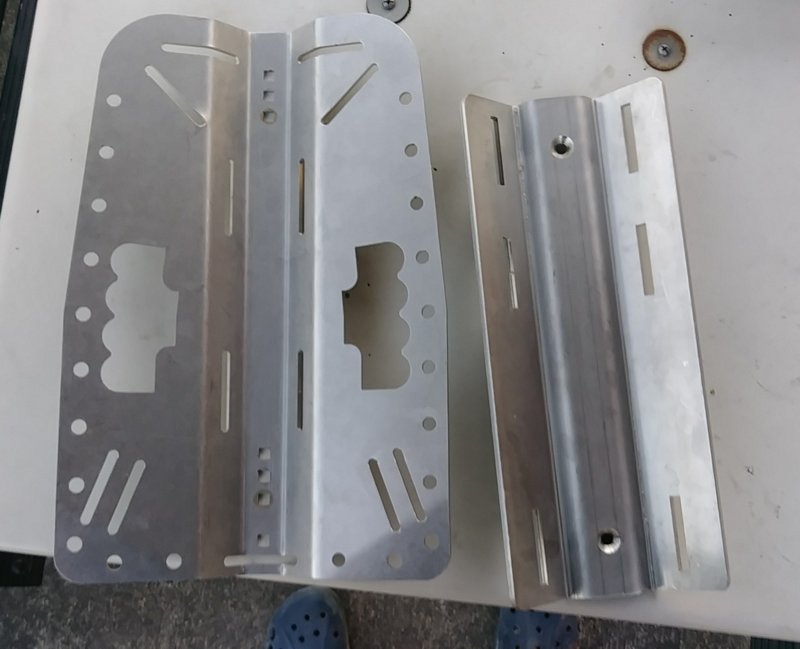
My BC is one I made myself. There was a custom metal shop in Pennsylvania that made custom backplates out of solid stainless steel. The company was called Hammerhead SCUBA. They have since gone out of business. The plate and tank adaptor, pictured below, weigh in at about 12 pounds.

To that, I added a single length of seatbelt webbing wound through the plate, making it into both a waist belt and shoulder straps. On the waist belt, there is a single pouch for adding a single soft weight, so I can use it to adjust buoyancy for things like thicker wetsuits. Also on it are numerous stainless steel d-rings so I can attach various things to my gear when needed.

Also attached to the backplate is an OxyCheq wing with 30 pounds of available lift. They are great wings, and in over a decade of diving, I actually wore one of them out and they let me buy a replacement at 50% off. Great company.

To make things comfortable, I also put a back pad in it. This also created a pocket of sorts that is the perfect place to hide a folding dive flag for when I am on the surface and want to be seen by nearby boats.

Regulators:

I have two Aqualung Legends, one with a DIN connector and one with a Yoke. The yoke connector fits my pony bottle. I also have an older Mares regulator that I sometimes use, there is a DIN fitting on it, and the two DIN regulators I have are tuned so that when you take a good breath on them, they practically force air down your throat. When I am working hard, I want there to be no feelings of being air starved. I have a mechanical pressure gauge on all of them, as well as a QD hose for my dive computer, which allows me to move the computer easily from one regulator to the other, if needed.

Computer

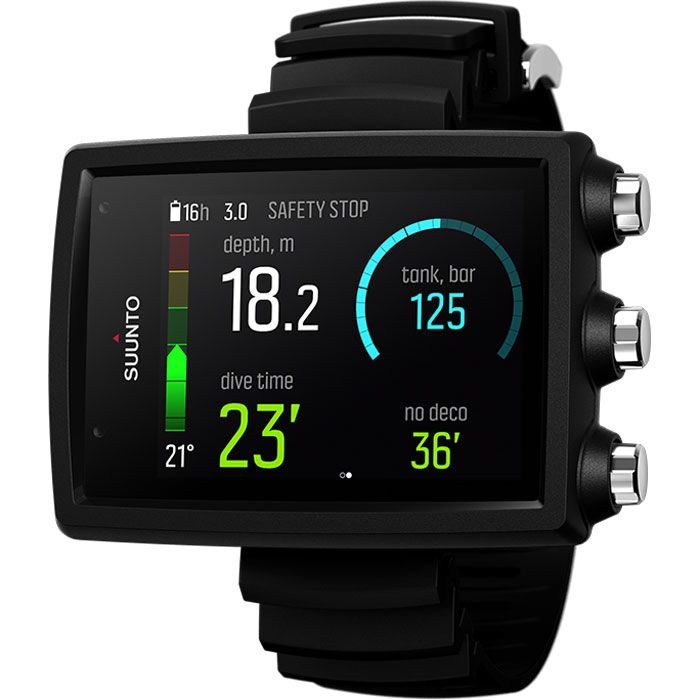
I went through a few computers before I found one I really liked. I tried the wireless ones, and didn’t like them. They lose connection to the pressure sensor too easily. My favorite computer is the Oceanic Pro Plus. Also, it has large numbers that are easier for this old man to read without glasses than is a wrist mount computer. Other advantages are that it allows me to change between three different gas mixes on the same dive. I’ve had great luck with this computer- it served me on hundreds of dives with no issues, including the occasional decompression dive.

Tanks

For tanks, I have a pair of 120 cubic foot high pressure steel tanks, and another pair of 100 foot tanks. I like the 100 foot tanks better. They are 11 pounds negative when full, 2 pounds negative when empty. Using this and a steel backplate enables me to dive without using a weight belt. With this configuration, I am neutral at 10 feet of sea water and an empty tank. Perfect buoyancy. I only accept EAN from companies that blend. I will not use banked EAN because I have had too many issues with contaminated gas from them.

I also have a 19 cubic foot aluminum tank that I use either as an emergency supply or as a deco tank. As a deco tank, I fill it with EAN80, as an emergency tank, it either has air or EAN32.

The rest of it

Completing my setup, I dive with 36 inch freediving fins, because I find that a long stiff fin allows me to drift and steer with little effort but also lets me take advantage of strong leg muscles and really get some speed on. I wear a pair of diving shorts with pockets, so I can store a lift bag and thumb reel with 100 feet of line in one pocket, and a rechargeable flashlight in the other. Attached to my waist belt is a short 4″ dive knife. No snorkel, none of that other extraneous stuff that isn’t really needed, just a simple mask. Too many divers buy a ton of crap that they don’t need, then look like they are wearing half the dive shop while they are in the water. All that does is create drag and weight, which slows you down and causes you to use more gas.

Diving for (Almost) Free

At first, my girlfriend at the time and I used to maintain a website that was a list of dive spots and boats in Florida. We would review all sorts of sites and boats. That’s why my internet handle is divemedic. The site is gone, but it was fldiving.com, and once a boat or shop found out you were running a website for divers, you got all kinds of free stuff. Then my girlfriend and I split up, and I let her keep the website. It lasted a year or two longer, then it disappeared. I guess she didn’t keep up with it.

After that, I spent a few summers working as an underwater dive guide. You don’t make any money at that. What you do get to do is dive for free. Get on the good side of a local dive shop, especially near a tourist area. Florida does some odd things diving that people up north aren’t used to. One of the things we do is drift diving, which other places really don’t do. Tourists want someone to walk them through it, so the dive shop gives them your name and number. They call, and you recommend a boat. There are boats that know my name and offer to let me dive for free if I bring at least three other divers with me. The tourists make the reservation with the boat and pay for their dives and give the boat your name. It doesn’t cost the tourist any extra money for my services, they get a guide who makes sure they have a good time while being safe, and the boat gets some business for the price of an extra diver that costs them nothing. Everyone wins.

When it comes time for the dive, you help them get set up on the boat, then right before we all jump in, I would check their gear to make sure it was setup correctly. After that, all I had to do was throw on the BC and mask, jump in the water, pull on my fins, and I was good to go. This setup is very quick and easy to get into and out of. Fitting these dive trips into my fire department schedule was easy, and I would spend the summer getting in as many as 50 or 60 dives a month. One summer, I hit almost 200 dives from June through August. The most dives I have ever done was a two day period when I did 10 dives between 60-110 feet in just two days. All free.

I would guide my tourist puppies through the dive and get them back to the boat. Sometimes they would tip, sometimes not. I didn’t care. All the tips did was pay for the gas and tolls to get from Orlando to West Palm Beach, Pompano, or Boynton Beach, those being the locations of my favorite dive boats.

The drift diving here is fantastic. The boat drops you on a reef one or two miles offshore, with the bottom being 55-110 feet below, depending on which reef you are diving. For tours, I used to seek out 55-65 foot deep reefs so I could dive it on EAN36 without an issue. The leader (me, when I was the guide) tows a buoy with a dive flag on it using a rope. The divers drift with the current along the reef. You can see a tremendous amount of interesting sea life. At least one or two sharks on every dive- most of the time, you will see even more. Occasionally, you see a really large one- 8 feet or more. During the summer, water visibility can vary from 20 feet all the way up to being able to see the dive boat while on the bottom at 80 feet. On those days, it’s like swimming in a glass of gin.

The limit for the dive is when the first diver in the group hits 700 pounds of gas remaining, a diver hits his NDL limit, or we have been in the water for an hour. I would then have the entire group surface with me. We would spend an hour on the boat, change tanks, then do a second dive. In all, we would spend about 3 or 4 hours on the boat. I would use the rinse hose and some baby shampoo to shower on the back of the boat while we were headed back to shore. Sometimes, I would take a vacation or sick day and spend a week diving every day.

Those were my best days of diving. I spent my summers (this was about 2 years after I divorced my first wife) SCUBA diving. I was great- my tan was awesome. I can see the allure of being a beach bum. It was amazing. I got over 2,000 dives in less than 3 years, averaging more than one dive every calendar day.


One of the boats used to joke with me, because I once spent over an hour and a half on a 60 foot dive and he was pretty pissed. I pointed out to him that he said “dive the limits of your computer or until you are at your reserve air pressure.” Not my fault I have great SAC, a 120 cubic foot tank, and was breathing EAN36.

After that day, the captain would drop my buddy and me in the water first, motor off some distance to drop the rest of the divers, pick them back up, then come over to get me. He was a nice guy. Near as I can tell, his boat is no longer in business.

Compounding Tragedy

During the efforts to recover the bodies of the four divers whose bodies still haven’t been found, one of the military divers has died of decompression illness. As a result of this latest fatality, the Maldives government is suspending body recovery operations until experts in deep and cave diving can arrive on the scene, perhaps tomorrow.

The woman who was the defacto leader of the group is being called an “expert with over 5,000 dives.”

Ms Montefalcone’s husband, Carlo Sommacal, told Italian outlet La Repubblica that his wife was an “expert” and had done 5,000 dives.

I can’t stress how difficult and dangerous this dive is. As I said in the other post, my experience and certifications are remarkably similar to hers, and I am telling you now that I am not, and she is not, in any way qualified to do that dive, nor was she equipped to perform that dive. I know I am not trained or equipped for it. In addition to being NAUI and PADI certified as a divemaster, rescue diver, nitrox, public safety diver, and cavern certified, I am also SSI certified for extended range diving and extended range nitrox. (the first two classes in this list.)

The reports I am seeing is that her group of 5 divers were diving ordinary open circuit with single aluminum 80 cubic foot tanks. That is not the way to do this, and she should know better. It is my belief that Dunning-Krueger is in full effect here- she was making the assumption that all diving is the same, so diving to double the recreational limit is no big deal, and basing that on her training and experience in shallower depths- perhaps thinking her professorship and TV fame made her smarter than everyone else.

The issue with this latest death, is that the Maldives military is no better. It’s being reported in SCUBA circles that the military diver was in recreational gear with single tank and an extra slung aluminum 80. That is nowhere near good enough. The entrance to that underwater cave is at 160 feet. The caverns that are being searched are at 200+ feet.

  • There is no safe limit for diving to that depth that doesn’t require decompression.
  • Nitrogen is intoxicating at that depth. This compounds the danger, and requires mixed gases, especially as you approach 180 feet or deeper.
  • Oxygen in normal air becomes toxic when breathed at depths greater than 185 feet.

For the reasons above, dives to that depth require what’s called hypoxic trimix, a mix of 10-16% oxygen, 50% helium, and the remainder nitrogen. That mixture avoids the risks of OXTOX, narcosis, and lessens the issues with decompression sickness. The issue is that hypoxic trimix can’t be breathed on the surface or at shallower depths. This means a diver has to have what’s called a transit gas, usually trimix with 21% oxygen, to get from the surface to about 150 feet or so. Then there are decompression gases needed, which can include 50% nitrox or other gases. The exact depth for each gas and when to switch depends on the chosen mix, target oxygen pressure (1.2–1.4 atmospheres), Equivalent Narcotic Depth (END), and the decompression plan. The people who do this always use gas and dive planning software. This isn’t the sort of dive where you just dive in and go for it.

In all, a dive like this could require every single diver to enter the water with 4 or more tanks, and still be required to use a surface supplied decompression gas. In many cases with a dive like this, divers will go in ahead of the search team and bring in full tanks of trimix that are left in staging areas within the cave. It’s a very complex and dangerous operation.

Now multiply that by the number of divers you need- this will include the search team, support divers who don’t enter the cave but assist the search team in managing the dive at depths from 150 feet up to the surface, the divers who penetrate the cave to set up staging tanks, then there is a medical team, and other members.

Each diver who enters that cave will have about 25 minutes to conduct the search, then will spend the next two hours working their way to the surface as they decompress at progressively shallower depths. Total run times of 3+ hours are common, with significant stops on 50% nitrox and pure O₂ required to decompress.

In all, an operation like this will take a dozen or more people and cost over a million dollars.

Or you could just cancel the entire useless exercise and leave the dead where they lie. Why risk creating more bodies? My opinion is leave them where they are. They are already dead, and any potential benefit in recovering the bodies isn’t worth losing yet another life. If the Italian government or the family isn’t happy with that, they can mount the expedition, with the understanding that any other death will result in the supervisor of that dive being charged with negligent homicide.

The ocean is an unforgiving bitch if you don’t show her proper respect.

Dive Accident

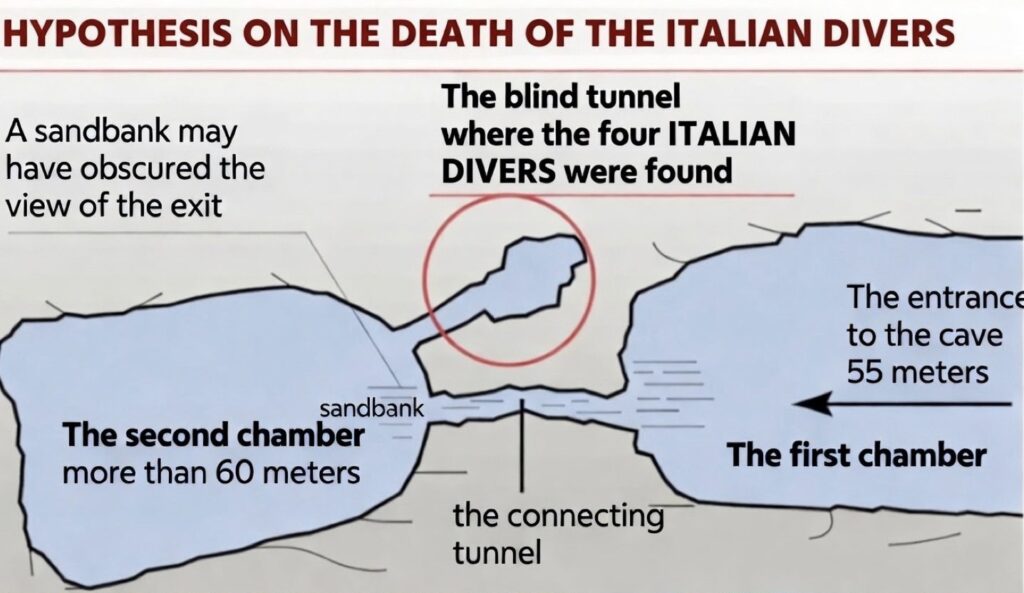
The worst diving accident in the history of the Maldives– 5 people died while on a cave dive to a depth of 160 feet. They died because they were foolish and likely were diving beyond their training, experience, and equipment. Let me explain:

Waves alone were likely not a factor. When you are underwater, you can feel waves to a depth of about 7 times the waves’ height. In order to even feel the effects of waves at 160 feet, those waves would have had to have been at least 23 feet high. That’s not very likely. However, strong winds can cause significant currents around atolls and through underwater caves. That may have factored into this, but no one is talking yet. Still, they had an experienced local dive guide who would be familiar with local conditions with them, so this may not be the case.

More of a factor was depth and the fact that they were in a cave. When you are SCUBA diving, the ultimate safety factor is being able to reach the surface. That’s why new divers are told to always dive with a buddy, because you can share that buddy’s air supply to reach the surface in an emergency. New divers learn all sorts of limits that are intended to ensure you can reach the surface.

When you can’t reach the surface, you are doing what is called “diving in the overhead.” In other words, there is something between you and the surface that is keeping you from reaching it. There are four things that can keep you from reaching the surface. Let’s discuss them:

SAC

The first is the amount of breathing gas you carry. A standard SCUBA tank is filled with 80 cubic feet of compressed air. At rest on the surface, a well experienced diver will breathe half a cubic foot of air per minute. Inexperienced divers can easily triple that, and a diver exerting themselves will also have increased air consumption. That is called your Surface Air Consumption, or SAC.

Depth increases your air consumption. Since pressure increases by one atmosphere of pressure every 32 feet of seawater, a person at 160 feet is breathing 5 times the air as one on the surface. That 80 cubic feet of air is now going to last only 32 minutes instead of 160 minutes. Add in fear, exertion, and the fact that it will take 3 minutes to get to that depth and 5 and a half minutes to safely ascend from that depth, and now your bottom time is about 7 or 8 minutes, maybe less.

When I was heavily into diving, I would usually dive with 120 cubic feet of gas. At 120 feet, I could get a maximum dive time of about 25 minutes. If they were diving Aluminum 80s at 150 feet, that time would likely have been no more than 14 minutes, and my SAC was excellent.

You are limited from returning to the surface simply because you will drown before you get there if you don’t have enough breathing gas.

No Decompression Limits

Another thing limiting your return to the surface is physiological. Your body absorbs gas while you are breathing it under pressure. Since air is a mixture of multiple inert gasses that are not metabolized, those gasses tend to be absorbed into your body tissues. The principle of these is nitrogen. Once the pressure is relieved by going to a shallower depth, that Nitrogen comes out of your tissues and makes tiny bubbles that expand as the pressure lessens. Think about the bubbles in soda. That’s what is happening. Those bubbles get trapped in places like joints, blood vessels, and various organs and cause all sorts of problems.

To prevent this from happening, divers restrict the amount of gas that is absorbed through limiting the amount of time they spend at depth. The maximum time a diver can remain at a given depth is called the “no decompression limit” or NDL. The definitive table for determining what the NDL is for any particular depth comes from the US Navy. (non-hosted pdf warning) It’s a complex subject, but the NDL for 160 feet of depth is about 7 minutes. If you remain at that depth for longer than this, you can’t return to the surface without decompressing, or you will get decompression sickness.

The NDL can be extended by using gas mixtures other than air. For example, a mixed gas called Nitrox was carried on the boat involved in this accident. Nitrox allows divers to stay down longer because some of the nitrogen in the air is replaced with oxygen. The catch here is that oxygen becomes toxic when breathed under pressure (called oxygen toxicity, or OXTOX). That limits the depth at which Nitrox can be used. The most common Nitrox mixes are EAN32, and EAN36. These contain 32% oxygen/68% nitrogen, and 36% oxygen/64% nitrogen. Neither of those mixes is safe for 160 feet. The maximum oxygen mix you can have at 160 feet is 27%, which is an uncommon custom blend.

Decompression sickness can also be avoided by letting those gasses leech out of your tissues at a slower rate. The easiest way to do this is to return to a shallower depth for an amount of time, to allow them to bleed off. For example, a diver might stop at 30 feet for 6 minutes to bleed off some of the nitrogen he absorbed while at a deeper point before returning to the surface. Many divers do what is called a “safety stop” at the end of every dive, which is in reality a 3 minute decompression stop at 15 feet.

For various reasons, most divers don’t use tables to compute all of this. Instead, they wear computers that constantly compute the amount of gas in your tissues and advise you on how long you can stay down, and if you violate that limit they will make recommendations for decompression stops.

Physical barriers

The next barrier to reaching the surface is a physical one- diving in a location where there is a literal thing between you and the surface. That can be inside of a wreck, or in a cave. The hazard here is that it is easy to become disoriented or lost inside of one of these, and you are trapped and unable to find your way out. It takes different procedures, training, and equipment to enter a wreck or cave.

This incident

From diving oriented publications:

Though the dive-group were said to have entered the water in the morning, the alarm was raised only at 1.45pm, suggesting that they might have been prepared for a long, deep dive. Details have yet to be released about the equipment they were using.

Other reports indicate that the weather may have caused strong currents, which could have contributed. No information has been given about the precise cause of the fatalities, although some media reports have made references to oxygen toxicity and gas mixture problems.

Accidents

I have been present for several diving accidents, and I have known several people who have died SCUBA diving. I have also read hundreds of reports of SCUBA accidents. In each and every case of which I am aware, the accident was caused by a diver who went into a situation for which they were not:

  • experienced
  • equipped
  • or trained

Or some combination of those three. That appears to be the case here. A dive inside of a cave, at a depth of 160 feet is beyond the training and experience of recreational diving. It’s called a technical dive, and these require a lot more training and equipment than most divers have.

Dives that go into more complex environments have to be planned. The deeper you go, the longer you stay down, and going into a cave or wreck all require much more planning than a simple 60 foot open water dive.

When diving in an overhead environment like this, the rule of thumb is take enough gas so where you have 1/3 of it in reserve when you reach the surface. For this dive, that would mean about 100 cubic feet of gas, but more like 110 cubic feet to be safe.

On top of this, the Maldives limits recreational diving to no more than 100 feet in depth.

This tragedy was a case of divers going beyond their limits, as most dive accidents are. Diving is a safe sport, as long as you follow the safety rules. Too many divers get tempted to push just a little beyond the limit, and that’s when tragedy strikes.

That is reportedly the case here, even though it isn’t a reliable source, the dive community is saying they were diving on recreational open water equipment, which seems to solidly point towards diver error.

Screenshot

The ocean can be an unforgiving bitch if you don’t respect her.

On the gripping hand

Other than diver error, there is also the possibility that their air was contaminated. Breathing in carbon monoxide, or air contaminated with compressor oil can be deadly. I once dove with Nitrox that was contaminated with compressor oil. I got a buzz from it at 50 feet and had to abort the dive. It cost me several hundred dollars to get all of my equipment cleaned for oxygen service. I never returned to that dive shop.

So there are other possibilities, but the smart money is on diver error.

My training

I have over 4000 logged dives, and I don’t know how many unlogged ones. I am a Master Diver and served on a Rescue Dive team for a number of years. We mainly did body and evidence recovery. The majority of my logged dives were from 60-120 feet, with my deepest dive being a 180 foot dive in Mexico. I’ve done a number of wreck dives, and a few caverns and caves. Caverns and caves just don’t interest me, it’s just a bunch of rocks. Boring.

I was just beginning to get into tech diving when I stopped diving. I had just completed extended range nitrox and was looking into doing trimix. Sadly, it became harder and harder to find others to dive with, so I went no further. My last dive was about 6 years ago.

I’m not going to say that I never broke the rules. I was just lucky enough not to get dead. I once went SCUBA diving in a hurricane. Well, the edge of a hurricane. We thought we would sneak a dive in, in between squall lines. That was one of the scariest dives I have ever done, and I learned an important lesson about the unpredictability of currents when the weather turns bad. Still, I got off lightly. All I wound up losing was a fin strap and the flooding of a $1200 underwater camera.

Words and Self Defense

Social media is abuzz over some streamer in Tennessee named Dalton Eatherly who goes by the handle of “Chud the Builder.” I must confess this is the first I have heard of him. Still, he is known for posting streaming content some call “racist,” although you know how low the bar is to be called a racist these days. I tried to find some of his content, but all I could find were stories about current events, and people complaining about him being a racist. So, I have no opinion on whether or not his content is racist.

Racist content or not, I think it is boorish and rather childish to run around trying to piss people off so you can film the reaction and make money or fame.

Be that as it may, the current events are lacking in details, but it appears to be essentially like this: A black man saw Eatherly streaming and asked him to walk away, which he reportedly did. The man later walked up to Eatherly and started a second confrontation. The man mentioned having PTSD, then warned: You start saying all that chimp out shit to me and I’mma hit you.” The man punched Eatherly and began repeatedly hitting him. Eatherly then shot the man, the man kept attacking him, so Eatherly shot him at least once more. During the struggle, one of the bullets struck Eatherly himself.

At the end of the day, Eatherly was charged with a list of crimes including attempted murder.

There are many people, including quite a few on the right and in self defense circles, who claim Eatherly was in the wrong because he is known for posting racist comments, and those comments are considered “fighting words.” That is incorrect. Just because a person says inflammatory things at some point does not grant people who heard him in the past the legal right to physically attack you for the rest of your life. That’s not what fighting words mean.

Remember Charlie Kirk, and how the left kept attempting to incite the right by pointing at their necks? Or say a black man once called someone a cracker, does that mean I get to beat him? Of course not. Eatherly doesn’t forfeit his right to self defense simply because he called someone a nigger or a chimp, whether he did so in the past or even in the immediate seconds before the attack. Mere words don’t justify a physical attack unless they rise to fighting words, but that is a fairly high bar to clear, as discussed above.

Legal Standard for Incitement

The controlling precedent is Brandenburg v. Ohio (1969). The Supreme Court ruled that the government cannot punish speech advocating force or law violation unless it is:

  1. Directed at inciting or producing imminent lawless action, and
  2. Likely to incite or produce such action.

Abstract advocacy, inflammatory rhetoric, or offensive language—even racist speech like that at a KKK rally using the word “nigger” and calling for “revengeance” against Black people and Jews—was protected. according to the court. The Court struck down a broader Ohio law criminalizing advocacy of violence.

Someone using language that others find offensive or cause emotional distress, or potential for unrest does not qualify. Courts protect “the thought that we hate” precisely because the First Amendment prioritizes robust debate over shielding feelings. The First Amendment is there to protect unpopular speech. Someone saying “Puppies are cute” doesn’t need free speech protection. Someone speaking things making people uncomfortable does, even if that speech is unpopular, especially if that speech is unpopular.

A narrower exception involves “fighting words” defined as personally abusive epithets directed at an individual that, by their very utterance, tend to incite an immediate breach of the peace (Chaplinsky v. New Hampshire, 1942). However, this has been significantly narrowed:

  • Courts repeatedly hold that racial slurs, including the N-word, are not fighting words per se. Context matters heavily (e.g., tone, intent to provoke a fight, likelihood of immediate violence).
  • Examples: Someone loudly calling a Black man ‘nigger’ while trying to start a fight could qualify in one case, but yelling it without evidence of imminent violence or actual breach of peace does not. What matters is that the person saying it was trying to provoke a fight, and not merely being insulting.
  • Yelling slurs is widely viewed as rude, inflammatory, or bigoted, and it can have serious social, professional, or civil repercussions. But legally equating it to incitement to violence would gut the First Amendment, as affirmed across decades of Supreme Court rulings. Context always determines outcomes in edge cases.

Hate speech, slurs, and bigoted expression are generally protected unless they cross into true threats, targeted harassment, or the narrow incitement/fighting words categories.

Proportionality

However, once the physical confrontation began, the question becomes whether Eatherly reasonably believed he faced imminent death or serious bodily injury, and whether shooting was a proportionate response. There aren’t enough facts out there to determine that at this point.

In my opinion, this entire case hinges upon proportionality. Tennessee’s Stand Your Ground law (Tenn. Code Ann. § 39-11-611), like most states, allows deadly force only if the person reasonably believes it is immediately necessary to prevent death, serious bodily injury, or certain other harms.

  • A single punch or minor scuffle generally does not justify deadly force.
  • Factors that strengthen a claim: Continued attack after the defender is down, multiple strikes (“ground and pound”), size/strength disparity, weapons involved, or signs the attacker would not stop (e.g., the victim continuing to hit after being shot).
  • Juries assess this objectively: Would a reasonable person in Eatherly’s position fear serious injury?

Some accounts say Fox continued hitting even after being shot. If that was indeed the case, that could strengthen Eatherly’s case for self defense.

Critical gaps for proportionality:

  • How sustained or severe was the beating? One punch + a few follow-ups vs. a prolonged assault that put Eatherly at risk of being knocked unconscious or stomped?
  • Positions during the shots (standing, on the ground, distance after initial punch)?
  • Did the man stop after the first shot, or was he still actively attacking?
  • Any video evidence (courthouse surveillance, bystander, or Eatherly’s own stream) showing the full sequence.

If evidence shows Eatherly was actively being beaten in a way that created a credible fear of serious injury (e.g., head strikes, unable to disengage, larger/stronger attacker with PTSD-related agitation noted), self-defense is viable. If it appears more like a fistfight where Eatherly quickly resorted to a gun and fired multiple rounds, conviction on a lesser charge (aggravated assault) or full conviction becomes more likely.

There are not many facts out there, but there are plenty of people running around saying that because Eatherly said racist things in the past, he deserved to be punched, and is not allowed to defend himself from the attack. That’s false, and can’t be the law, or else we are all open to attack for any offense we may have caused someone to take by something we may or may not have said at some point in the past.

The case will hinge on the seconds of physical violence and whether shooting met the proportionality/necessity test. More evidence (especially video) will be decisive. As of now, it’s too early for a confident prediction. As usual, this case will rely upon all of the evidence, and right now the details are very thin.

Punches Are Not Lethal Force

There appears to be a group of men who are either afraid of the law being used against them, or are using the law as a fig leaf to avoid getting in a fight. From multiple comments on the delivery of a punch to someone that is sexually assaulting your wife:

If that haymaker kills or disables the drunk, how well can you take care of your wife from prison. He could have backed up the drunk verbally, then if the drunk throws a punch, now it’s self defense.

The claim is that a punch becomes “Deadly Force” if someone dies. It’s a question that comes up often in discussions about self-defense:

If you throw a punch to defend yourself and the other person unexpectedly dies, does that automatically turn your action into “deadly force”?

The answer is simple: No it does not, at least not in Florida. What matters is the force applied, not the outcome of the force used. If the punch was lawful at the time it was delivered, the fact that the person who was punched later died is immaterial. Florida courts have been clear on this point:
Whether force is considered “deadly” depends on the nature of the force used at the time—not the result. In other words, the legal system doesn’t start from a lethal outcome and then work backward from to label the level of force used. Instead, it asks:

Was the force used likely to cause death or great bodily harm when it was applied?

A single punch, in most situations, is not considered deadly force even if, in a tragic and unforeseen way, it leads to death. One of the key controlling court cases in this matter is Hosnedl v. State 126 So.3d 400 (2013). In this case, the defendant was involved in a physical altercation. He used his hands/fists (no weapon), and the person who was punched unfortunately died. The legal dispute wasn’t just what happened, but how the jury should evaluate the level of force used.

The jury was given the stricter self-defense rules for the use of lethal force since the had person died. The defense argued this was wrong because the force used (punching) was not necessarily deadly force. The defense was overruled by the trial court. The defense then filed an appeal. The appellate court agreed with the defense and made an important clarification:

Whether force is “deadly” depends on the nature of the force used—not the result.

As a result of this case:

  • Fists are not automatically deadly force
  • Even if serious injury (or death) occurs, that doesn’t automatically make the force “deadly”
  • The jury should decide whether the force used was:
    • Likely to cause great bodily harm or death (deadly), or
    • Not likely to do so (non-deadly)

How Florida Law Defines Force

Florida’s self-defense law separates force into two categories:

  • Non-deadly force: Force not likely to cause death or serious bodily harm
  • Deadly force: Force likely to cause death or great bodily harm

This distinction is critical because different legal standards apply to each. You’re generally allowed to use non-deadly force to stop an imminent threat, but deadly force is only justified under much stricter circumstances.

Under Florida law, a person is justified in using force—including deadly force if necessary—to prevent an imminent sexual battery. That means:

  • A punch used to stop a sexual assault will almost always be viewed as justified force
  • The legal question becomes: Was the force reasonably necessary to stop the attack?

So now that we have cleared that hurdle, is it legal to punch someone for groping your wife?

Under Florida law (Fla. Stat. § 794.011):

Sexual battery = oral, anal, or vaginal penetration OR union with the sexual organ of another
“Union” means any contact, not just penetration

Courts interpret “sexual organ” to include buttocks in certain contexts involving lewd touching, especially when tied to sexual intent. See Richards v. State (Florida 4th District Court of Appeal, 1999)  and also Gordon v. State, as well as State v. Hearns.

Now we have established that a person grabbing a woman’s hips and stroking her buttocks without her consent is sexual battery. Since it was done without her consent and using physical force, that makes it a forcible felony. This isn’t even an attempted or imminent battery- the mere touching of her buttocks without consent means that the battery is ongoing and in progress. All of the elements are in place, this is a crime.

Considering these circumstances, if the husband deemed it reasonably necessary, he would be authorized to use deadly force to stop this attack. However, that isn’t what he did, as we showed above, a punch IS NOT DEADLY FORCE under Florida law.

Under Florida Statute § 776.012, a person may use force—including even deadly force—if they reasonably believe it’s necessary to prevent an imminent forcible felony (which includes sexual battery). So the real legal question isn’t “Was a punch allowed?” The actual question is “Was that level of force reasonably necessary to stop what was happening right then?”

Short answer: Yes—using a punch to stop that kind of unwanted groping would very likely be seen as reasonable under Florida law, assuming the force stops once the crime ends.

A court would typically look at:

  • Was this non-consensual sexual contact?
  • Was it happening in the moment (imminent)?
  • Did the woman (or a third party) reasonably perceive it as a sexual assault or escalation risk?

If the answer is yes, then a single punch to break contact or stop the assault is very likely to be viewed as:

  • Non-deadly force
  • Proportionate
  • Reasonably necessary

Security Layers

No agency has an unlimited budget of manpower and money. Even if they did, there are still going to be limitations. In the case of the WHCD, it was located in a Hilton that still was operating. The people in that hotel still have rights, as does the hotel itself. For that reason, the Secret Service has limits to its power and what it can do to protect those in their care.

When I was in the military, we used a layered system. This is a much more effective use of resources, and is also the same system used by the Secret Service.

Property boundary:

The property line of the facility or event. This is often secured by police directing traffic, employees of the location (i.e. Hilton employees) Generally, they are there to keep casual people out of the way. This filters out many if not most of the people in the area, and allows the next layer to concentrate on those who make it through. In the case of the WHCD, this area would be the grounds of the hotel and the streets immediately surrounding it.

The Controlled area:

This is a layer that is monitored and watched, but people in this area can’t pose a real threat. This area would have been the hotel building itself. Access is minimally controlled, mostly by asking people who enter to prove that they have legitimate business there. For example, show a room key to prove you are a guest of the hotel.

The Restricted Area:

This is an area where people have access to things that you want to protect. This would be the first layer that is protected by the Secret Service. People entering this area need an invitation, they will be searched on entry, and are carefully screened and monitored. The restricted area in this case would have been the ballroom itself, with the magnetometers being the control point allowing entrance to the restricted area. Our shooter made it to one such checkpoint and tried shooting his way through. He didn’t make it past the checkpoint, which is why the checkpoint is there.

The Exclusion Area

Access to this area is extremely limited. No one gets in here unless they are expressly authorized. This area would be the President’s escape route, where the CAT team is located, and other sensitive areas. No one is allowed in here unless they are Secret Service or are escorted by them.

The system is all about defense in depth:

Each inner layer adds more stringent access control. You don’t jump straight into an exclusion area—you pass through multiple controlled boundaries, with authorization becoming progressively stricter.
Access → Clearance → Invitation → Explicit designation

In the case of the shooter at the Hilton, the shooter penetrated the outer layer by simply being a guest at the hotel. That allowed him into the controlled area. However, he wasn’t authorized to go any further. He tried to go deeper, but only made it to the limits of the control point- he never even made it to the stairs that descended to the next layer.

Had he done so, he would have faced more agents who were better armed and had looser rules of engagement.

This is how layered security works. Your own house is the same- someone who knocks on your door to deliver a package is in the controlled area. If you open the door to accept the package and he attempts to push his way in (to the restricted area), but you tackle him just inside the door, that wasn’t a failure of security if he didn’t reach the bedroom where your loved ones are sleeping (the exclusion area).

Sure, this guy penetrated the outer layer. You can’t make the outer layer absolute. Hotels, city streets, and public venues must keep functioning, and there simply isn’t enough money or manpower to search every guest, lock down entire buildings indefinitely, or abuse people’s rights. Even for high-profile events, full “sterilization” of a large hotel is often impractical or politically unacceptable. The outer layer will always be porous by design, more of a filter than a brick wall. You accept risk at the outer edge. You manage risk in the middle. You eliminate risk at the core.

Poll

Take a look at this:

My thought is this is sexual battery, or at least an attempted one. One of my duties is to protect my wife from this sort of attack. I will use force to do so.

Some in comments to that video have said the husband will go to jail for using excessive force.

  • So do you think the law requires a husband to stand there and allow someone to caress his wife’s ass?
  • If no, what level of force is appropriate?
  • Did this husband’s use of force exceed that?

Others say that the husband deserves to have his head stomped in.

Is this force used by the husband excessive? Discuss.

Don’t Talk to the Police, the followup

Look how well this works.

It looks like they are about to try again. They even had a brief talk about how to yank open that second door when she opens the inner door.

Don’t open the door. There are no exigent circumstances, they can’t legally enter your home without a warrant. Tell them through the doorbell cam to fuck off and come back with a warrant.

Honestly, there is a certain point when you are willing to find out if the local police have level IV plates.

Don’t Talk to the Police

First, a bit of background:

Police have two ways they can talk to someone in the public: consensual or seizure. A police consensual encounter is a voluntary, non-detention interaction where an officer approaches a person to ask questions or for identification. The person is free to leave, refuse to answer questions, or decline requests at any time- to include refusal to provide ID. It does not involve commands, force, or blocked movement. 

A seizure is where a person isn’t free to leave. Police can use force to keep you there, they can search you, demand your ID. Noncompliance with this is considered obstruction or resisting and is illegal. The person being questioned still has the ability to refuse to answer questions, or refuse to answer them without a lawyer present. This is why asking police if you are free to leave is so important. This tells you if you are in a consensual encounter or have been seized.

If the police want to talk to you, they can ask or they can seize. In order to seize, they have to have probable cause that you are or have committed a crime, or they have to have a warrant. If you are in your home, a warrant is generally required, if they don’t have exigent circumstances. Those include the belief you are destroying evidence (e.g., flushing drugs down the toilet), or there is something going on that is an emergency (say you are murdering someone in the home). Police cannot make a warrantless, non-consensual seizure inside someone’s home just because they have probable cause. They generally need an arrest warrant (unless exigent circumstances apply). This is important.

Now to the case at hand:

Two years ago, three men were involved in a fight in a bar in Saint Cloud, Florida. One of the men was reportedly armed with a handgun and had left the scene. The other two individuals who were in the fight contacted police: one of them refused to give a statement, and the other (visibly intoxicated) man did give a written statement claiming the third man displayed a handgun. Both of the men who spoke to the police at the bar were rather vague on details about the fight or what started it.

The next step you would expect an investigator to do would be to, well…investigate. You would think that the cops would contact the man, ask him to come in and answer a few questions, or perhaps even send a cop or two over there to ask. After all, he isn’t under arrest, they don’t have a warrant, and the contact at this point is consensual. Or supposed to be.

The cops immediately assembled a tactical team and had a meeting where they discussed the methods and tactics they would use to take him into custody. They surrounded the house by posting two cops at the rear of the home to prevent his escape, the cops out front had a K9, bullet shields, and NFA long guns with suppressors. They called him on the phone and asked him to step outside to answer some questions.

The Raid

What happened next was captured on body camera video, you can see the video below. They held him at gunpoint and ordered him to the ground. Even though his hands were raised, they kicked him to the ground, used the K9 to bite him because he wasn’t going down fast enough, and used quite a bit of force for a consensual encounter.

Any reasonable person would agree that they are not free to leave at this point. This is a seizure. They avoided the requirement for a warrant by luring him outside using a friendly tone and a request to just “Answer a couple of questions.” Since police tricked him to come outside specifically to avoid the warrant requirement, courts tend to scrutinize that. This trick is called constructive entry. This was never intended to be a consensual encounter, as evidenced by their own meeting and plans to take him into custody.

There was no reason to rush over there and arrest him. The incident was over, and there was plenty of time to secure a warrant. There were no exigent circumstances, and therefore no exception to the requirement to get a warrant. This doesn’t look like a casual “knock-and-talk” but more like a planned arrest operation without a warrant, which courts scrutinize closely. Payton v. New York ruled that police cannot do indirectly what they’re forbidden to do directly—i.e., they can’t avoid the warrant requirement by tricking or forcing someone out of their home.

  • House surrounded by armed officers
  • Officers positioned to prevent exit
  • Suspect called and told to come out
  • Show of force (guns, numbers) suggesting no real choice
  • Use of force when subject was compliant and not offering active resistance

In my mind, there is little doubt that this man’s constitutional rights were violated, both in the arrest without warrant, and in the manner the arrest was carried out. There was no reason to use force on a man who had come out voluntarily and was offering no resistance. Not one of those cops mentioned “hey, maybe there is a better, more constitutional way to do this.” This, in my opinion, destroys the “few bad apples” trope.

To make it even worse, it turned out that this man was the victim and the two intoxicated men had attacked him. The prosecutor in the case dismissed all charges, saying that the case was “unsuitable for prosecution.” He has since filed a lawsuit against the city and its police department for violating his civil rights. The cops will almost certainly hide behind qualified immunity claims.

There is a lesson to be learned here.

Don’t talk to the police.

I’ve said this before- don’t talk to the police. Ever. There is no such thing as a friendly chat with cop. I will refer you to an old post of mine on the subject that contains a video titled “Don’t talk to the police.” Don’t talk to the cops, no matter what. They aren’t your friends. They aren’t there to help you. They are there to make a case to arrest someone, and they will get the arrest that requires them to do the least amount of work they can. At best, they are there to find reasons to take you to jail, at worst they are there to use their cool toys on you- whether that be a machine gun, a K9, or just a good old fashioned beating.

Most cops are pussies and cowards. We see that time and again- they will use overwhelming force on those who pose no threat, even going so far as to toss grenades into a baby crib, but will cower outside with their machine guns and body armor while children are being killed by an armed murderer.

A cop calls you on the phone and wants you to come out and answer questions, ask them if they have a warrant. If the answer is no, you tell them you don’t want to answer any questions or speak with them until you have an attorney. Offer to come down to the station with your attorney to answer questions, and tell them your attorney will schedule the meeting. Whatever you do, don’t open the door. You have a doorbell camera for a reason.

Open that door, and this just might happen to you. Ever since my incident in Orange County, Florida in 2001 where a Deputy Sergeant threatened to kill me when I presented him with my concealed weapons permit during a traffic stop, I don’t inform cops of shit.

The cops may not have enough to arrest someone, but you talking will give them what they need. If they DO have enough to arrest you, there is nothing you can say that will talk them out of it. Refuse to talk to them, don’t open the door, and go about the rest of your life.