ObamaCare to eliminate 72% of firefighters in the US

In the US, there are over 750,000 volunteer firefighters. This number represents 72% of all firefighters in the US. The IRS is trying to define the provisions of Obamacare, and the way that the law is written now would require volunteer fire departments to provide health insurance to their volunteers. This would be prohibitively expensive, and bring volunteer firefighting to a halt.

One of Obamacare’s reforms is known as the “Shared Responsibility
Provision,” which requires that large employers offer health insurance
to their employees. The act defines large employers as those with 50
or more full-time employees (FTEs) or FTE equivalents. The act further
defines an FTE to be an employee working 30 or more hours per week.

So any time a volunteer works more than 30 hours per week, the volunteer department with more than 50 volunteers would be required to provide that volunteer with insurance.Even though the volunteer system was disbanded years ago, Osceola county, Florida once had a dozen individual volunteer fire companies providing protection to the rural areas of the county, while career stations provided service to the more urbanized areas of the county. This meant that each individual volunteer department had fewer than 50 volunteers, collectively there were several hundred “employees” that would have needed insurance under Obamacare.

The uncertainty surrounding the Shared Responsibility Provision is
compounded for fire departments due to conflicting federal guidance on
whether a volunteer firefighter or emergency medical provider is an
employee of their fire department. While the Department of Labor
classified most volunteers as non-employees, the IRS is responsible for
enforcing the Shared Responsibility Provision and considers all
volunteer firefighters and emergency medical personnel to be employees
of their fire department.

Simply changing this IRS rule for the purposes of Obamacare won’t work, either. See, the rule was passed in response to a policy that many career fire departments once had, where they required their full time paid personnel to work a certain number of hours each year without pay as a volunteers.

All of this is causing volunteer departments to curtail or even shut down operations. Burlington, Washington has 9 full time and 30 volunteer firefighters. The city’s fire department announced early in November that they will have to curtail volunteer’s activities.

 “If we were to extend full medical benefits to those firefighters, it
would be $750,000 that the city hadn’t anticipated. And given the entire
fire budget is $1.6 million, that’s a substantial portion of the
budget,” said City Administrator Harrison. “I’m not sure where we’d get that money.”
We need to pass it to find out what is in it, indeed. The unintended consequences of this law are just now beginning to come to light.

93 years of corrupting the Constitution

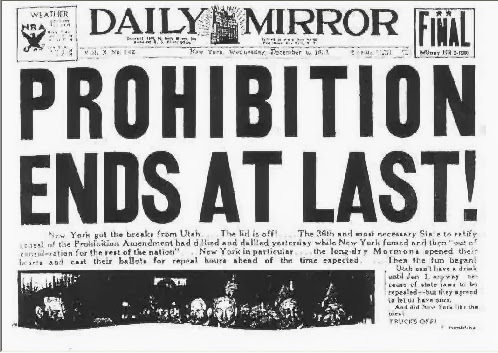
Eighty years ago today, the 21st Amendment to the US constitution was ratified, ending alcohol prohibition in the United States.

The 18th Amendment, ratified on January 17, 1920, outlawed alcohol in the United States. The Amendment was enforced through the Volstead Act. One thing that I find interesting is the fact that Heroin and Cocaine were still perfectly legal during prohibition.

The Amendment was passed because  legal theories at the time said that the states were responsible for the law within their borders, while the Federal government only had jurisdiction over international affairs and interstate commerce. Thus, making liquor that stayed purely within a state’s borders illegal at a Federal level was unconstitutional

At first, it seemed as though prohibition was working: liquor consumption dropped, arrests for drunkenness dropped, and the price of alcohol soon rose to a level that was more than the average worker could afford. Many people that had supported the Amendment initially were angered by the Amendment and had felt misled. They felt that the phrase “intoxicating liquors” would not include beer and wine, but the Volstead act defined the term to mean anything with more than 0.5% alcohol.

Just like today’s war on drugs, the enforcement of alcohol prohibition granted many new powers to the Federal Government. Over the prohibition years, the Supreme Court modified its
interpretations of the 4th, 5th, and 10th amendments in order to uphold
the Volstead Act and interpret the enforcement power in the 18th
amendment expansively.  The court allowed wiretaps without a warrant,
allowed a person to be charged twice for the same crime under state and
federal statutes, and allowed warrantless searches of motor vehicles –
establishing the “reasonable suspicion” standard.

The law of supply and demand soon caught up with prohibition, and people that were willing to break the law to get beer were soon willing to break the law to get other liquors. Demand for alcohol soared, criminal enterprises began supplying it, and prices came down as supply increased. Criminal enterprises began competing for territory. It was not long before the problems of public drunkenness were replaced with organized crime, the corruption of police and courts, and widespread violence.

Many states eventually grew tired of the hassle. In
fact, by 1925 six states had developed laws that prohibited police from enforcing the Volstead Act. Cities in the Midwest and Northeast were
particularly uninterested in enforcing Prohibition. By 1928, 28 states had stopped enforcing the law. Juries began nullifying the law by refusing to convict people.

When confronted with what the people and the states believed to be
federal overreach, the people responded with outright disobedience and
jury nullification.  The cities and states nullified through sporadic or
complete absence of enforcement.  As with the Whiskey Rebellion and resistance to the Federal Fugitive Slave Act, the federal government was unable to overcome the resistance and was eventually forced to repeal the detested intrusion.

 So you can see that the Prohibition era and the Temperance movement changed our Constitution and damaged our freedoms. It set the stage for the drug war, Obamacare, the NSA scandal, sobriety checkpoints, the TSA, and tons of other overreaches of Government power.

it
seemed as though prohibition was not only a great idea, but that it was
working. “The amendment worked at first, liquor consumption dropped,
arrests for drunkenness fell, and the price for illegal alcohol rose
higher than the average worker could afford. Alcohol consumption dropped
by 30 percent and the United States Brewers’ Association admitted that
the consumption of hard liquor was off 50 percent during Prohibition.”
However, as time progressed, the statistics would change.

it
seemed
it
seemed as though prohibition was not only a great idea, but that it was
working. “The amendment worked at first, liquor consumption dropped,
arrests for drunkenness fell, and the price for illegal alcohol rose
higher than the average worker could afford. Alcohol consumption dropped
by 30 percent and the United States Brewers’ Association admitted that
the consumption of hard liquor was off 50 percent during Prohibition.”
However, as time progressed, the statistics would change.
as though prohibition was not only a great idea, but that it was
working. “The amendment worked at first, liquor consumption dropped,
arrests for drunkenness fell, and the price for illegal alcohol rose
higher than the average worker could afford. Alcohol consumption dropped
by 30 percent and the United States Brewers’ Association admitted that
the consumption of hard liquor was off 50 percent during Prohibition.”
However, as time progressed, the statistics would change.

Work is for suckers

Hosts on a KLBJ radio station in Austin, Tx, had been talking about how
accustomed people have become when it comes to welfare.  Expressing the
fact that some people would rather sit around and wait for their free
check in the mail than go to work, got at least one listener upset. The listener called in to say that she would always be on welfare, and that everyone else is an idiot for doing otherwise.

One of the hosts then asks the woman if she viewed the working class as
idiots because we go to work instead of staying home and reaping the
benefits that have been paid by those working.  She sadly replied that
she did think working was foolish declaring that even though she doesn’t
work, she’s still going to get paid. According to her, her parents were on Welfare, her kids are on Welfare, and she will be on Welfare for the rest of her life.

and she votes. This nation is doomed.

Servers are a whiny bunch

Via Peter at Bayou Renaissance Man, we find a blog post about how we all should tip more.

I am so tired of hearing about how servers don’t get enough in tips.


 Here is a description of your job: You write down what I want, and
then someone else prepares it. You pick up what I asked for (that
someone else prepared) and bring it to my table. If I ask you for
something like more sugar or ketchup, you bring it to me. You keep
refilling my glass. That’s it. It isn’t skilled labor. That is why they
call it the ‘service industry’.

You complain about how hard your job is? Try working a summer in
building construction, laying roofing tile. Think your pay as a server
is low? Get a job running a cash register at Wal Mart.

Look, let’s say that you work at a restaurant that assigns you four
tables, and each table spends about an hour eating. Let’s also say that
the average check for each table is $60, and let’s also say that your
employer only pays you $3 an hour, and the rest of your pay comes from
the ‘cheapskates’ that you are serving. Even if half the tables stiff
you and the other half only tip 10%, you are still making $15 an hour.
Where I live, that is double the minimum wage, and there are many, many
people who make less than that. In this scenario, if one in four tables
stiff you, and the others tip the 20% you constantly whine for, you are
now making $39 an hour.

Sorry, what you are doing isn’t worth $78,000 a year. So my new
tipping policy: I tip 15% for GOOD service, and less for crappy service.
My tips are capped at $10 for each hour I am there. That is more than
enough, and if you work a second table during that hour, means you are
making more than I am. For carrying stuff. Be happy you have a job.

My sister is a high school dropout. She went back and got her GED, but the highest paid job she can get is waiting tables at TGI Friday’s. She comes home from an 8 hour shift with $80-100. That is in addition to the $4.77 an hour she gets from her employer. Of course she complains that her check is frequently $0, after taxes are taken out, and that she must rely on tips for her entire income. Welcome to the real world. We all pay taxes, and your pretax income is $15-17 an hour- pretty good money for unskilled labor.

Marker

A 76 year old woman is robbed by three young people in her own driveway, as she was arriving home from work. She has a concealed weapons permit and managed to shoot one of her attackers before they killed her.
The comments on the article are appalling. Just click on the “worst rated” to see the mentality of the people there who are blaming her as they assume that the robber would have not attacked her if she was unarmed. If we are to take this advice, we are relying on the good will and conscience of the criminals.

If I have a weapon, I have a choice: I can submit, or I can resist.

If I do not have a weapon, I must submit. That is what a weapon does for me: it gives me a choice. It is freedom. I know that a firearm is not a guarantee of safety. It is not a magic wand or talisman. I would hope that if I find myself in such a situation that I would come out alive, and if this is not possible, at least I will be found in a pile of my spent brass, not on my knees with my hands tied behind my back.

At least in this case, the victim marked her killer for future identification.

Robot Watchman

After the school massacre at Newtown, a company named Knighthawk was founded. They claim that they want to sell and market a robot watchman that will prevent shootings like this from happening.

The robot is unarmed. So tell me how a burglar alarm system on wheels is going to prevent a shooting when, according to the article, it can’t even prevent unruly teenagers from tipping it over. When asked about teens tipping it over, they said that the video recording ability of the robots would deter this. Explain to me how a person engaged in a suicide mission of killing kids would be deterred by the fact that he was being video recorded.

Irony

Paul Walker, star of the Fast and Furious film series, died in a fiery crash, as the car that he was riding in slammed into a tree. The police think that speed was a factor in the crash. Oh, the irony.

The Fast and Furious movies glamorized riding around in heavily modified small cars and street racing them.

The first of the movies was released on June 22, 2001.

In 2001, the National Highway Traffic Safety Administration (NHTSA) reported that police listed street racing as a factor in 135 fatal crashes. The total was up from 72 street-racing-related fatalities reported in 2000.

The city of San Diego prosecuted 147 illegal street racing cases in 1999, 161 in 2000, and 290 in 2001.

The numbers of street racing related deaths increased in 2001, 2003, 2006, 2009, and 2011: each and every year that a new Fast and Furious movie was released.

That’s Hollywood: Glamorizing things like street racing and killing people, and then claiming that your movies don’t influence people’s behavior, but charging big bucks for product placement because seeing your product in the movies makes people want to buy it.

Retention holsters, people

In a local ER, a patient was being seen as a Baker Act, because he had made statements that he wanted to commit suicide. When he got to the ER, the Sheriff’s deputies that brought her in escorted her to the nurses’ station. There was an armed security guard there, and she tried to steal his gun. The cops and the guard beat her profusely. The whole time they were wrestling with her, she was screaming that she wanted to kill the nurse.
She is now spending her time in the ED screaming about how she wants to kill the nurse.

Now, not only is she a Baker Act, but after she gets out of the three day hold for that, she is going to jail for armed robbery (stealing the guard’s gun), aggravated battery, attempted murder, and terroristic threats. I hope at least a few of those charges stick and she gets some serious time.

If you are going to open carry, use a retention holster.

Five year test of CFL bulbs

Five years ago, I wanted to do an experiment. The government passed a law that phases out incandescent light bulbs in favor of more efficient bulbs. They claimed at the time that the more efficient bulbs would save a homeowner money through lower energy costs, despite the fact that the newer bulbs were much more expensive. They claimed that this was due to the longer life of the lower energy bulbs.

So I set out to look at this issue, because I am a big geek like that.

There are 46 light bulbs required in my home. I replaced 25 of them with compact fluorescent bulbs.

19 of them were of the spiral variety. They currently cost $1.50 each. At the time that I originally bought them, they were more than $8 each. 4 of them burned out and had to be replaced during the five year test period. At today’s prices, this means that the 19 bulbs cost $34.50 over the five year test period.

6 of them were PAR lamps that were used as spotlights in the track lighting that illuminates the kitchen. These bulbs were quite expensive, costing $12 each at the time. They currently cost $4 apiece. Three of them burned out, for a total cost in today’s prices of $36.

During that same period, four of the remaining 21 incandescent bulbs had to be replaced. These bulbs cost 50 cents each, with a total cost of $12.50.

The total cost for fluorescent bulbs is $2.82 for each  of the bulbs, factoring in the costs of replacement bulbs. They are not as long lived as the government claims, with about a third of them failing over the five year period.
The total cost for incandescent bulbs is 60 cents each.

The CFL bulbs use 18 watts of energy each. The incandescent bulbs use 60 watts. The price I pay for electricity is 12 cents per kilowatt hour.

This means that the difference in energy costs for outfitting my entire home with CFL bulbs would require me to run my every one of my 46 light fixtures for 3 hours per day each in order to break even. Of course, no one does that.

Conclusion

The only way that this becomes cost effective is if you only replace the lights in your home that are most frequently used. Closet and bathroom lights, which are used far less than lights in the living and bedrooms, are simply not used enough to justify the added costs of CFL bulbs.

Also, the costs and performance of the PAR type CFL bulbs make them a poor choice.