I know this post isn’t exactly timely, but it’s something I have wanted to talk about for the past several weeks. This is just the first chance I’ve had to write it all down.
There is a segment of the left that hates President Trump and this nation so much, they want the US to be defeated in every way. That includes the reported fire that reportedly occurred on the USS Ford. They are screaming about how it must have been an Iranian missile, and have come out as experts on Naval warfare, firefighting, and all things military. They are all incorrect. I will discuss the basic damage control for a Navy ship at sea. In port is a different story that is beyond the scope of this post and won’t be discussed.
Every sailor has received some training in boot camp on damage control, but it’s a rudimentary training at best. In smaller ships, a fire will generally cause the captain to put the ship at battle stations so the crew can fight the fire. The same is true on an aircraft carrier, except aircraft carriers are large and there is always a lot going on. When an aircraft carrier goes to battle stations, nearly half of the crew is assigned to damage control, to include firefighting. The ship has too much going on at all times to do this lightly, so for small fires, there is a dedicated fire department that is there to handle smaller incidents and prevent the ship’s crew from having to go to battle stations several times per week.
The capabilities of the ship’s damage control are fairly robust.
The fire party is broken into different areas. There is one segment, crash and salvage (colloquially referred to as ‘crash and smash’) whose job is to fight fires on the flight deck and hanger bay. You will sometimes see them on television and movies wearing “silver suits.” The second segment of the fire party is called the nucleus fire party. That is a team of 23 damage control specialists and 2 electricians whose job it is to fight fires everywhere else on the ship- from the nuclear power plant, to the weapons magazines, berthing spaces, you name it.
There is a sprinkler system on the ship that is capable of releasing firefighting foam or seawater through sprinkler heads in the hanger bay and on the flight deck. When aircraft are aboard, there are men on watch in armored booths whose job is to watch for fires in the hanger. They can close large armored doors remotely and activate those sprinklers as well as sound the alarm if there should be a fire. The ship has more than two dozen fire pumps capable of sending more than 35,000 gallons per minute of seawater into the ship’s fire mains. Magazines have flooding systems that can flood a magazine with seawater to prevent an explosion.
Repair Lockers, aka Damage Control Lockers
If all of that fails, the ship can go to battle stations. One of the things this does is close all watertight doors, separating the ship into ten different watertight compartments. On top of that, each of those watertight compartments has a “repair locker” inside of it. These lockers are actually rooms that are about the size of a large living room in a home, and are filled with firefighting and other damage control equipment, as well as detailed drawings of the locker’s area of responsibility. When the crew is at battle stations, each of those lockers has several dozen crew members assigned to it, commanded by an officer, a chief petty officer, and other enlisted personnel.
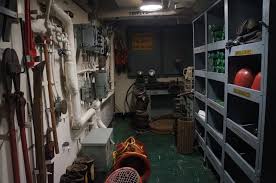
Also located throughout each compartment are smaller teams of sailors (8 or 9 to a team) who also have smaller stashes of firefighting equipment. Also located throughout the entire ship are ‘camels’, stations with connections to the fire main and a couple of hundred feet of fire hose.
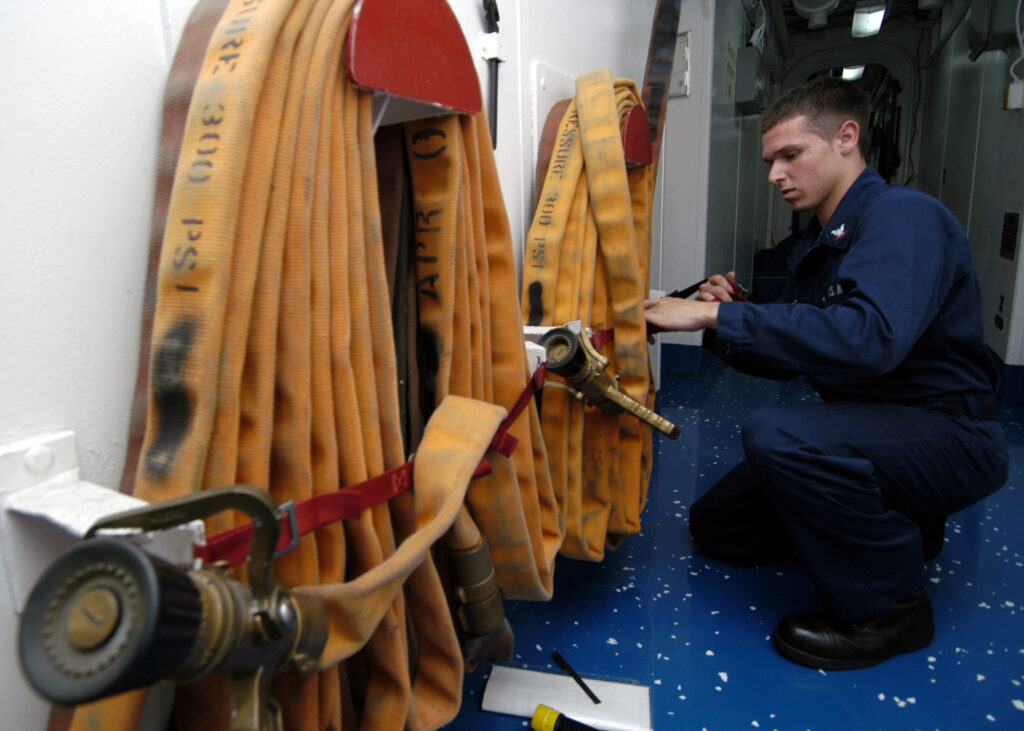
In all, there are about 1,000 sailors on a Nimitz carrier who are assigned to damage control when a ship is at battle stations.
I spent five of my six years in the Navy on a Nimitz class aircraft carrier, the USS Eisenhower. During my first two years on the ship, I was assigned to a small firefighting team located just under the flight deck for my battle station. Then my battle station was moved to the aft hanger deck to be in repair 1A. For my last year or so, I was then assigned to the engineering plant and no longer did damage control. I was also one of the electricians on the Nucleus Fire Party for about two years.
When an aircraft carrier is at sea, they tend to have fires. It’s a huge industrial activity with thousands of tons of explosives, millions of gallons of jet fuel, two nuclear power plants, 50 or 60 aircraft, and literally thousands of ignition sources. As I recall, we would average a fire or two every week while we were at sea. Things like welding, electrical fires, fires in trash cans, and even fires in heat generating spaces like the ship’s laundry, one of the two power plants, and even involving aircraft. It happens.
So that’s the background. Now to what I think may have happened:
A fire could have begun in the laundry. The first indication would be someone reporting smoke. The nucleus fire party would be called out to investigate:
Ringing bell on the announcing system (the “1MC”) then three dings (three dings means in the aft part of the ship) “Ranch hand, ranch hand, ranch hand, away the nucleus fire party. Investigate white smoke in the area of the ship’s laundry. Compartment [Deck]-[Frame]-[Compartment]-[Compartment Use] (e.g., 3-120-3-Q). Use repair 1 alpha.”
The party would locate and begin fighting the fire. At some point, the team recognizes that the fire is beyond their capabilities, and the officer in charge would recommend to the chain of command that the ship go to general quarters. If the Captain concurs, it would sound like this:
At this point, personnel assigned to that repair locker will arrive and take over firefighting from the Nucleus fire party, or would work alongside of them, as determined by the chain of command. The DCA (Damage Control Assistant, a Lt Commander, or O4 who assists the Chief Engineer, who is the ship’s damage control officer) would direct firefighting efforts aided by his staff in Damage Control Central, a control room amidships, located next to the #2 Reactor’s Main Machinery Room. At this point, the repair locker personnel in that area of the ship, plus the nucleus fire party, would have meant about 200 people would be fighting the fire. The area around the laundry is a machinery area: the firefighting materials and supplies in that area are plentiful. It’s below the main deck, so the bulkheads in that area are stout and designed to contain water and fire.
The fire would have been contained fairly quickly, and I remain skeptical of the reports from the MSM, claiming it took more than 30 hours to put out the fire. The USS Forrestal caught fire in 1967, that fire was HUGE, involving the detonation of multiple tons of explosives and hundreds of gallons of jet fuel, and it only took 18 hours to completely extinguish.
I know some of you are likely thinking of the USS Bonhomme Richard, but that was a different animal. It’s a fire that happened in port, the watertight hatches couldn’t be closed because they were blocked by temporary cables and hoses passing through them due to repair work, and most of the crew wasn’t on board. That can’t be compared to a warship steaming in wartime conditions.
The reports I saw of unlivable berthing spaces and sailors sleeping on the floor is likely due to the loss of power to the berthing spaces, caused by damage to electrical cables that passed through the fire area. Naval ships have electrical cables that run through nearly every compartment, up near the overhead. A fire in a compartment can damage those cables, thus cutting off electricity and ventilation to other spaces, even spaces located quite far away from the actual fire. It’s my guess that this is what happened.
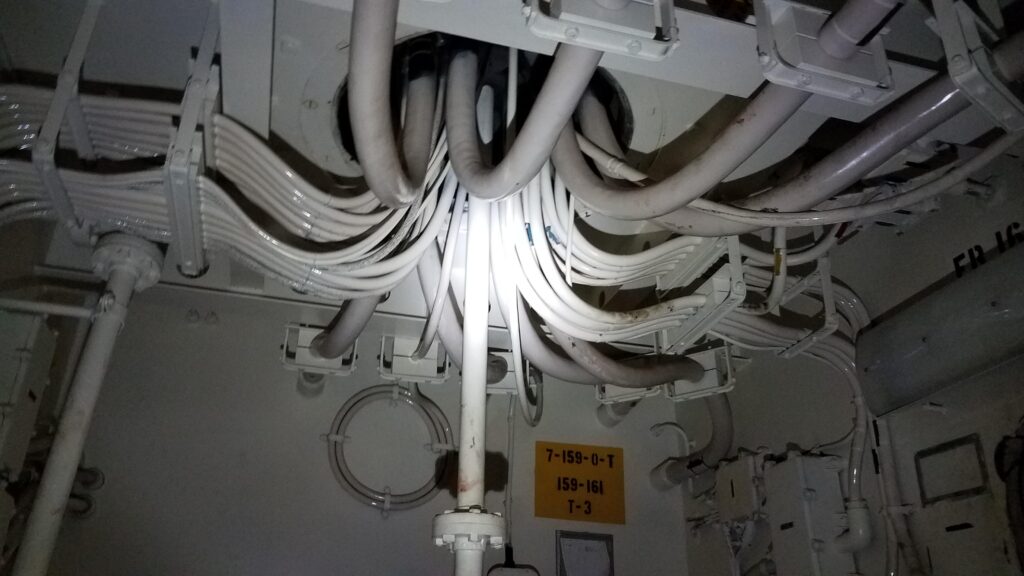
It doesn’t take action by the enemy to cause damage like we saw. This is reinforced in me by the fact that the Ford was in and out of the repair facility in a matter of days. The crew themselves could repair much of this damage themsleves, assuming they had all of the needed parts. When I was a workcenter supervisor, I had a large store of secret parts that were not on my approved list of spares. Any good NCO will tall you that they have resources unknown to the chain of command. I know I had several thousand feet of various sized cables, parts, boxes, clamps, and numerous electrical transformers that had been ‘liberated’ from a storage yard in the shipyard, and that is in addition to the hundreds of tons of parts an aircraft carrier has in official store rooms.
In a case like this, I would have had every electrician pulling cable whenever they weren’t doing anything to further the mission. Much of the damage would have been fixed in a matter of 2 or 3 weeks. When I was aboard, there were over 200 electricians on the ship. That number of skilled electricians can pull a lot of cable within a couple of weeks. I can still draw parts of the ship’s electrical system from memory, because we were required to know that in order to stand certain watch stations.
As an aside, nothing discussed in this post is classified. There are certain cases where some of the things I wanted to share were classified, and those were intentionally left out of the story or even altered slightly in ways that did not materially change the facts or story, so as to protect classified material.
Also, I possess no specific knowledge of what happened onboard the USS Ford, but I am familiar with carrier electrical systems and actually helped to write an SOP for electrical systems damage control and watch standing duties when I was in, but I am certain that those SOPs have changed in the 30 plus years since I served. Still, the general principles are still in place.
0 Comments