I know this post isn’t exactly timely, but it’s something I have wanted to talk about for the past several weeks. This is just the first chance I’ve had to write it all down.
There is a segment of the left that hates President Trump and this nation so much, they want the US to be defeated in every way. That includes the reported fire that reportedly occurred on the USS Ford. They are screaming about how it must have been an Iranian missile, and have come out as experts on Naval warfare, firefighting, and all things military. They are all incorrect. I will discuss the basic damage control for a Navy ship at sea. In port is a different story that is beyond the scope of this post and won’t be discussed.
Every sailor has received some training in boot camp on damage control, but it’s a rudimentary training at best. In smaller ships, a fire will generally cause the captain to put the ship at battle stations so the crew can fight the fire. The same is true on an aircraft carrier, except aircraft carriers are large and there is always a lot going on. When an aircraft carrier goes to battle stations, nearly half of the crew is assigned to damage control, to include firefighting. The ship has too much going on at all times to do this lightly, so for small fires, there is a dedicated fire department that is there to handle smaller incidents and prevent the ship’s crew from having to go to battle stations several times per week.
The capabilities of the ship’s damage control are fairly robust.
The fire party is broken into different areas. There is one segment, crash and salvage (colloquially referred to as ‘crash and smash’) whose job is to fight fires on the flight deck and hanger bay. You will sometimes see them on television and movies wearing “silver suits.” The second segment of the fire party is called the nucleus fire party. That is a team of 23 damage control specialists and 2 electricians whose job it is to fight fires everywhere else on the ship- from the nuclear power plant, to the weapons magazines, berthing spaces, you name it.
There is a sprinkler system on the ship that is capable of releasing firefighting foam or seawater through sprinkler heads in the hanger bay and on the flight deck. When aircraft are aboard, there are men on watch in armored booths whose job is to watch for fires in the hanger. They can close large armored doors remotely and activate those sprinklers as well as sound the alarm if there should be a fire. The ship has more than two dozen fire pumps capable of sending more than 35,000 gallons per minute of seawater into the ship’s fire mains. Magazines have flooding systems that can flood a magazine with seawater to prevent an explosion.
Repair Lockers, aka Damage Control Lockers
If all of that fails, the ship can go to battle stations. One of the things this does is close all watertight doors, separating the ship into ten different watertight compartments. On top of that, each of those watertight compartments has a “repair locker” inside of it. These lockers are actually rooms that are about the size of a large living room in a home, and are filled with firefighting and other damage control equipment, as well as detailed drawings of the locker’s area of responsibility. When the crew is at battle stations, each of those lockers has several dozen crew members assigned to it, commanded by an officer, a chief petty officer, and other enlisted personnel.
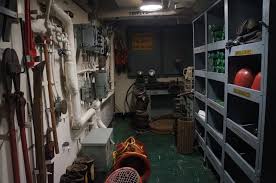
Also located throughout each compartment are smaller teams of sailors (8 or 9 to a team) who also have smaller stashes of firefighting equipment. Also located throughout the entire ship are ‘camels’, stations with connections to the fire main and a couple of hundred feet of fire hose.
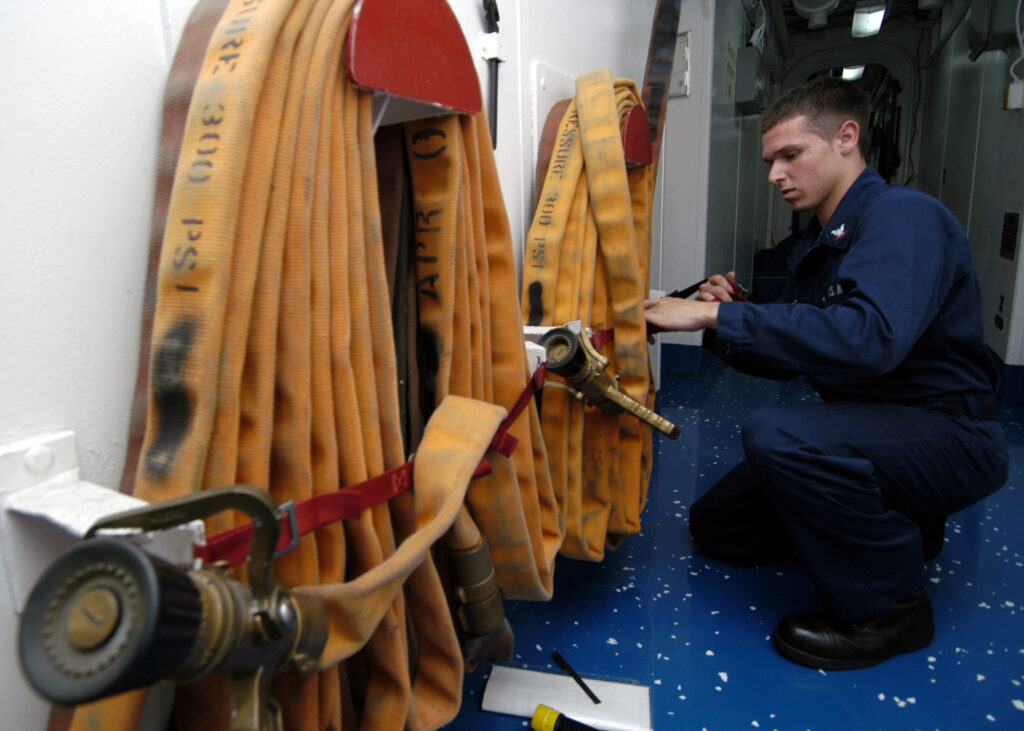
In all, there are about 1,000 sailors on a Nimitz carrier who are assigned to damage control when a ship is at battle stations.
I spent five of my six years in the Navy on a Nimitz class aircraft carrier, the USS Eisenhower. During my first two years on the ship, I was assigned to a small firefighting team located just under the flight deck for my battle station. Then my battle station was moved to the aft hanger deck to be in repair 1A. For my last year or so, I was then assigned to the engineering plant and no longer did damage control. I was also one of the electricians on the Nucleus Fire Party for about two years.
When an aircraft carrier is at sea, they tend to have fires. It’s a huge industrial activity with thousands of tons of explosives, millions of gallons of jet fuel, two nuclear power plants, 50 or 60 aircraft, and literally thousands of ignition sources. As I recall, we would average a fire or two every week while we were at sea. Things like welding, electrical fires, fires in trash cans, and even fires in heat generating spaces like the ship’s laundry, one of the two power plants, and even involving aircraft. It happens.
So that’s the background. Now to what I think may have happened:
A fire could have begun in the laundry. The first indication would be someone reporting smoke. The nucleus fire party would be called out to investigate:
Ringing bell on the announcing system (the “1MC”) then three dings (three dings means in the aft part of the ship) “Ranch hand, ranch hand, ranch hand, away the nucleus fire party. Investigate white smoke in the area of the ship’s laundry. Compartment [Deck]-[Frame]-[Compartment]-[Compartment Use] (e.g., 3-120-3-Q). Use repair 1 alpha.”
The party would locate and begin fighting the fire. At some point, the team recognizes that the fire is beyond their capabilities, and the officer in charge would recommend to the chain of command that the ship go to general quarters. If the Captain concurs, it would sound like this:
At this point, personnel assigned to that repair locker will arrive and take over firefighting from the Nucleus fire party, or would work alongside of them, as determined by the chain of command. The DCA (Damage Control Assistant, a Lt Commander, or O4 who assists the Chief Engineer, who is the ship’s damage control officer) would direct firefighting efforts aided by his staff in Damage Control Central, a control room amidships, located next to the #2 Reactor’s Main Machinery Room. At this point, the repair locker personnel in that area of the ship, plus the nucleus fire party, would have meant about 200 people would be fighting the fire. The area around the laundry is a machinery area: the firefighting materials and supplies in that area are plentiful. It’s below the main deck, so the bulkheads in that area are stout and designed to contain water and fire.
The fire would have been contained fairly quickly, and I remain skeptical of the reports from the MSM, claiming it took more than 30 hours to put out the fire. The USS Forrestal caught fire in 1967, that fire was HUGE, involving the detonation of multiple tons of explosives and hundreds of gallons of jet fuel, and it only took 18 hours to completely extinguish.
I know some of you are likely thinking of the USS Bonhomme Richard, but that was a different animal. It’s a fire that happened in port, the watertight hatches couldn’t be closed because they were blocked by temporary cables and hoses passing through them due to repair work, and most of the crew wasn’t on board. That can’t be compared to a warship steaming in wartime conditions.
The reports I saw of unlivable berthing spaces and sailors sleeping on the floor is likely due to the loss of power to the berthing spaces, caused by damage to electrical cables that passed through the fire area. Naval ships have electrical cables that run through nearly every compartment, up near the overhead. A fire in a compartment can damage those cables, thus cutting off electricity and ventilation to other spaces, even spaces located quite far away from the actual fire. It’s my guess that this is what happened.
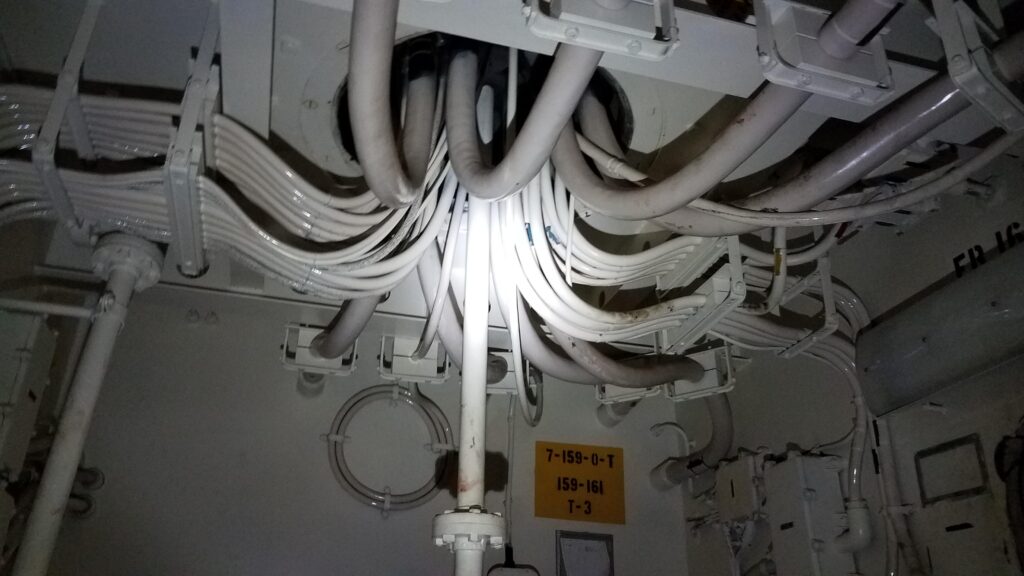
It doesn’t take action by the enemy to cause damage like we saw. This is reinforced in me by the fact that the Ford was in and out of the repair facility in a matter of days. The crew themselves could repair much of this damage themsleves, assuming they had all of the needed parts. When I was a workcenter supervisor, I had a large store of secret parts that were not on my approved list of spares. Any good NCO will tall you that they have resources unknown to the chain of command. I know I had several thousand feet of various sized cables, parts, boxes, clamps, and numerous electrical transformers that had been ‘liberated’ from a storage yard in the shipyard, and that is in addition to the hundreds of tons of parts an aircraft carrier has in official store rooms.
In a case like this, I would have had every electrician pulling cable whenever they weren’t doing anything to further the mission. Much of the damage would have been fixed in a matter of 2 or 3 weeks. When I was aboard, there were over 200 electricians on the ship. That number of skilled electricians can pull a lot of cable within a couple of weeks. I can still draw parts of the ship’s electrical system from memory, because we were required to know that in order to stand certain watch stations.
As an aside, nothing discussed in this post is classified. There are certain cases where some of the things I wanted to share were classified, and those were intentionally left out of the story or even altered slightly in ways that did not materially change the facts or story, so as to protect classified material.
Also, I possess no specific knowledge of what happened onboard the USS Ford, but I am familiar with carrier electrical systems and actually helped to write an SOP for electrical systems damage control and watch standing duties when I was in, but I am certain that those SOPs have changed in the 30 plus years since I served. Still, the general principles are still in place.
14 Comments
Anon · April 8, 2026 at 2:35 pm
Cool – were you a nuke EM? I was on the Enterprise way back when (nuke class 8005) and this brings back a lot of memories.
lynn · April 8, 2026 at 3:39 pm
I shudder to think of an aircraft carrier on fire with around 4,000 people below the deck.
Michael · April 8, 2026 at 8:21 pm
Excellent information, some of which my Uncle Paul used to tell me about with non-nuke Carriers during Vietnam. Damage control was something American Carriers had in Spades during WW2.
However, is the Ford still out of action? They say something about its fully operational but SNIP
The USS Gerald R. Ford (CVN 78) arrived at Naval Support Activity Souda Bay, March 23, 2026, for maintenance and repairs after operating in the Red Sea. The aircraft carrier remains fully mission capable.
SNIP Souda Bay
Bay of Crete, Greece
SNIP The distance from Souda Bay, Crete, Greece to Iran is approximately 2,100 to 2,400 kilometers.
I’ve heard this sort of boilerplate many times in my 2+ decades in the military and it isn’t quite as it sounds for real life. I remember during the 70’s when the US Army Germany had serious drug issues, we issued such statements even though I was quite aware that more than half our M60 tanks were motor pool queens and we were rotating crews and repainting turret numbers on them daily for East German observers to count.
What’s your thoughts?
Divemedic · April 9, 2026 at 5:10 am
The Ford left Croatia after 5 days.
https://www.navy.mil/Press-Office/News-Stories/display-news/Article/4450761/uss-gerald-r-ford-departs-split-croatia/
Bear in Indy · April 9, 2026 at 12:51 am
Thank you. My dad was trained as a firefighter in the Navy, during WW2. After the war, he was a volunteer firefighter for 30 years in our small community. As a Seabee, on transport ships in the south Pacific, I am sure there were many “problems” that confined spaces porvided for potential fires.
Thank you for the insight, means a lot to me to understand how complex ships are.
Bear in Indy
Exile1981 · April 9, 2026 at 6:36 am
30 hours may not be untrue depending on jow its reported. At our plant if a fire is extinguished we report the time from call out till no hot spots. A fire watch is kept after its extinguished to ensure no flare ups or hot spots reigniting, so 30hrs could include that time.
Divemedic · April 9, 2026 at 6:56 am
The Navy has a standardized reporting system for that sort of thing. It doesn’t vary from ship to ship.
mike fink · April 9, 2026 at 8:00 am
I think it is an error to judge the current navy against the navy of 30 years ago or WW2. This simple fact is that all of our military institutions have been radically reformed for the worse to suit political objectives, and as if that were not enough, we have the destructive influence of the Military/Industrial/Congressional Complex driving disastrous policy but milking trillions for the corrupt creatures running the system. I support this view with 2 examples, though there are plenty more. Surface Warfare officers used to undergo many hours of underway training in Yard Patrol Craft. This was phased out in favor of simulators to save money. The results in recent years has been a navy that has a poor record of frequently running into other ships. The breakdown in traditional crew training and discipline also plays a large role in that particular problem, and the confluence of lowered standards and training cutbacks can be a lethal one. Sailors not keeping watch or alerting pending collisions and female deck officers on the bridge and CIC not speaking because of “boy problems” leads to a surface contact on a collision course not being reported and no warning sounded before a lethal collision. The inquiry let the guilty parties off with a slap on the wrist instead of jail time. That is your modern US Navy in a nutshell.
The Ford fire in the Red Sea exposes at least one problem and possibly many. The fact is the passage through the Suez Canal and through the Red Sea was to reposition to a more tactically advantageous spot in wartime. That she had to turn around and leave the war zone over a laundry fire can be nothing else but an epic failure of the ship as a combat system. The 30 hour fire reports are widely spread, and to my knowledge the War Department has not contested that report or issued a different timeline. Even if the fire did not last that long, our best modern carrier still was put out of action by a fire in a crew comfort system. I assert that if it had been an ordinance accident on par with the Forrestal, the Ford would have been a complete loss. I have personally witnessed USN BDC in action on a few occasions in the last 15 years and the results have been disgraceful spectacles of cowardice and incompetence in every instance.
The technical issues with the waste disposal plumbing are real enough and speak to a lack of maintenance due to the extended deployment and/or a poor design. There is no doubt that foreign objects were introduced on multiple occasions as sabotage to compound the problem. Given the extent of that activity, the ongoing NCIS investigation of same, and the fire immediately following, it is fair to suppose that crew firefighting efforts were unacceptably slow due to poor training or even a desire to put the ship out of action. So what we have here is a $13 billion dollar ship that cannot meet its wartime mission because;
-It is poorly designed and can be put out of action by what should be a small fire.
-The crew is incompetent at BDC.
-Crew moral and performance was so low that they had become more of a risk to the ship than enemy action and were withdrawn from deployment.
All 3 of these things can be true at the same time. I will finish by saying that Iran claimed in a roundabout way that IRGC personnel operating out of Yemen hit this ship with some kind of advanced ordinance. No damage was evident when she pulled into Crete, including the open area near the fantail. FWIW, Colonel MacGregor’s son was formerly a USN officer and maintains personal contacts with serving USN personnel, which are sourced from time to time for the Colonel’s and others insights into what is happening in the fleet. This line of information was cited as saying the Ford most certainly was hit by hostile fire in the Red Sea in the area of the open fantail, which just happens to be in the area of the laundry fire.
Divemedic · April 9, 2026 at 8:42 am
I don’t think there is enough data to support any of your assertions. I understand that ship maintenance and training have slipped a bit over the years, and I have posted about that on this very blog, but training in damage control costs the Navy absolutely nothing. I just don’t see it slipping that badly. Unless there is evidence of that, I remain unconvinced.
As to theories about the ship taking a hit:
Let’s talk ship contruction:
The open area of the fantail is the jet engine shop, which is located on the first deck directly aft of the hanger bay. That’s where technicians repair the jet engines installed on the ship’s embarked aircraft. The ship’s laundry is 20 feet below the waterline on the sixth deck at frame 215, which is about about 160 feet further forward than the fantail. (In case you are wondering, the compartment is 6-215-1-Q My berthing compartment, the place where I lived for five years, was on the second deck, directly below that jet engine shop. Located below that on the third and fourth decks are the ship’s steering gear. Those steering gear rooms are vital to ship operation, and she couldn’t maneuver without them. For that reason, those areas of the ship are armored with fairly thick walls, and those are in turn surrounded by void compartments that are designed to be blown up. I spent a year standing watch in those steering gear rooms as the aft steering gear electrician.
If “in the area of the laundry” means 6 decks down and 160 feet forward, behind three armored decks and multiple compartments and machinery spaces, then I guess.
Yemen doesn’t have the technical capability to hit a carrier below the waterline using a torpedo. That leaves a missile. Yemen has been using ballistic missiles, which would fly in a ballistic arc- in other words, it would be falling in a parabolic arc from above. In order to hit the laundry, a missile hitting the jet engine shop would have enough power to make a huge, noticeable hole in the back of the ship that extends through 4 decks and blows off the aft 200 feet of the ship, which would make it impossible for the ship to make it to Croatia, let alone do it without damage visible from the outside.
When I was in the navy, the National Enquirer ran a story with photos of UFO’s parked on the Eisenhower’s flight deck. This is about as accurate as that story was.
J J · April 9, 2026 at 9:52 am
Unless you’ve served on A USN warship it’s difficult to understand the depth of organization and training involved in damage control. For submariners damage control was literally life and death, all of our usual bullshit and levity disappeared when that training was going on.
Additionally, even “sources who have sources” within the USN most likely don’t have direct knowledge of everything that happens in the fleet. As a radioman, I had direct knowledge of things that the scuttlebutt was from mildly to completely wrong about.
Mike Fink · April 9, 2026 at 11:31 am
The hostile action could very well be false. I have not concluded that it is true, only that there are people reporting it as such. It is not safe to assume we know anything at all about what Iran and her allies in the region have in the way of capability, and the bombastic reports out of the Pentagon about their alleged accomplishments that are demonstrated to be incorrect weeks later do not lend credibility to what they say the enemy can and cannot do. Our opponents in the Red Sea held of the USN and allied warships for 7 months in the previous round of fighting. The USN ultimately left the area without forcing the enemy to yield or open the Bab-el-Mandeb until Israel had agreed to a wider ceasefire.
The undeniable fact here remains that this Supercarrier was ordered to transit out of her wartime station in the Med and reposition to the Arabian Sea by way of the Red Sea. That she had to turn around a couple of days later and pass back through the Suez Canal for repairs to a minor shipboard system does not spell mission accomplished no matter which way you want to cut it. The best thing you can say about it is that the ship suffers from a bad design that inhibits crew fire fighting.
My personal anecdotes of the modern navy are just that, but they suggest a widespread problem of training priorities and leadership failure. We have a rainbow flag navy now that puts highest priority on sexual identity celebrations and DEI indoctrination under the guise of essential training, and it comes at the expense of core mission skills. Hegseth has not completely eradicated that in the last year nor mitigated the effects of same within the institution.
This fleet is full of expensive and ineffective warships that cannot survive in modern battle except to project power ashore against weak opponents. There has not been a successful new class of warship introduced in a couple of decades at the very least, and the poor condition of the active fleet is plain to see for anyone watching them come and go from port. The squadron of LCS hulls that were stationed in Bahrain at our now smoking ruin of 5th Fleet HQ were all transited out of the Persian Gulf ahead of hostilities and left the theatre by way of the Strait of Malacca to come home and be scrapped years ahead of schedule. What does that say about our war planners? What does that say about the LCS program and ship procurement in general? What does that say about the prospect of the US Navy forcing the Strait of Hormuz open? If you want to know what the merchant mariners of the world think of US Navy seamanship, go look up some of the threads on GCaptain relating to the multiple peacetime collision events like the one I mentioned. American greyhulls are regarded as a positive menace by real professional seamen whatever their nationality.
You obviously have some relevant personal experience in this subject matter, and you should be proud of that. I think you said it was 30 years ago though, and anything before the Obama Era is too far back to be taken as an absolute template for what the current navy is doing and the state of readiness, training, morale, and culture at this point in time. I gave up my dream job with the Navy and turned in my CAC card in 2021 because the President and then SecDef mandated the Covid Jabs. I left rather than take them and I was the only one in my command who refused. My decade of working with Navy sailors, officers, and civilian personnel of all ranks exposed me to the dysfunctional current state of that service on a daily basis. I was an Infantry officer in the Army through the 1980’s, so I know the difference between a functional military organization and a uniformed jobs and social engineering clownshow.
Divemedic · April 9, 2026 at 12:08 pm
Occam’s Razor. What is more likely:
1 Yemen possesses some new super weapon that is able to damage a warship so severely that it cannot accomplish its mission, but leaves no visible trace of damage, and not only that, has never been seen or used by any other nation, and that they haven’t used on the other carrier in the region, or
2 A ship, deployed too long, had a fire in the ship’s laundry, and that fire made living on the ship difficult because no one could do their laundry.
If you wanted to tell me that a crewmember set the fire deliberately because he was tired of being deployed, I could believe that. But a Yemeni superweapon? Also, the video above of the firefighting drill is from 8 years ago. It looks nearly identical to the drills we did when I was in the Navy. The only real difference is they are using SCBA now instead of OBAs, which is an improvement as far as I am concerned.
mike fink · April 9, 2026 at 1:05 pm
I mentioned the rumor of the Ford being his as something that had been making the rounds. I indicated very clearly when I said it that The Ford did not have and evident damage when she arrived at Crete. I also said more than once that I have not been
persuaded that the rumor had any merit. I’m not sure why you insist on making that piece of information the centerpiece of my observations (it is not), yet here we are.
Frankly, as I have also previously stated, the Ford leaving her wartime assignment is an operational failure under any set of circumstance you care to view it in. Leaving a combat station for a minor systems fire and crew comfort considerations does not spell naval supremacy. The proof of that is Hormuz was closed, remains closed, and the USN has no capacity to open it. If they did they would have done so and not loitered around south of Oman. The Ford and the other carriers are obsolete and cannot add very much to an already ineffective air campaign anyway. So let her come home. I predict her 14 months of projected repairs leads directly to 24 months and eventually the scrapyard. I know an embarked LCDR on the Ford, just an acquaintance really, but I will see what he is willing to discuss when they get back.
Divemedic · April 9, 2026 at 2:34 pm
OK. I’ve spent enough time on this. Believe what you want.
Comments are closed.