“General Li, I want to assure you that the American government is stable and everything is going to be okay,” Milley said. “We are not going to attack or conduct any kinetic operations against you.”
“General Li, you and I have known each other for now five years,” Milley added. “If we’re going to attack, I’m going to call you ahead of time. It’s not going to be a surprise.”
A big shoutout to our APD Bomb Squad. These officers bring a level of training, expertise, and steady nerves that most people never see. Handling 80-year-old explosives with unknown stability is dangerous, precise work, and they do it with the professionalism this city counts on. The devices were safely seized and removed
Cops cordoned off the area “to protect residents.” The grenades were in a cardboard box in some old person’s garage for 80 years. The cops want you to believe it took bravery and skill to dispose of them. Spare me the drama.
A little digging will get you the missing fact that will boil your blood. He is an illegal immigrant from Mexico. According to the federal sources, he illegally crossed into the United States in December 1999. He was granted Deferred Action for Childhood Arrivals by the Obama administration in 2014. The Biden administration extended it in 2024.
Shortly after 2:30 p.m., as the victim was walking to his car through a tunnel near the school, investigators said a 16-year-old struck him. Eight other students joined the attack, repeatedly punching the victim in the face and head. Disturbing cellphone footage of the assault showed several students punching the victim while voices in the background shout… The victim’s mother took him to a hospital, where he received 11 stitches to close wounds to his face.
Investigators said the cellphone video of the attack helped deputies identify all nine suspects. Working with Harmony High School staff, deputies arrested the students at the school Wednesday. Two 18-year-olds, Quianelle Antonio Reyes-Cintron and Brian Alexander Ramirez, were booked into the Osceola County Jail. The seven juvenile suspects were transported to the Juvenile Assessment Center.
To me, the only valid punishment is:
Jail for the adults, and juvenile detention for the ones under 18 years old.
Expulsion for the attackers and for the ones recording the attack.
Five days suspension for anyone who was caught on video cheering on and encouraging the attack.
Our schools have gotten more violent than some prisons. Students shouldn’t be forced to accept being victims of assault in order to attend school. On another note, when I was that age, it made you a pussy to need help in a fight. You fought one on one, like a man. Not gang attacks because you were too much of a pussy to fight on your own.
Smith wielded the country’s most powerful law enforcement tools to nab data on Trump supporters who purchased MAGA hats, including their shipping addresses.
Smith’s sweep — though ostensibly focused on the events of January 6, 2020 — captured data back to 2005.
The documents suggest that Smith sought to ensnare the information of thousands of everyday Republicans, effectively treating them like parties to a criminal conspiracy due to their party affiliation.
All of that data is still on file somewhere. Your guess is as good as mine when it comes to figuring out what all of that data is going to be used for.
On a side note: Most of my posts are written the night before, and scheduled to post the next day, with the first one of the day posting around 3am, Eastern time. This one is a live post, that is, I posted it as soon as I wrote it.
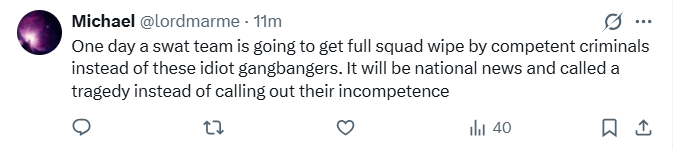
Some serious incompetence here. This video is from a SWAT service of a search warrant June 2, 2026.
Atlantic City SWAT officers came under fire after breaching a door, leaving two officers wounded, one critically. Sharing this video, not as criticism, but as a reminder to those active and/or who train others, to never stop learning, training, and improving. pic.twitter.com/9shhzu5Orq
So they are approaching a house where they KNOW there is no element of surprise. The armed criminal KNOWS you are there and are about to come knocking.
There was a cop who was standing right in front of the window (he was the one with the shield and crossed in front of the cop with the bodycam just before the breach). He should have seen the shooter who was covering the door. What the hell was he doing, if not covering that window and whatever was behind it?
They call the doorway a “fatal funnel” for a reason. Both of the two cops who were shot and wounded in this video were standing in the middle of the door.
The cop who kicked the door in, did so while the one with the hydraulic ram was still on his knees in the middle of the door. In that position, the entry team can’t enter because the ram guy was in the way, and the outgoing fire is almost guaranteed to hit him. Stupid.
As they approached, you hear cops say: “The front door is open. Oh, he just shut it.”
This is a group of cops who have little experience making entries. “Oooh, we have special tactical uniforms and cool looking guns. That will scare everyone into compliance.”
The best comment was this one:
What happened was every cop there was hyper-focused on the door and breaching activity. No one was watching the backs of the entry team. This is incompetence and complete stupidity. Atlantic City PD has 300 officers for a city with a population of 39,000. Now you know that their SWAT operation is lacking in the training department.
I am beginning to suspect that this is the case for a majority of US police departments. It’s become trendy for police departments to have fully kitted out SWAT teams, but I suspect the vast majority of them don’t have the training to be effective against anything more than grandmothers, soccer moms, and the occasional gang banger whose homes they raid.
I was never on the SWAT team, but I did train with them and did go to the SWAT Round-Up International hosted in Orlando once. As a purely supporting role as a medic. I was never a member of any entry team. Still, I did attend some training, and this team looks like a bunch of amateurs trying to COSPLAY as operators operating operationally in support of operations.
There is a huge effort by Federal agencies to create and maintain a list of Americans who are enemies of the revolution. The post office is keeping a list. All they have to do is see who you get mail from. The NRA? Second Amendment Foundation? Conservative fundraising? Think about the mail you get, and ask if someone could determine your political leanings by looking at your correspondence. It’s basic traffic analysis.
After all, a sitting member of Congress is the one who suggested that the government keep an “enemies list” so they can be confronted. Even the media joined in, including the “conservative blogger” who works for the Washington Post:
Any R now promoting rejection of an election or calling to not to follow the will of voters or making baseless allegations of fraud should never serve in office, join a corporate board, find a faculty position or be accepted into "polite" society. We have a list.
1. Lists of people interacting with Trump’s Twitter account—2023. Smith’s office obtained a warrant requiring Twitter to disclose account interactions from October 2020 through January 2021. It expressly sought lists of users who followed, unfollowed, muted, blocked, or otherwise took specified actions toward Trump’s account. Reporting on the released warrant also identifies demands for lists of people who liked or retweeted his posts. This is a close parallel: investigators sought identifiable groups connected to Trump’s online activity.
2. Bank searches using “Trump” and “MAGA”—January–February 2021. FinCEN shared methods with banks for reviewing transactions, including payment-message searches containing those political terms. Treasury’s February 2024 response acknowledged the terms but said they were intended to be considered alongside other suspicious-activity indicators.
3. Bank of America’s customer list supplied to the FBI—2021. According to testimony reproduced in the House report, Bank of America supplied names of customers who used its cards in the Washington region January 5–7, 2021, with firearm-purchase information used to prioritize names. The FBI circulated information to field offices.
Separately, the FEC maintains searchable political-donor records, including Trump donors, under disclosure requirements applying across parties. Those are public campaign-finance records, a different category from investigative collection.
Now combine that with the location data that is being compiled by a nationwide network of Flock cameras.
These lists are going to eventually be used- whether officially, unofficially, or simply abused by those who have access. We’ve already seen some so-called “rogue cops” who are using them to stalk former and current lovers as well as targeting enemies. Make sure that you have robust contact with others who may be on the list. Once prominent people on the list begin to disappear, you will know that the lists are being used.
It is a sure sign of a dictatorship when there are mass arrests and disappearances. The Soviets even had a word for it- “vzyali” meaning “they have taken,” and there was no pronoun or noun needed to indicate who “they” were- “they” were unspeakable. They were feared. It was never “arrestovani” or arrested, because there were no charges and no trial. They simply disappeared. Vzyali was a word that struck fear in the hearts of Soviet citizens.
The people who were vzyali were never put in jail. They weren’t executed, for the most part. No, they were put into camps where they were forced to work themselves to death. Read about the eight most evil gulags at this page, and remember that all communists wind up using their lists for this purpose.
The Broward county sheriff built a $75 million gymnasium for his cops to use. The commissioners of the county want to investigate the expenditures, and voted 7-0 to open the facility up for inspection. The Sheriff is refusing, claiming it could endanger undercover officers who may be working out at the facility.
In response to the Broward Commissions 7-0 vote this morning to seek any legal means to force Sheriff Tony to open op his $75 million gym to the public for inspection, Sheriff Tony promises to mobilize all 67 sheriffs in the state to fight it all the way to the Supreme Court.… pic.twitter.com/87hITm8vgB
This is the ridiculous bullshit the cops always pull out-
“Oh, we are undercover, and there are criminals out there who are targeting us. That’s why we need money and nationwide weapons permits. You never know, some meter maid from Oregon might be on vacation at Disney with her family, and some criminal will attack them, which is why we need LEOSA.”
What this really is, is more of the same old, same old: government wasting your tax money to set themselves up as some sort of potentates who are living large on your dime. I don’t care if it’s cops, firemen, or the town clerk. There is no evidence of any criminals hunting down and attacking police officers, other than a few cases of Mafia members targeting FBI agents. Some cop from Bugtussle, Arkansas has no greater risk of being stalked and attacked by criminals than does anyone else in the public.
Still, there is one lever left to the county commission- cut off all or some funding of the Sheriff’s office until he permits the requested investigation.
In the meantime, I will vote to do the same, by voting for Amendment 3.
I’ve long said the Civil War of the 1860’s was not about slavery. At its core, that war was about the North pillaging the wealth of the Southern states. Profits were being secured by having the southern states nearly completely fund the federal government, and those same states were forced by tariffs into captive consumers of union manufactured goods. Protectionism at its most brutal.
Lol, Woman brings in family heirloom from the civil war which they think is a slaves bracelet, turns out to be a dog collar. Even better? Slave bracelets never existed.
The look on her face at the end is pretty close to priceless. This is on the list of never not being funny. pic.twitter.com/I936IJX1Ub
The Tariff of 1828, which included very high duties on raw materials, raised the average tariff on imported goods to 45 percent. The Mid-Atlantic states were the biggest supporters of the new tariff. Southerners, who imported all of their industrial products, strongly opposed this tariff.
The tariff was nominally created to repay the debts incurred after the War of 1812. This wasn’t actually the case. By 1832 the national debt was paid and there was no reason for this tariff. What actually happened was that the tariff created a favorable situation for the North, who benefited greatly from such high taxes at the expense of the South. Since the Southern states didn’t produce manufactured goods, they were forced to buy those goods from either Europe or the Northern states. Since the South also needed to sell their agricultural goods in Europe, this created a situation where the Southern states were paying roughly 75% of all American taxes.
The Southern states just didn’t want to pay the tariffs, and began refusing to do so. (This idea of “State nullification” of Federal laws that states didn’t feel were constitutional was first advanced by Thomas Jefferson and James Madison.) The states, led by South Carolina, declared the tariff null and void, and simply refused to pay.
So in 1833, the “Force Bill” was passed, allowing the president to use whatever force he deemed necessary, including the military, to collect taxes owed by the Southern states. Along came Lincoln, who campaigned on a platform of putting the tariffs back in place so that his sponsors could again enjoy the profits that the protectionist scheme caused.
Then it came to pass that in 1861, a new tax was passed, the Morrill Tariff. This tariff was the highest tax in American history to that point, and taxed imports at over 45%, with imported iron products taxed at 50%. This forced the South to buy northern iron products from the North at whatever prices the North wanted to charge. Victorious Republicans cheered the heavy taxes that benefitted the Northern industrialists who had backed Lincoln’s campaign.
The South announced that it no longer wanted to be a part of a union where they would be robbed in order to make northern businessmen wealthy. They seceded. The north still enforced the tariffs using military force.
Draw your own parallels as you realize the Union states were nothing more than thieves who were using the power of the Federal government and an Army as a means of stealing the wealth of others. No different from the DSA party movement of today.