Extortion

In Central Florida, traffic can be horrendous, especially near the tourist areas. The key to avoiding this is to use one of the many toll charging expressways. The money that you spend in tolls is usually made up by less fuel consumption, and fewer frazzled nerves.

Florida has installed a statewide toll system, where you purchase a transponder to put in your car, and the toll is paid as you drive by the toll booth. This is a convenience for the driver, and a money saver for the state, as the system requires fewer toll booth operators. The system is called SunPass.

With the SunPass system, you set up an account, tell it which transponders are yours, and you prepay your tools by purchasing credits in $10 increments. You can do it with cash, or program it to place a predetermined amount of money in there, and charge it to a credit card. I have one, and it is convenient to not have to stop and wait at the toll booth every few miles.

Good idea, right? Until politics get involved. You see, Orange County figured out that they can get more cash if they cut the state out of the action, so they established the Orange County Expressway Authority. This authority has their own automated toll system, called EPass. An Epass transponder is supposed to allow you access to the SunPass system roads, and vice-versa.

Note that I said “supposed to.” Yesterday, I got a letter from the EPass with a picture of my car, and a letter telling me that they have recorded 8 instances in the last two months where I passed through, and the system failed to recognize the transponder. The letter went on to say that the authority “may” issue me a citation for EACH time I failed to pay the toll. I immediately called the number on the letter.

This is what I was told, and what makes this so incredible:
The two systems are not always good at compatibility, and if the systems fails to communicate, it fails to pay the toll correctly. However, it is still the driver’s fault that the system didn’t pay the toll, hence the ticket.

1 On what planet does a known flaw with a provider’s equipment remain the problem of the customer?
2 There is no way for the driver to know that the toll wasn’t paid at the time of the failure. My first indication was the letter.

Nice racket, government. All of the money, none of the legal responsibility.
Boy

Robb talks about having to put down his cat, which reminds me of my own experience. I am not a “cat person,” or at least I wasn’t until about 9 years ago. That was when my (now) ex-wife brought home a seven year old cat that she rescued from the shelter. Not being a cat person, I largely ignored him. I wouldn’t even name him, I just called him boy cat. That was when he decided that I was to be his human.
Over the next eight years, that cat was a constant companion: he would nap with me on the couch, he would sit on my desk as I worked or surfed the internet, he would follow me around the house. He loved food, and and became so fat that his belly would sway to and fro when he ran. He used to sit on my chest while I laid on the couch, and he would tap me on the chin each time he wanted a treat, and I obligingly gave him one. He was a sweet, loving animal. He was my friend. Eventually, boy cat became Mr. Boy, and that was his name.
Four years after we got him, he began vomiting. A lot. The vet couldn’t find anything wrong. He ruined several pieces of furniture. After a year or so of this, the vomiting stopped and we thought he was getting better. Then he began losing weight. He became rail thin.
Then came the day, last fall, that the diarrhea began. It became more and more frequent. His teeth began breaking. Then, one morning, I couldn’t get him to stand, he was weak. He just laid there, looking at me, so weak that he couldn’t even raise his head.
We took him to the vet, and the diagnosis was cancer. We had to put him down.

That was last September, and I still get teary eyed when I think about him. I miss my friend.

Logical disconnect

I just got in an argument on the Huffington post site with an anti-gunner. This is how it went:

Guns should be illegal.

Me: “Because that has worked so well with drugs.”

Banner:  “People are cooking drugs in their home kitchens. Know anyone
manufacturing guns? If they would legalize drugs they could take the
money out of it, regulate it, tax it and diminish the criminal element
connected to it. Worked with alcohol. Guns are different.”

 Few people make their own guns because guns are legal, and it is cheaper in terms of knowledge and cash to buy it commercially. The same argument you use for drugs. If people want something and are willing to pay for it, they will get it because someone will provide it. Make a product illegal and the only people who will get that product are, by definition, criminals. How are guns different from any other product?
Making guns illegal would simply result in a black market of guns.
As to your comment about no one manufacturing guns: Here is a 3D printable one, and here is a weapons factory in Pakistan where everything from antiaircraft guns, to machine guns, to pen guns are made by hand.

Promises

I thought it would be nice to revisit the Obama campaign promises, and see how he is doing after four and a half years:
1 Close Guantanamo Bay within one year. Status: Broken. It’s still open. In fact, many detainees have been cleared to go home, but Obama won’t release them.
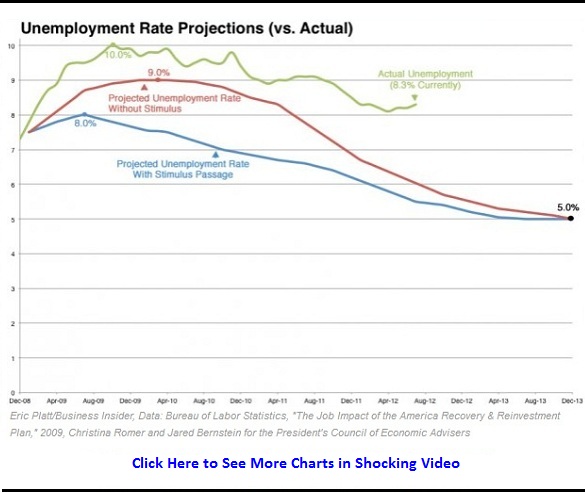
2 Create or save 1 million jobs using $25 billion in Federal Funds. Status: Fail. This picture says it all.

3 All troops out of Iraq within 16 months. Status: Broken. There are still 3,000 troops in Iraq. (Even though most people believe that the troops left nearly two years ago, hundreds of special forces remained, and last September, after Congress cut of funding for those troops, Obama sent troops there to “keep an eye on Syria.”
4. Create secure borders. Status: Broken. He is actually working to open the border and grant amnesty.
5. Reform government spending. FAIL. He increased the debt by $5.8 trillion during his first term. That’s more than all Presidents from Washington through Clinton, and more even than GW Bush- the guy that the Democrats slammed for excessive spending.
6. End torture: Status: Broken.
7. Require new hires to deny cronyism. Status: DO I REALLY have to point this one out?
8. Deliver weekly fireside chats online Status: Broken. He only held a few, and then only when there was something he wanted. The last one was in February and talked about gun control.
9. Toughen hate crime laws Status: Broken, also see the next one:
10. Remove discriminatory obstacles to voting. Status: a twofer with the Black Panther case
11. Lift ban on gays serving openly in the military Status: Kept. He lifted “Don’t ask, don’t tell” in 2011.
12. Penalize vote fraud. Status: Broken, but the voter fraud was all in his favor, so why should he?
13. End American dependence on foreign oil in ten years Status:
with his ban on Gulf oil drilling, I don’t see this happening. We are
more dependent on foreign oil than we were 5 years ago.
14 Ban executive employees from taking gifts from lobbyists. BROKEN.
15 But I can promise you this: I will always tell you what I think and where I stand. Need I say more?
16 Post bills online 72 hours before signing them Status: Congress doesn’t even read bills before Obama signs them
17 Increase minimum wage every year Status: Broken. Although I oppose minimum wage laws, I want to point out that minimum wage increased twice during the George W Bush Presidency, and once during the Obama administration.
 18 Ensure taxes don’t go up for families with incomes lower than $250,000 Status: Broken
19 Cut taxes on the middle class Status: Broken
20 Defend Israel Status: Broken
21  Remember when he said that he was not going to push for gun control?

For you who voted for Obama- Is this what you voted for?

Most Dangerous

The top 25 most dangerous neighborhoods in America. Detroit has four of them, including the top three. Chicago claims the fourth most dangerous. Together, Michigan and Illinois contain 11 of the 25 worst neighborhoods.

Houston has two, Memphis has two, and just across the river, West Memphis has one. St Louis has two, Indianapolis has two, and the remaining 25 are rounded out with cities that have one each: Tulsa; Flint, and Saginaw, MI; Atlanta; Nashville; Greenville; and  Spartanberg.

Minimum wage again

The Obama administration is talking about a minimum wage hike. The one that has been proposed is a hike to $10.10 an hour, which equates to $21,000 a year. The Federal poverty level for a family of four is $22,320, and for a single person is $10,890. So Obama’s plan will wipe out poverty, right?

Wrong.

Coming on the heels of the massive costs involved with Obamacare, it would cost $12,000 more per year to hire a new worker than it did when Obama took office. Employers are not bottomless pockets full of money. In order to afford these new, higher wages, employers will have to do one of three things: cut costs, raise prices, or a combination of the previous two. Most likely, this will be done as a combination of the previous two. The first effect will be fewer jobs.

The second effect will be pay compression. Let me give an example: In 2004, workers in Florida followed the Federal minimum wage law. The minimum wage in Florida was the same as the Federal wage, $5.15 an hour. In those days, an unskilled position like fry cook at KFC started at about $6.50 an hour. A
semi skilled position, EMT, started at $8 an hour. A
skilled position, Paramedic, started at $14 an hour.

In 2005, the voters of Florida put a law in place that increased the state minimum wage each year. (Here it is – pdf warning) Right now in Florida, an unskilled position like fry cook at KFC starts at about $8 an hour. A semi skilled position, like EMT currently starts about $9 an hour. A skilled position like Paramedic starts at about $13 an hour. So, the minimum wage in Florida increased by $2.64 (a 51% increase) over 7 years, and while the wages of unskilled labor climbed by 23%, the wages of semi-skilled laborers climbed by only 12.5%, and skilled labor actually fell by 7%. Factoring in inflation, and unskilled laborers were the only ones who saw an increase. This is illustrated in this Sentinel article. About three quarters of the way through the article,

Eric Jackson is CEO and president of Total Roofing Services, a
2-year-old Orlando company with about eight employees. Jackson starts
his employees out at $10 an hour, saying he wants to give everyone “a
chance to earn a living wage.”

Jackson said he’s not particularly concerned an increase in the federal
minimum wage would drive up his labor costs. He said he’d tell new
employees, “I’m already paying you a buck above that. Prove yourself,
and you’ll make more.”

So the skilled workers  making more than minimum wage would not make more when the minimum wage is raised, and would be making the same as what a KFC fry cook makes, only now all of the businesses who had to give raises to their employees (KFC, grocery stores, gas stations) charge more. Inflation.

Inflation brings us to the second way that employers react to an increase in labor costs: they raise prices. They pay for the wage increases and the increased costs of providing health insurance by raising prices.

One of the biggest complainers about the minimum wage law is waiters and waitresses. They have a “tipped minimum wage” that is only $2.13 an hour. They claim that this places them below the poverty level. I claim bullshit. I know your game. Waiters and waitresses make HUGE amounts of money, they just don’t claim them. Since much of these wages are “under the table,” unreported income, they appear poor, but my daughter works as a server, and she regularly brings home $200 a night in tips after an 8 hour shift.

A meal for two at a moderately priced restaurant like the Outback or Olive Garden runs about $35, meaning a tip of $4 or more. The average server works 3-5 tables. This translates into $12-20 an hour in tips. For a job that requires no licenses or real skill. All you have to do is write down what the customer wants and carry it to the table.