I spend a good number of posts in pointing out police malfeasance. Now I am going to take some firefighters to task. Those who read this blog know that I was a firefighter for more than 2 decades, and I have a drawer full of certifications that back this up. I want you to look at this video, then I will give you my 2 cents’ worth.
Firefighters are permitted to break and move things, as well as forcibly damage property in order to deal with exigent circumstances. The emergency does not give them unlimited authority, but firefighters are not generally permitted to do more than is reasonably necessary for the exigency. Courts assess the need and the response in light of what responders reasonably knew at the time. The controlling court case here is Bowditch v. Boston, 101 U.S. 16 (1879).
The exact authority, compensation rules, and potential liability also depend on the state and local law governing the fire department. Bowditch, for example, addressed a Massachusetts statutory compensation scheme, while the Fifth Circuit’s Baker v. City of McKinney limited its ruling against compensation to damage objectively necessary to prevent imminent harm during an active emergency.
So the question becomes: Was that path for the hose objectively necessary to gain access to the water supply? I would argue that there was a better path for that hose, and taking that alternate path to gain access to the water supply would have taken less time than breaking the windows on the car. Here is a picture of Engine 82 (the same exact fire truck). If you look at the area within the red circle, you will see that there is pump intake in the middle of the fire truck, and the yellow circle is the front bumper intake of the fire truck.
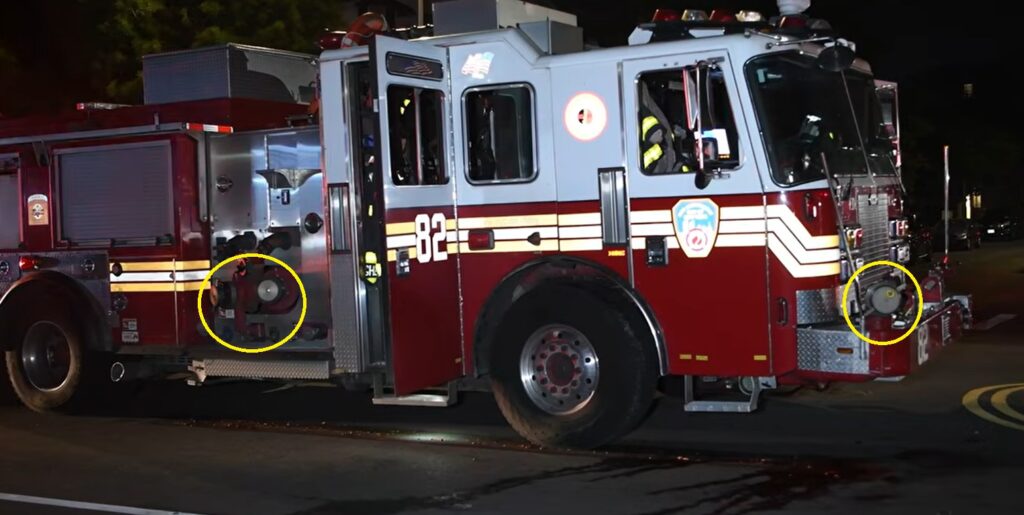
Looking at the video, the firefighters spent 41 seconds breaking out the windows on the car, and another full minute passing the hose through the car from the hydrant to the front intake. So, it was nearly two minutes to connect the hose by going through the car.
Now take a look from the video of the firefighters breaking the window:
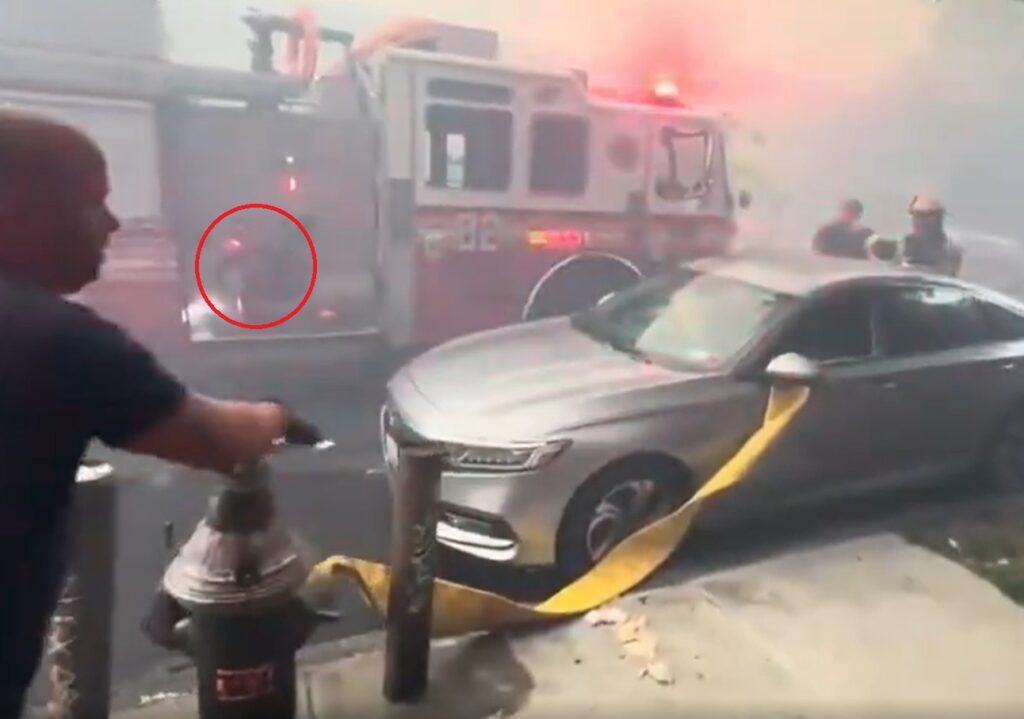
Which method do you think would be faster? The question then turns, according to the court cases involved, was it necessary for the firefighters to break this car’s windows?
Note the New York firefighter who posted this admits they weren’t doing it to gain access to the hydrant, they did what they did to “deliver justice like this to the bad guys,” and also calling this an “act of justice.”
Delivering justice as some sort of ad hoc parking enforcement court is not the firefighters’ job. Go ahead, Google “FDNY engine 82 break car windows” and see just how many times FDNY is “delivering justice” by doing thousands of dollars in damage to car owners whose only transgression is illegal parking.
This is wrong. Had I done this in my department, I would have been fired, and rightfully so.
18 Comments
Univ of Saigon 68 · September 23, 2026 at 9:17 am
Was he actually parked illegally? There was no yellow paint on the curb, and he was, maybe, 6 inches past one of the stanchions, if that. So no, it was just a bit of sanctioned vandalism.
Divemedic · September 23, 2026 at 9:25 am
In New York City, it is illegal to park, stop, or stand a vehicle within 15 feet of either side of a fire hydrant.
Fred · September 23, 2026 at 10:09 am
I’m with you about government overreach and abuse of power. I think qualified immunity is a crock of crap and public servants should have a transparent life. Lead from the front and all that that entails. But having said that, shitbags that park that close to fire hydrants, or in handicap spots, will also hang their bumper over the fog line into the traffic lane. It’s an attitude of “I don’t have to follow the basic rules of society because ‘reasons’ and you need to quit judging me [insert foul name]”.
And it’s why we now have a shitty low trust society… I’ll buy into your notion of them being wrong when the city starts assigning tow trucks to all fire calls and cars like that being automatically towed to the impound yard with no mercy, no quarter and no exceptions.
If we want a decent first world society then basic standards need to be enforced or the lowlifes will continue to dilute our culture.
Piss poor social behavior is what caused white flight from the cities. White flight from the cities was the seed that grew into higher taxes for city services. Some cultures are self correcting and some are not. The ones that are not drag the rest down to their level.
Here’s an illustration [racism warning]:
The vast majority of white women that engage in miscegenation wind up adopting the ghetto culture. The vast majority of black men that hook up with white women do not become MacArthur Fellows.
In conclusion, busting the windows of that car out is a brutal and expensive warning to the driver about social boundaries.
Divemedic · September 23, 2026 at 10:29 am
There are courts for that. If firefighters are to mete out punishment for those who violate social boundaries, why not allow them to kick the driver’s ass? Break out windows of homes without smoke detectors? Allow homes to burn to the ground if the owner hasn’t paid for his parking tickets?
CE · September 23, 2026 at 10:23 am
Malicious damage to property (often called criminal mischief, malicious mischief, generally requires the prosecution to prove four core legal elements beyond a reasonable doubt.
1) The defendant must have physically damaged, destroyed, defaced, or tampered with property.
2) The-property must belong wholly or partially to someone else, or be public property.
3) Intent: The defendant must have acted willfully, purposefully, or maliciously—meaning the damage was deliberate and not accidental or merely careless.
4) Unlawfulness: The act must be completely without legal justification, excuse, or the owner’s explicit consent.
It would seem to hinge on #4, whether there was a valid excuse. Breaking windows takes extra time, and subjects the firefighter to possibly injuring themselves on cut glass. On analysis might be, could the firefighter just as easily ran the hose beneath or around the vehicle ? Which would seem to take less time and not subject the firefighter to potential peril of cut glass shards.
If this is acceptable procedure, I’d recommend using a spring-loaded center punch.
It is totally justifiable for the city government to enact a huge fine, say, $1000 for parking in front of a hydrant when no fire occurred, and up it to $10,000 in the event the hydrant was needed when the driver wrongfully parked there.
Steve S6 · September 23, 2026 at 10:27 am
Why not just use the fire truck as a plow when you arrive if the hydrant is “blocked”? Shove cars until you have clearance and proceed with your job.
Divemedic · September 23, 2026 at 10:55 am
LOL. That’s another myth. No department is going to want you to use a fire truck worth between $500k and a million as a batttering ram.
D Wall · September 23, 2026 at 10:38 am
I also thought the car was legally parked because it wasn’t between the posts. I was not aware of the NYC law of a 15′ radius around a fire hydrant. Regardless, the fireman could have saved a lot of time AND instilled the same “justice” if he would have draped the hose over the car. That canvas cover is abrasive and a charged hose is extremely rigid and heavy. Add the fact that there was a water charging port (circled in your photo) much closer to the hydrant, the guy was just being an a$$hole.
Maybe he’s seen a few too many showings of “Backdraft”…a movie most firefighters I know think/thought was not only unrealistic, but downright silly.
Grumpy51 · September 23, 2026 at 12:36 pm
That’s LDH (Large Diameter Hose – either 4″ or 5″). Doesn’t have canvas, it’s more like the covering on your garden hose, non-abrasive. Beaumont Fire Dept, C-shift, Engine 12 – last century….
Divemedic · September 23, 2026 at 1:15 pm
A fellow C shifter! I was C shift for all but 1 year of my career, with the one year being an Engineer on B shift. I also spent quite a bit of time working overtime on A shift.
I rode every piece of apparatus the department had- Engines, Trucks, Squad, Medics, even command vehicles. I joke that I did every job in the department that didn’t have chief in the title.
Grumpy51 · September 23, 2026 at 4:20 pm
Ya know how they figured out who was riding the hearse?? (literally, our first ambulance was a GhostBusters hearse with a cherry on top). Captain had each of the rookies get in the front passenger seat and squeeze through the small window to the back. Myself and another did it, SUCKERED!! Riding next to the stretcher required being bent over at the waist, and forget doing CPR – arms only, there was NO way to get your body over the victim.
1982 – we were the first academy to use LDH (we just called it 5″). C-shift saw us at the training grounds every shift, thanks to District Chief JoeBob May (real name). GREAT times…..
KEEP WRITING!!! You have a talent for it.
Grumpy51 · September 23, 2026 at 12:30 pm
He’s just being a DICK!! that hose could’ve been routed in front of the car without the hard curve at the hydrant.
But it’s FDNY…. there were several issues of Firehouse magazine back in the 80s that showed 2.5/3″ hose going through a car like that and they intentionally put the coupling inside (leaked like crazy).
Terrapod · September 23, 2026 at 1:45 pm
I lived in NY for about 7 years in the 70’s, the attitude of new yorkers in general is nothing like the rest of flyover country. Anything, and I mean anything that makes the FD or PD departments jobs more difficult gets treated like this, SOP and they just don’t care about your “feelings”.
Smarter folks make sure they are not in the way, the dumb keep getting taught a lesson then paying for tow impound release and repairs. Some places charged 100 bucks to get your car back and that was real money back then. The use of “grease” payments was also common to make some problems go away…. lessons from the mob were also to be avoided.
Pat H. Bowman · September 23, 2026 at 1:58 pm
That was capricious and unnecessary. They accomplished nothing except add NYC firefighters to the list of “public servants” I no longer support. It would have taken 1/2 the time and effort to use the side intake and route in front of the car. But no, he had to be a dick. I say this as someone who was in the fire department back when 5″ hose became a thing. We were the first department to have it on our trucks in the entire county.
Anonymous · September 23, 2026 at 4:58 pm
I used to wonder what might possess people to take pot shots a firefighters. Looking at that picture, one might decide the smashing might be excessive. However, the truck might have had to move to the right to get closer to the blaze, therefore the auto might have impeded access.
Divemedic · September 23, 2026 at 5:17 pm
I will tell you what I was told: You can always add to the hose.
Tom235 · September 24, 2026 at 8:03 am
We used to pop a window in the time it took to take a center punch to it. Boing, the window shatters into ¼” chunks. Part of our regular equipment. Regardless of the “law”, that car wasn’t blocking access to the hydrant. But being NYC, I’d expect assholes in city jobs. That guy was a dumbshit asshole.
Wilson · September 24, 2026 at 9:44 am
My take on the jr fire marshals, I am fighting with my local gov. about a guy spray painting a rv 20 feet from my house. The jr fire marshals say the VOC’s are not flammable or dangerous to breath. I’ve been to the ER twice for breathing problems.
Comments are closed.