Socialism and communism are two flavors of the same ice cream. In fact, if government and economic systems could be ice cream, those collective philosophies would be strawberries and salmon flavored. It’s just that socialism would have sprinkles and communism would be in a waffle cone. Oh- and someone else would pay for it on your behalf.
Liberal city residents, when questioned on this, make it obvious that socialists are just people who want free stuff so they can go ahead and spend their money on baubles. They think socialism means- in his words- “taking care of the needs of people, things like national health care, like that.”
Then he is asked, “What about the government taking property, businesses, things like that?” He mentions not really thinking about socialism like that.
This socialist supporter then says, “I don’t like the idea of government taking things away from you.”
Then they switch to a guy who, let’s put it gently, doesn’t look very masculine and is wearing a Cuban flag medallion on a chain around his neck. His opinion is that there is too much wealth inequality in this country, and that could be solved with higher taxes on the rich.
The next woman comes on and is at least honest- her belief of what socialism is, is the elimination of private businesses. She says it’s too difficult to run small business, and corporations have too much power, so the way to solve this is to make all businesses owned by the government. She is at least the first person they interviewed who knew the answer and was not shy about honesty.
That’s the problem with socialists- they have a desire for free necessities, but don’t give a single thought into how it will be paid for, or the ones who DO think about that, assume it will be taken from those evil “rich people.”
These two theories of government are, simply stated, government ownership. Socialists will be quick to argue the two are different because in socialism, you still get to own your property. Do you really? No, you don’t. Socialism is an idea about organizing the economy so that businesses and resources are owned or controlled socially, in other words, by the government. The stated reason is to reduce inequality and serve public needs. In other words, seizing the means of the production of goods and services.

What collectivism is not is a synonym for “everything the government does.” There are legitimate reasons why we form governments, and why we grant that government with certain powers. That is, we give up a little autonomy in order to gain things we could not get on our own.
In socialism, all businesses are now the property of the government, who decides what and how much everyone will receive. Imagine an economy with the efficiency of the post office and the compassion of the DMV. Of course, no one will be corrupt, and not a single government official will give money and extra power to their relatives.
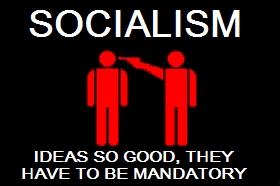
It’s great when everyone contributes to a society. The flaw in collectivism is simple: some people will take advantage of the collective contributions of others to reap benefits without themselves having to do a thing to create those benefits. If you’ve ever been involved with a group project in school or at work, you know what I mean.
The difference between a legitimate function of cooperation for mutual benefit and the loss of autonomy found in collective governments is not a bright, hard line. It’s more a shifting from day to night, and somewhere in the middle you realize things have gotten so dark you can no longer see.
That’s how collectivism works- the government has ultimate control over everything from your labor to the factory, farm, or business you perform that labor in. That’s an important difference from a Republic or a free market.
To me, the difference is clear: is the benefit being paid for with tax dollars available to everyone, or just to some? Is the cost borne by everyone, or just a few? Some things to consider:
- A military. Collectivism, or free market? The answer is it can be both. A free market military is either volunteer, or everyone has to serve. If people with power and wealth aren’t forced to participate in the draft, then it’s collectivism. See the Vietnam draft versus the WW2 draft.
- What about fire departments? Again, they can be both. If the fire department is better equipped in a rich neighborhood than a poor one, but everyone pays the same tax to support it, or the opposite: everyone pays different amounts but receives the same service, it’s not free market.
- What about police and the courts? Again, everyone should get the same level of service for the same legal rights, which doesn’t mean they are collectivist.
- Schools. Government run schools are a collectivist policy. Forcing people without kids, or whose kids don’t attend schools to pay for a school system from which they derive no benefit is definitely not free market.
- Social Security and Medicare are not free market and are definitely collectivist. They weren’t intended to be, but there you are. The problem is Social Security was intended to be self supporting, with contributions in your working years being intended to fund the money you received in your retirement. We all know what happened there.
- Medicaid. Collectivist, and has NEVER been free market. Everyone pays, but you have to qualify in order to get it.
- Public Beaches, Parks, and Libraries. Not collectivist. Everyone pays, but its free for everyone. It’s a public service, which is quite different from means tested collectivist perks.
- Roads. Not collectivist. They are funded through tolls and fuel taxes. The people who use them are the ones paying for them.
Now it’s plain to me this government we live in has never been a complete free market. There have been differing levels of service and taxes since forever, and to be quite frank, I am not sure a completely free market can actually exist and still support a cohesive society. Likewise for communism. There is no way that any society made of humans can be completely communist. Some will have more abilities, a stronger work ethic, while others will be more likely to sponge off the system.
What communism attempts to sell is complete equality, but it falls far short- as it must.
What socialism sells is taking from those who produce and giving to those who consume- favoring the sick, lame, stupid, and lazy.
The free market allows some to fail. If an individual can’t or won’t work in a pursuit that ensures they can provide for themselves, they must rely on the charity and good graces of others, and some people just can’t handle that while blaming society and those who produce, rather than the person whose fault it actually is.
0 Comments