I’ve been asked why I don’t just use Cat6 cable in my network upgrade. Here is why:
Thirty years ago, I still had dialup Internet. My first internet was a 9.6 kbps connection around 1992 or so. I remember thinking how fast my 56 kbps connection was when I got that just a few years later. I’m sure you all remember it taking hours to download a single picture. Then Time Warner started offering their “Road Runner” high speed broadband service in 1999, boasting speeds of up to 1.5 Mbps. Now here we are, 26 years later, and I have available Internet speeds of up to 1.2 gbps, nearly 22 THOUSAND times faster than it was just 30 years ago. Now word comes that we are about to get fiber Internet within the next year, and they are offering speeds of up 8 Gbps.
When I was a kid, my Dad, who you may remember was an engineer for Hewlett Packard, told me that no one needed a hard drive larger than 10mb. Why, he told me, 10mb could hold the text of every book within the Library of Congress. The computer (the HP computer he brought home was an early DOS machine built into a suitcase) had all the storage anyone could need, he predicted.
He was wrong. A corollary to Moore’s law, Internet speeds have historically doubled about every 2 years or so. With that in mind, I set out to build a home network that would anticipate these advances. Sure, I have 1GB speed now, but in a year it will likely be 2 GB. Within a decade, I would be looking at 32 or even more Gbps.
The network traffic between devices in a home can be even higher than that. In 2015, 1 Gbps was the usual home switch speed. Today, 1 Gbps remains the mainstream baseline, with 2.5 Gbps becoming a common upgrade. Sure, my computer may only be capable of 1 gbps, but what happens when there are multiple computers, streaming televisions, and IoT devices? All that traffic adds up, and you can soon overload a network.
The maximum speed we will ever get out of Cat 6 is 10gb. A couple of years, and a home wired with CAT6 will be obsolete. I’m not getting any younger, and I wanted to have a system that wouldn’t require a ton of work when I eventually get too old to climb up in the attic.
So with that in mind, I designed my home network. There were some initial observations:
- Internet enters my home via coaxial RG-6 cable.
- It travels through the walls and attic to the utility room, where the modem is located
- The modem has a maximum of 1 gbps
- from that utility room, there are 5 CAT6 cables that travel to various parts of the house
- My old system was a WiFi mesh and wasn’t capable of speeds I wanted
I noticed that I was paying for gigabit Internet, but speed testing showed I was only getting 300mbps or so, sometimes less. I plugged my computer directly into the modem, and was getting over 800 mbps. My network was the bottleneck. I was also having Internet connection issues. At first, I was just trying to clean up my WiFi, then I decided to redesign the entire network. I envisioned using CAT6 Ethernet cables to haul up to 2.5 gbps from clients to switches, and 10gbps connections from one switch to another, and to the server I was using. That would allow all of those 2.5 gbps connections to come together and not bottleneck at the switches.
So after over 7 months of work, this project is coming to a completion. The holdup has been the cost of buying the equipment. The server and its hard drives were the most expensive segment at a cost of about $3200, and the rest of the project cost about $4700, but that includes the Home assistant stuff and the cameras. All told, this project came in at just under $8,000 for everything.
I decided to use LC fiber optic cable, because those cables are capable of up to 40 gbps, even if the switches I have aren’t capable of that. Yet.
So my network looks like this:
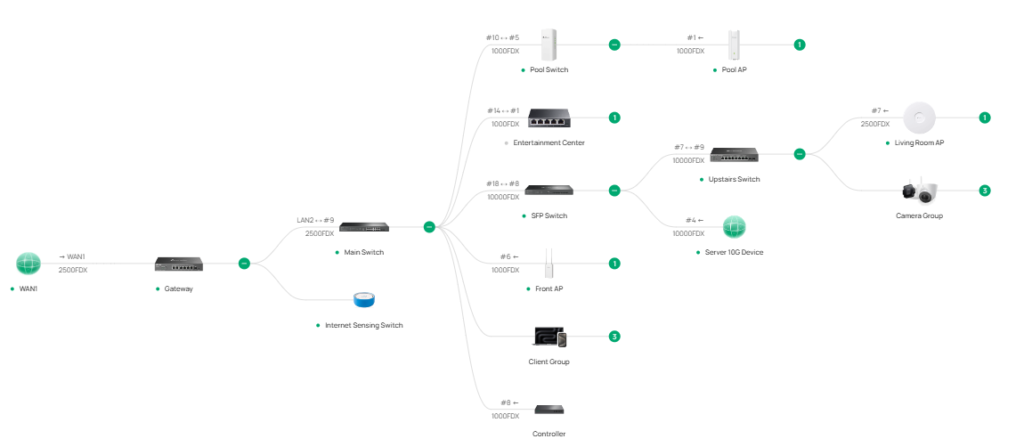
There are a couple of single gigabit switches, but they supply a television or some Internet speakers, and those don’t need any more bandwidth than that. One of the switches is a 10gbps SFP switch, and the others are 2.5 gbps with 10gbps uplink connections. The only remaining choke point is my ISP, the 1 gigbit modem, and the gigabit router. Once fiber comes in, I can replace the router and connect to the fiber ONT, and I will have a fully capable 2.5gbps network that can easily be reconfigured to 10gbps. The wires will already be there if I want to transition even higher at some point.
4 Comments
paul · October 3, 2026 at 4:28 pm
I replaced most of my Ethernet wiring with Cat8 a while back. I had one funky cable that I couldn’t isolate.
I have Starlink and may never have fiber to the house. I replaced the switches with GB capable speed. My PCs have 10/100/1000 Ethernet. And so…. the bottleneck isn’t my LAN.
Starlink bumps around 200 Mb depending on cloud cover. Web pages download faster than I can read. I’m cool.
P-Tar · October 4, 2026 at 6:13 pm
That obsolescence factor in cables is no joke! I’m in the weeds for house design and I’ve decided to do the lower sections of interior walls with removable wainscoting to access pipes and wires.
Protects the walls from scuffs and dings bumping around the house, and gives access to key infrastructure without having to bust through drywall and replace it every time something goes wrong.
Sections with wet infrastructure behind it or in rooms like the kitchen will have a polyurethane coating on the inside of the wainscoting. After nearly 20 years of managing properties I’ve seen every way something can break (and the aftermath).
I’m designing the house with ‘A-10 philosophy’ (sadly I can’t make it fly or obtain a rotary cannon to build it around!) – “It’s gonna take huts, build it to survive”, and make it easy to repair or upgrade.
Floor drains in the kitchen and bathrooms and floors recessed an inch below the level of the rest of the floor for the inevitable flooding when a pipe or valve busts is another thing I’m planning.
The flood mitigation features would save homeowners thousands over the lifetime of a home. I seriously don’t know why we don’t do this as a general thing.
TRX · October 4, 2026 at 2:20 pm
Back in 2010 I had the ceilings and most of the walls out during a major remodel. I bought a big spool of Cat-6 and ran it everywhere. I wanted to run fiber, but nobody was selling just the fiber unless it was on gigantic commercial-size spools, so I bought a bunch of pre-terminated cables and ran those.
The problem was, there were at least a dozen different fiber-optic connector types, with no apparent standardization even by brand. I bought a box full of the most common pre-terminated cable type at the time and ran those. It’s almost certain that whatever fiber optic hardware I eventually get will use a different connector. Maybe there will be adapters. Probably, I’ll have to pay someone to come in and re-terminate the cables. Terminating a fiber looked like a fiddly operation that called for expensive tools, though if the tools are cheaper when the time comes, I’ll just buy them and do it myself.
liberty · October 5, 2026 at 11:21 am
Fiber is a good call for new work, but cables don’t obsolete as fast as it might seem. Cat5e handles 10g fine for runs < 100ft and cat6a is 10g good to about 300'. 1g has been the home standard for a very long time, only recently has 2.5g started to supplant it. I think it will be many years before something faster than 10g becomes mainstream outside of server racks and data centers. If I was betting, I'd go with you will move before you'll be speed limited by wiring.