Fire engines are all built the same basic way. They have a pump, some mounted in front of the powerplant, some behind. The vast majority of fire pumps are centrifugal pumps. That is, the shaft of the pump spins a sort of pinwheel called in impeller that throws water from the center of the impeller to the outside.
One thing is always in common- the intakes for the pump are always located at or below the centerline of the pump, and the discharges are located above the centerline of the pump. Here is a fire pump that has been removed from the fire engine and has cutaways for students to learn how a pump works.
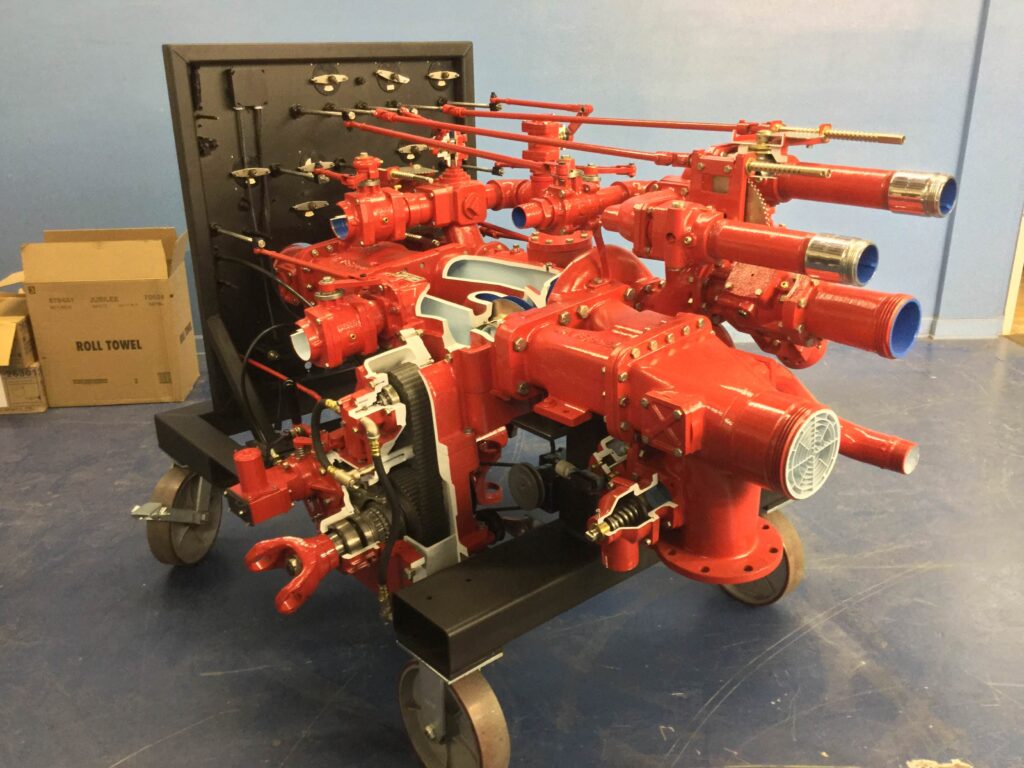
Fire pumps on trucks are rated by gallons per minute that can flow from the pump while it is drawing a suction from a static source like groundwater up a 10-foot vertical lift and a discharge pressure of 150 psi. If they are being supplied by pressurized water, like from a hydrant, they can pump far more. The pump on my last engine was rated for 1625 gpm, but we went out and tested it for training once while hooked up to a hydrant on a 36 inch water main and got more than 2800 gpm.
You can quickly see a pump’s capacity without even looking at the data plate by just counting the discharges. The only ones that count are 2.5 inches or larger.
- 2.5 inch discharge: Rated for 250 GPM
- 4-inch discharge: Rated for 625 GPM
- 5-inch discharge: Rated for 1,000 GPM
- 6-inch discharge: Rated for 1,440 GPM
As an example, my engine had 4 inch and a half discharges, which don’t count. It also had 4 two and a half inch discharges and a 4 inch discharge.
For supply connections, we had one on each side of the engine, and one on the front bumper. Since that one on the front bumper had piping that had to bend around the engine, front axle, and other structures, it was not as effective due to friction losses as the ones on the side of the truck, which went directly into the pump itself.
Fire engines can have a water tank as small as 300 gallons, although 500 is typical. Since we were in a an outlying area of town with hydrants that could be farther away, the tank on my engine was 1250 gallons of water and 50 gallons of foam concentrate. The other engines in the city had 750 gallon tanks.
The hose carried on a fire truck is impressive, and the smaller the tank, the more hose and other equipment it can carry. My engine carried:
- 1200 feet of 5 inch supply line
- 500 feet of 3 inch supply line
- 300 feet of a 2.5 inch attack line in the hose bed
- 250 feet of 2.5 inch attack line in a crosslay
- a pair of 200 foot long 1.75 inch attack line in two different crosslays
- 100 foot of attack line on the bumper for car and trash fires
- other miscellaneous short lines for odd jobs, which totaled another 300 feet or so
An engine with a small 300 gallon tank has quite a bit more room for hoses and other firefighting equipment. In addition to all of the hoses, we carried hose fittings, spare nozzles, fans, saws, extension cords, power tools, 12 spare air bottles for SCBA, a ground monitor for big deluge operations, another 25 gallons of Class A foam, medical equipment, thermal imaging equipment, hydraulic and pneumatic extrication equipment, 5 different ladders, and more.
A person who was going to drive that truck had to have at least 18 months on the job, spend at least 50 hours driving it under instruction from a senior driver, had to attend and pass a pump operator’s course, and be able to navigate our obstacle course made of traffic cones. Also, he had to demonstrate the basic maintenance and operation of every single item on the vehicle.
A new guy at our station had to, within 2 weeks of being hired, be able to draw from memory a diagram of the contents of the entire truck. Additionally, he had to be able to go get any piece of equipment when asked, without opening any compartment other than the one where the equipment was found. Firefighters who couldn’t do that would have their probation extended, and if they still couldn’t do it in a reasonable amount of time, they were terminated.
In a future post, I will explain everything it took to become a firefighter in my department.
0 Comments