Fire engines are all built the same basic way. They have a pump, some mounted in front of the powerplant, some behind. The vast majority of fire pumps are centrifugal pumps. That is, the shaft of the pump spins a sort of pinwheel called in impeller that throws water from the center of the impeller to the outside.
One thing is always in common- the intakes for the pump are always located at or below the centerline of the pump, and the discharges are located above the centerline of the pump. Here is a fire pump that has been removed from the fire engine and has cutaways for students to learn how a pump works.
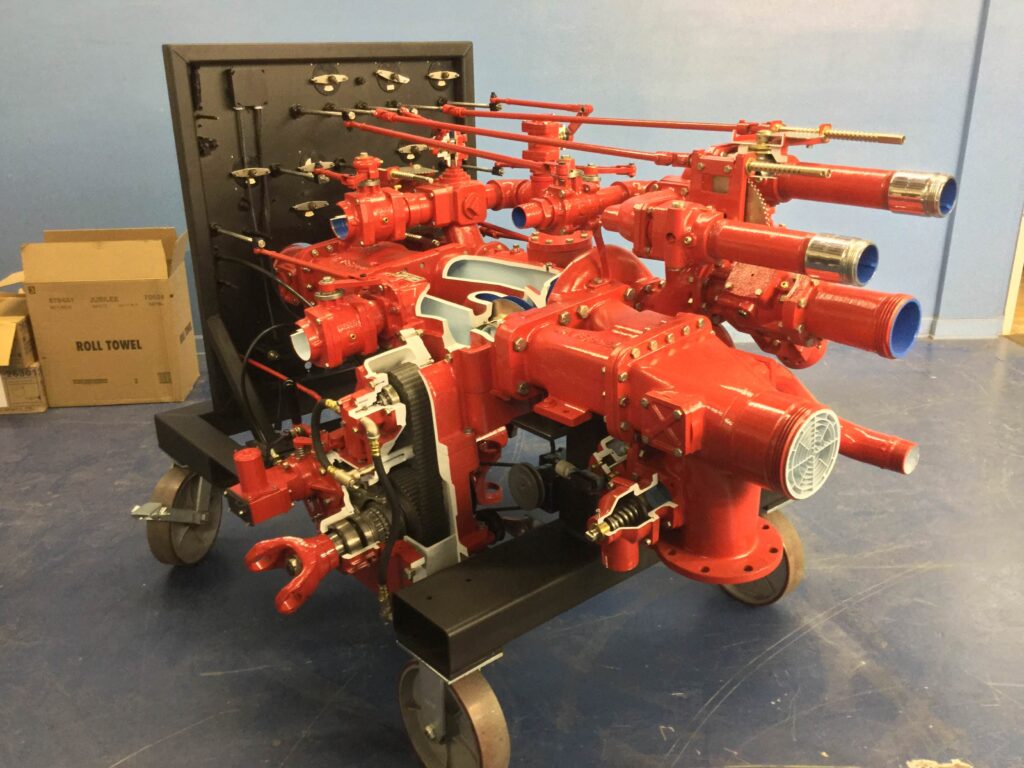
Fire pumps on trucks are rated by gallons per minute that can flow from the pump while it is drawing a suction from a static source like groundwater up a 10-foot vertical lift and a discharge pressure of 150 psi. If they are being supplied by pressurized water, like from a hydrant, they can pump far more. The pump on my last engine was rated for 1625 gpm, but we went out and tested it for training once while hooked up to a hydrant on a 36 inch water main and got more than 2800 gpm.
You can quickly see a pump’s capacity without even looking at the data plate by just counting the discharges. The only ones that count are 2.5 inches or larger.
- 2.5 inch discharge: Rated for 250 GPM
- 4-inch discharge: Rated for 625 GPM
- 5-inch discharge: Rated for 1,000 GPM
- 6-inch discharge: Rated for 1,440 GPM
As an example, my engine had 4 inch and a half discharges, which don’t count. It also had 4 two and a half inch discharges and a 4 inch discharge.
For supply connections, we had one on each side of the engine, and one on the front bumper. Since that one on the front bumper had piping that had to bend around the engine, front axle, and other structures, it was not as effective due to friction losses as the ones on the side of the truck, which went directly into the pump itself.
Fire engines can have a water tank as small as 300 gallons, although 500 is typical. Since we were in a an outlying area of town with hydrants that could be farther away, the tank on my engine was 1250 gallons of water and 50 gallons of foam concentrate. The other engines in the city had 750 gallon tanks.
The hose carried on a fire truck is impressive, and the smaller the tank, the more hose and other equipment it can carry. My engine carried:
- 1200 feet of 5 inch supply line
- 500 feet of 3 inch supply line
- 300 feet of a 2.5 inch attack line in the hose bed
- 250 feet of 2.5 inch attack line in a crosslay
- a pair of 200 foot long 1.75 inch attack line in two different crosslays
- 100 foot of attack line on the bumper for car and trash fires
- other miscellaneous short lines for odd jobs, which totaled another 300 feet or so
An engine with a small 300 gallon tank has quite a bit more room for hoses and other firefighting equipment. In addition to all of the hoses, we carried hose fittings, spare nozzles, fans, saws, extension cords, power tools, 12 spare air bottles for SCBA, a ground monitor for big deluge operations, another 25 gallons of Class A foam, medical equipment, thermal imaging equipment, hydraulic and pneumatic extrication equipment, 5 different ladders, and more.
A person who was going to drive that truck had to have at least 18 months on the job, spend at least 50 hours driving it under instruction from a senior driver, had to attend and pass a pump operator’s course, and be able to navigate our obstacle course made of traffic cones. Also, he had to demonstrate the basic maintenance and operation of every single item on the vehicle.
A new guy at our station had to, within 2 weeks of being hired, be able to draw from memory a diagram of the contents of the entire truck. Additionally, he had to be able to go get any piece of equipment when asked, without opening any compartment other than the one where the equipment was found. Firefighters who couldn’t do that would have their probation extended, and if they still couldn’t do it in a reasonable amount of time, they were terminated.
In a future post, I will explain everything it took to become a firefighter in my department.
9 Comments
Joe · September 25, 2026 at 10:58 am
Looking at and reading this post reminded me of my Fire Science courses 45 years ago in Junior College. The days of being a Volunteer and having to re lay the hose bed with double jacket 2 1/2 at 4a.m. then going to work roofing all day. Good times.
Steady Steve · September 25, 2026 at 5:28 pm
People don’t realize the high level of competence and big balls it takes to do that job. I’ve only done training for shipboard firefighting with monthly drills and a refresher every 5 years for my Merchant Mariners license. Thank God I only had 2 fires during my career both extinguished without any serious injuries.
Grumpy51 · September 26, 2026 at 5:53 am
I rebelled against everyone my senior year of high school….. failed everything but had to pass to graduate. Swore I’d never go to college. Joined Beaumont Fire Department after high school……the first thing they did was send me to the local university for fire school. I have 12 hours of college credits for it.
Life’s interesting and has its own quirks.
Big Ruckus D · September 26, 2026 at 12:35 am
As a plumber who has worked on some pretty serious pump setups, I have to say that is a absolute beast. Tear down and service on that has to be a real bitch, but I imagine it is built well enough to have a long MTBF. What kind of PM schedule is there for a pump like that?
Fido · September 26, 2026 at 12:03 pm
I have one from the mid ’70s that’s still quite functional (if you can find real gas for the old V8. wish it were diesel). Had to replace connecting hoses and valve seals, but the pump still works to 300psi ( I don’t have the cojones to try any higher ). The main seal leaks substancially, but not enoguh to motivate me to replace it … yet.
Steve · September 26, 2026 at 8:06 pm
The pump shown is actually very simple. It is sealed with graphite packing or by a mechanical seal both are simple to replace but require some detail of attention.
The transmission is separable, a splined shaft that runs through the pump is attached by a splined socket. The truck drive shaft is split and is yoke or flanged to the input and output transmission shafts. Drive to scene of fire, stop truck, shift from drive (detached output shaft) shift into pump, a chain and sprocket transmit power through a chain in the chain case (transmission). Go to http://www.waterousco.com for detailed information
Fido · September 27, 2026 at 1:00 pm
Mine’s a Hale. Seal is rope, I think. It’s not all that mobile, but for my purposes it doesn’t need to be.
Divemedic · September 27, 2026 at 2:29 pm
The material does look like a rope.
https://www.amazon.com/clp/B09TVKFL86?lv=shuf&channelId=500
Wild, wild west · September 26, 2026 at 10:33 am
I very much enjoy hearing how real fire departments and trained firemen do things, because I was on a small town – very small town – volunteer fire department from about age 16 to 28 when I moved out of that area in 1981. The main requirements to be on the department were do not piss off the chief, who was also a volunteer, and be physically able to drag hose, in that order. We received Scott air packs toward the end of my tenure, such as it was, and were lucky the town could afford helmets, bunker coats and boots. That was about it for equipment. Two trucks, one a 500-GPM built in 1956 and the other a 750-GPM built in 1972, and a 1200-gallon supply tanker older than either of them, donated by a fuel distributor, that also went on runs outside the city hydrant system. Then we got an army surplus five-quarter-ton jeep from the conservation department and built a brush truck, very much jury-rigged because we had no money. The PM schedule for the pumps was simple: there wasn’t one. We had no radios or pagers, but there was a conference call phone system that rang at the volunteer’s home phone and a fire siren that blew during “working” hours. If you have been out of town and noticed the trucks were not at the station when you returned, there was a chalkboard where the fire location was supposed to be written, if anyone remembered to write it down before leaving. The chief did what the town could afford in terms of training which wasn’t much, we literally did not know what we did not know, but he did what he could, and we worked hard at fund raising events, because we had to. Pie suppers and spaghetti feeds, don’t laugh, were major augmentations to our wee budget. None of the other towns in our hick county had it any better. Most were worse, and mutual aid calls were frequent. Things were so loose that I was still considered a volunteer during the three years I was off playing army. Thus it was that I learned the two most dangerous things at a fire were falling bricks and volunteer firemen. I’m informed that things are a lot better now, near professional quality or so I’m told, but that’s just the way it was back then.
Comments are closed.