This post is late because it’s concerning the Lindsay Clancy trial. I wrote and scheduled it before the mistrial was declared. I decided to postpone it so I could do some edits. This is the result.
The Lindsay Clancy case has brought the TikTok Detective bureau out of the shadows. These women, experts in everything from police procedure to medicine, psychology, forensic evidence collection, law, military tactics, and nuclear physics are on the case and have declared Lindsay to be not guilty for reasons ranging from insanity to “her husband did it.”
Of course claims she didn’t do it at all for some reason, including claims that it was her husband are demonstrably false. As evidence, we can take the word of her attorney. No, not the attorney in the current criminal trial, but her attorney from January, where she was the plaintiff in a lawsuit against her doctor. I’m posting a pdf of the notes from the case and the actual complaint filed with the Norfolk, Mass. court (pdf warning).
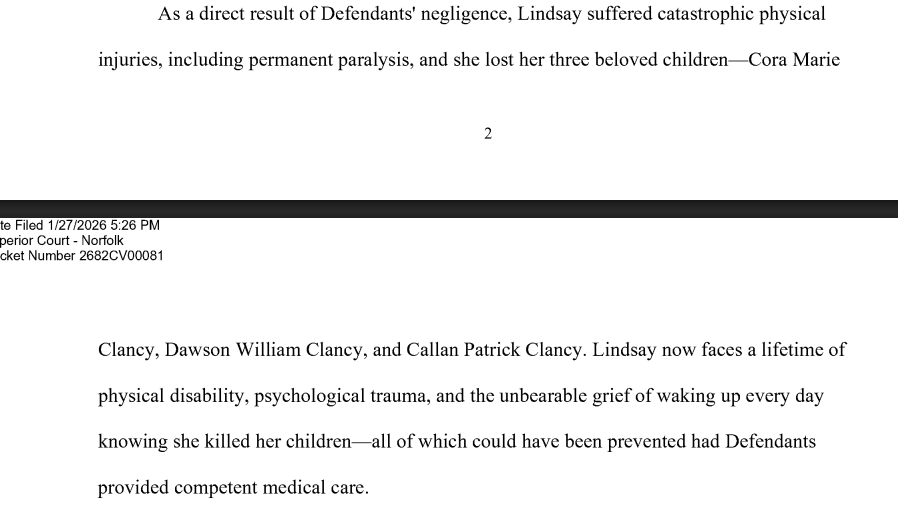
In that lawsuit, she made the following claim:
and this one, also from her lawsuit:
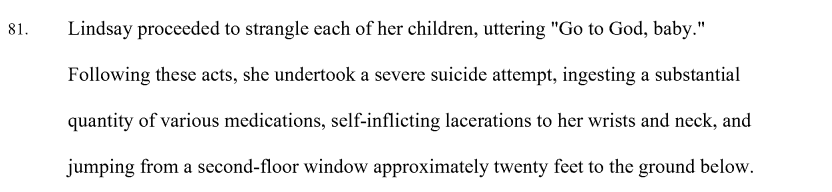
Keep in mind, she was indicted for killing those children in October 2023, yet waited to file this lawsuit until January of 2026, shortly before her criminal trial. This is part of a claim Lindsay and her attorneys are making, that she was not in control or aware of her actions at the time she killed the children.
For that reason, there is no doubt, zero, that she in fact killed those children.
Killing someone isn’t always illegal, but in those cases, the defense requires admitting to the facts. For example, if I shoot and kill someone who tried to rob me at gunpoint, claiming self defense requires that I admit to shooting and killing the person, but I have an affirmative defense in that self defense is legal. I make the claim of being in reasonable fear for my life. The prosecution then has to prove beyond a reasonable doubt that the shooting wasn’t in self defense.
The actual controlling Massachusetts rule is the doctrine of criminal responsibility, originating in Massachusetts Supreme Judicial Court case law rather than a statute specifically saying “psychosis.” The foundational case is Commonwealth v. McHoul, 352 Mass. 544, 546–547 (1967). The Massachusetts Supreme Judicial Court’s current 2026 Model Jury Instruction on Criminal Responsibility states:
A person is not criminally responsible for his conduct if he has a mental disease or defect, and, as a result of that mental disease or defect, lacks the substantial capacity either to appreciate the criminality or wrongfulness of his conduct or to conform his conduct to the requirements of the law.
The evidence never required anyone to believe Lindsay Clancy was well. She clearly was not, as anyone who will kill their children is not mentally well. But being profoundly mentally ill and not being responsible for your actions are not the same thing. The law in this case requires the person making the insanity claim be unaware of the wrongfulness of their actions.
None of the providers who treated Lindsay Clancy diagnosed her with postpartum depression or psychosis. The evidence instead pointed toward a serious mood disorder, with multiple of them diagnosong her as bipolar.
As many who are bipolar do, she resisted that diagnosis, changed providers, often skipping or refusing to take medications. Lindsay was prescribed 13 different psychiatric medications over several months. That does NOT mean she was taking 13 medications simultaneously. The prosecution’s evidence indicated roughly 2–3 at a time. Then there’s the actual pill inventory presented at trial:
- Zoloft: 30 prescribed — 23 remained
- Ativan: 30 prescribed — 24 remained
- Buspirone: 30 prescribed — 28 remained
- Hydroxyzine: 30 prescribed — 27 remained
- Buspirone refill: 30 prescribed — ALL 30 remained
- Trazodone: 30 prescribed — 22½ remained
She hid some of her most disturbing thoughts from the people treating her because she knew it would result in her kids being taken. Above all, people with this condition are well known for resisting treatment, because they “aren’t crazy.”
Lindsay claims through her attorney that she became convinced that her brain was damaged and she would never return to her old self. She was suicidal, but her children were a tether to life, according to her claims.
Then there is the alleged voice. After months of treatment without documented psychosis, Lindsay said she heard a voice telling her to kill the children in the days and minutes before the killings. We are talking about roughly an 18-minute window where a voice commanded she kill her children. She never spoke of this voice before, or mentioned it until after the killings.
Yet during the killings and the hours preceding them, she was capable of purposeful, sequential behavior.
She created the opportunity to be alone with the children. She researched how long her husband’s trip would take and added another errand to extend that time. She killed the children one by one over a 15 minute period. When her husband called during this time, she missed his call and then made the decision to call him back. In the middle of a psychotic break so profound that it compelled her to kill her three children without realizing the gravity of her actions, she still recognized her husband had called, understood that not responding could warrant him returning early, and took affirmative action to call him back. That is difficult to reconcile with the narrative that Lindsay suddenly “snapped” and had no awareness of what she was doing.
Lindsay was profoundly mentally ill and genuinely wanted to die. But she still understood what she was doing when she killed her children. Those things are not mutually exclusive. She took steps to hide her psychosis, this alleged voice compelling her to kill, to get her husband out of the house, and to one by one kill her children.
Mental illness deserves compassion, and postpartum mental health deserves treatment, attention, and resources. However, compassion can’t replace the legal standard for criminal responsibility.
If the standard becomes, “She was a loving mother, therefore she must have snapped,” we’re no longer applying the law to the evidence. We’re creating our own definition of justice based on emotion and feelings.
In my opinion, this woman knew exactly what she was doing. She took steps to hide her behavior while she was carrying out her plan. All of this suggests cunning and a sense of guilt. You don’t hide your actions if you are unaware of the wrongness of what you are doing. In Massachusetts, the legal term for this is “consciousness of guilt.”
The legal issue to which those facts are relevant is whether the Commonwealth proved that the defendant retained substantial capacity to “appreciate the criminality or wrongfulness” of the conduct and to conform conduct to law. Massachusetts defines “appreciate” as understand, “criminality” as the legal significance of the conduct, and “wrongfulness” as its moral significance.
In this case, taking steps to prevent her plan from being foiled:
- conceal what they intended to do
- waited until her husband was gone
- created a diversion to get her husband away from the scene
- lied about what she intended to do
- selected the time or place designed to avoid intervention
- took steps calculated to ensure nobody discovered or stopped the act.
In my mind, that is what it boils down to: Did this woman know what she was doing was wrong, as evidenced by the fact that she took active, complex actions to ensure no one could discover or prevent her from carrying out her plan.
I think the answer is that she knew full well what she was doing. I tip my hat to the one juror who had the cajones to stand his ground in the face of the other 11 members of the jury, the judge, and the defense attorney. He stood up for those children, despite surely knowing what would happen to him in the aftermath, once his identity is discovered. The left is going to make his life miserable.

Now there are actually dumbasses out there who are calling for the elimination of the jury trial, saying we should use professional tribunals instead.
20 Comments
Jester · September 5, 2026 at 2:46 pm
You did a fine job of laying out the case and the criminal responsiblity that existed. Unfortunately all the retards out there have no concept of facts or rules of actual behavior as they probally are all as mentally defective as the evil creature that strangled her children one, by one. I’m pretty sure being diagnosed with PTSD does not give me, as a male a blanket pass to do whatever the fuck I want. The opposite infact in many cases due to the stigma associated with it from those that don’t infact have it. This is a case of a bunch of women that decided empathy and to stand for her (because the bitch can’t ever stand up again) because well we feel bad and don’t think someone who murdered her children should suffer for it.
…But I wonder if the case would have been found the same way if it was a male that was suffering from a mental health crisis?
We know that answer don’t we?
Big Daddy · September 5, 2026 at 10:47 pm
It is even more important to keep insane people away from the rest of civilization when they commit crimes.
The robber may be punished enough to rationally change his mind about robbing people.
The insane, by definition, are not capable of reining in their behavior.
Life in prison or hanging. Never let them out. Never.
Plague Monk · September 6, 2026 at 2:25 am
1. I watched some videos calling on Mass to retry Ms. Clancy until “they get it right”, meaning a conviction. Is this really such a good idea?
2. I watched this video, which argues that Ms. Clancy’s defense team has a strong argument for dropping the case due to double jeopardy: https://www.youtube.com/watch?v=rjR5VUykTu4
Both sides, particularly the women, seem to be hysterical on the subject. My wife, normally pretty level headed(except when I overspend on Warhammer figures), rages about the case, and wants Ms. Clancy retried as many times as needed until she is convicted.
I’m dreading attending church today, because I know that this topic is going to come up; if not in the service, then at the usual after service lunch. I have little interest in the case, and I concentrate on talking things out with my wife so that she doesn’t stroke out on me. I’m more interested in the upcoming Starship launch, and the EU/Japan Mercury probe.
Elrod · September 6, 2026 at 7:37 am
Wait a minute – you said she killed her children in 2023, for which she was criminally charged…..but Massachusetts took until 2026 – three years later – to proceed with a trial?
Divemedic · September 6, 2026 at 8:24 am
That happens a lot. I’ve been involved with two murder trials, and both times it was more than a year before trial. There are all sorts of things that happen in the interim- discovery, motions, etc.
oldvet50 · September 6, 2026 at 7:47 am
Excellent synopsis/summary of the events. My question now is, what can we do with our form of government when there are not enough sane people left in the country to form a jury? The problem demonstrated by this trial is that she really got a jury of her peers – evil, crazy women.
Anonymous · September 6, 2026 at 8:13 am
Sick bastards. Terminate her and each lawyer that that supports her. The bitch and her cohorts are evil. And do this publicly, maybe, just maybe this will stop crap like this from happening again.
pcb_duffer · September 7, 2026 at 7:19 am
Defense attorneys don’t just defend the accused. They help defend our society against malignant cops & prosecutors.
Divemedic · September 7, 2026 at 7:37 am
Defense attorneys are what protect our constitutional rights. Their clients are rarely choirboys, but they do provide a service.
TCK · September 9, 2026 at 2:22 am
If the attorney who heroically tried to protect his clients from being subjected to Mengelesque medical torture by the Autopen Administration deserved to be disbarred for his actions, then this monster’s entire legal team deserves a fucking mass grave. And that’s BEFORE you consider that her main lawyer openly tried to dox and threaten the hold-out juror.
NeverThoughtOfThat · September 6, 2026 at 3:19 pm
Stefan Molyneux raises an interesting point – Has anyone investigated Clancy’s work history for anything out of the ordinary such as a high infant mortality rate amongst her cases ?
John Fisher · September 6, 2026 at 7:32 pm
Ironically, the lone juror may be the cause of Clancy walking free. Given the sh** show by both the prosecution and the judge, it is unlikely that the state will attempt a second trial. If he had yielded, she at least would have been confined for some period of time before she was judged ‘sane’ again. Don’t get me wrong. I admire what he did.
Grumpy51 · September 6, 2026 at 9:32 pm
Interesting point. If happens, I wonder if federal charges (violation of civil rights) could be used?? Was certainly used in the 1960s when states “failed”
Steady Steve · September 7, 2026 at 3:48 pm
The State has already said they are going to trial again in October. My guess is that the media will largely ignore this and move on to the next shiny object.
Anonymous · September 7, 2026 at 12:46 am
Very well stated !
Curtis · September 8, 2026 at 6:39 am
Excellent analysis. From here the only thing missing appears to be motive. The facts lead me to believe she killed them out of hatred either of them or her husband. Evil needs to be punished and the tide of shrieking harridans claiming she is justified is exactly why her punishment must fit the crime. Liberal women are way too close to the edges of sanity and it looks like they’re all willing to totally embrace evil depraved viciousness as long as they think it is deserved. They need recalibrating.
Randomatos · September 9, 2026 at 6:22 am
Mad dogs get put down.
Mercy to the killer is cruelty to the victims.
Anonymous · September 11, 2026 at 8:52 am
Hydroxyzine?
Is that an anticholinergic?
Does it interfere with memory forming and memory access (‘dementia’)?
Divemedic · September 11, 2026 at 9:01 am
It’s an antihistamine, works by blocking histamine 1 receptors. It does have some anticholinergic and antiemetic properties as well. Like other antihistamines (think Benadryl) it can cause drowsiness. I am not aware of any problems with memory, but that isn’t saying much. That’s certainly outside of my wheelhouse.
LargeMarge · September 12, 2026 at 12:15 am
re : three irreplaceable WHITE children dead
.
I wonder if all Northern European Heritage folk are grieving our loss… on a tribal DNA level.
.
.
Communally subconsciously, we all realize we need to BERSERKER on khazars, their brown bio-weapons, and nut-jobs in general.
.
The alternative is ThosePeople annihilating Northern European Heritage folk.
A planet without us should terrify them.
Without our generosity and calories, ThosePeople self-exterminate in two generations.
Comments are closed.