Central Florida Fire Academy
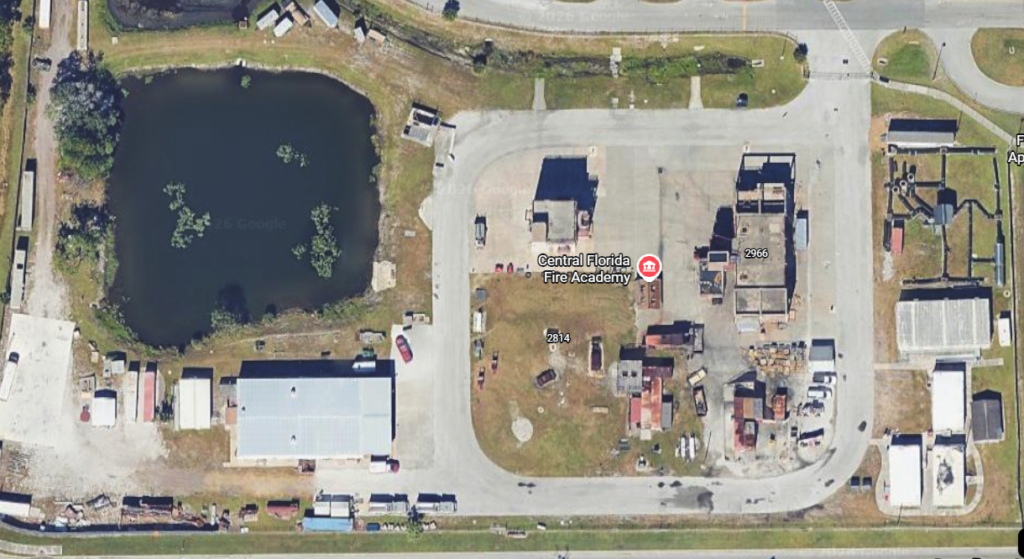
To orient you: On the grounds of the fire academy, the classrooms were in th5 buildings in the lower right corner. The building labeled “2966” was the burn building. Three stories tall, it’s where we did all of our practice fires. The building just above the word “Central” was set up for climbing, rappelling, and ladder drills. The field just below it and to the left was where we practiced natural gas and vehicle fires. The large building just below the pond had a fire station and some dark mazes in it.
There were field sessions and classroom sessions. Classroom sessions were where we learned regulations, fire theory, and which NFPA chapter regulated what activity. I remember the fire academy was divided into two sections- the first section lasted about 3 months, and we did about 1/3 field work and 2/3 classroom. Session two was flipped- another three months of about 80% field work.
We began every field day in the fire academy the same way:
We would line up in ranks on the pavement in front of that fire station with our gear on the ground in front of us. The chief instructor would walk in and yell “GO!” and you would have 60 seconds to get all of your gear on properly. Then the drills would start.
I went to the academy on a schedule that saw us doing field sessions all through the summer. That was brutal. You learn not to eat breakfast or lunch. All we would have for breakfast and lunch was gallon jugs of Gatoraide. I swear I was drinking two to three gallons of that stuff every single day I was in school. The instructors used to tell us that, if we did eat, we should eat something colorful so our vomit would be entertaining. They called it our art project. I think I threw up in training at least once a month. You try not to get it on you or your teammates, wipe your mouth, and keep going. For God’s sake don’t throw up while you have an SCBA mask on.
Half of the field days in session two was always us doing the “Big Three.” You would put on an airpack for time and score, then pull an uncharged hose from the hose bed about 200 feet, charge it, then use the water stream to knock down three cones that were 50 feet away. Then move over to pick up and carry a 100 pound ladder through an obstacle course and raise it against that ladder drill building. All in full gear, all for time, and all of it with the instructors grading everything.
You could lose points:
- If you forgot to sing out that both of the pressure gauges on the SCBA were within 100 psi of each other
- Didn’t call out that you had checked that the dogs on the ladder were both locked, points off
- staggered on your feet when water pressure was applied, points off.
- Face shield on your helmet not all the way down, points off
- If either end of the ladder touched anything it wasn’t supposed to (the ground, a cone, another student), you guessed it…
There seemed to be an endless list of things that got points deducted.
We did hundreds of drills that included:
- crawling through pitch black mazes that went up and down stairs, had ropes in them set up to entangle you, dolls and mannequins hidden in them you had to find, sometimes with choke points so small that in order to make it through you had to take the tank off your back while keeping the mask on, pass the tank through first, then put it back on after clearing the choke point.
- raising a 30 foot ladder to completely vertical, fellow students holding it there with ropes while you climbed up one side, went over the top, then climbed back down the other side.
- Rappelling from the third floor to the ground, then learning to rappel from the third floor in to the second floor window, tie a harness on to another student, attach them to your gear, then out that window with them to the ground.
- We ran the combat challenge once a month
And of course we put out fires: Basement fires, car fires, gas fires, you name it, we learned to put it out. It was an incredibly fun and rewarding experience. We did everything you could think of that a basic firefighter would do. Practiced with axes, saws, pike poles, air chisels, crowbars, you name it.
Even training like this was dangerous. Several firefighter candidates have been killed in training. One in Miami died from heat stress. Another in Orlando after falling from the ladder building was giving her class a thumbs up as they took her to the hospital. Her aorta ruptured after she got to the ED, and she died right there. It’s a dangerous business.
At the end of all of that training, a state examiner came and tested our skills. First a written exam, followed by “the Big Three,” then 5 random skills and an oral quiz about HAZMAT procedures. My class started with 30 people. Of them 24 graduated, and 22 of us passed the state exam.
As far as I know, all but two of us is now retired, and those two are now chief level officers.
For the most part, the women didn’t do as well. There were 5 women in my class. Two didn’t get certified. Of the three who did, one was a beast. She was a Native American and I swear her Indian name had to be Kicks Lots of Ass. That woman was a true warrior who didn’t know what the word quit meant. She was also the oldest one of us. I can’t imagine going through that class as a 40 year old.
One of the guys who didn’t pass was a heartthrob. Women loved him, he was a good looking guy who had abs that looked like he did sit-ups in his sleep. Strong as an ox and could run laps for days. He was a nice guy, but he was dumb as a post. He was so good looking that he was the one the local news channel did a story on how hard it was to become a firefighter. So why did he fail?
I spent 4 hours the day before the state test trying to teach him the eight knots you had to know to pass the state test. In that four hours, I managed to get him to tie one of them correctly on a consistent basis: a bowline. (Some of the others were clove hitch, figure eight, figure eight on a bight, chimney knot, sheep shank, sheet bend, I can’t remember what the eighth was, it’s been 30 years) Anyhow, as luck would have it, the knot he was asked to tie by the examiner was the one knot he had been able to master- the bowline.
He got it wrong and failed the exam.
That fire academy no longer exists. It shut down, and a chapter of central Florida history came to a close. 48 years of teaching young recruits to become firefighters. Three classes a year most years, usually 20-30 per class. Thousands of firefighters began their careers there.
0 Comments