American Dream

From wirecutter, we see yet another article lamenting the loss of the American dream and how it isn’t possible for a family to live in a home with only one breadwinner. I call bullshit.

I hear this all of the time, and I have to say that I disagree with it. Americans don’t want to have the lifestyle of their grandparents, they want to live a life of unbelievably expensive leisure and luxury.

Degradation of the Family

The idea of a basic family: The Father, Mother, and 2.4 children is no longer the case in America. The share of one-parent families with children under the age of 18 has grown from 7.4% of all families in 1950 to 34.3% of all families today. It’s harder for a family to make it when there is only one adult taking care of what used to be taken care of by two adults.

My mother made most of our clothes, and what store bought clothing we did have wasn’t expensive designer stuff. For jeans, we wore Sears Toughskins because my mother claimed that they lasted longer than the stuff she made at home. I was lucky, being the oldest. My younger brother wound up wearing all of the stuff that I handed down after it no longer fit. My brother and I owned two pairs of shoes at a time- tennis shoes for general wear, and dress shoes for church and other “nice clothes” events.

Mom cooked all of the meals. We almost never ate out. When there were dinners out, it was Mom and Dad going out and we got a babysitter.

Owning a home

The average home built in 2023 is 2657 square feet. Just 50 years ago in 1973, the average new home in the US was 1660 square feet. Seventy five years ago, in 1948, the average size of a new single family home was 983 square feet. In 1938, new homes were slightly larger at 1173 square feet, but it was also more common to have multigenerational households then, with grandparents, parents, and children all living under the same roof.
Children shared a bedroom. I remember when I finally got my own room- I was a teenager and thought we had become rich. My parents bought a new house, and my brother and we finally got our own rooms. Looking back, I remember thinking how large that house is. Built in the late 70’s, it’s a four bedroom house that is only 1854 square feet, small by today’s standards.

Materialism

Technology has played a role as well. Everyone in the family now has a smart phone with a data plan that permits them to be online 24/7. Multiple televisions in a house, something virtually unheard of in 1973, are the norm.

The stay at home mom didn’t sit around all day and watch TV 50 years ago. No, the woman of the house cooked, cleaned, took care of the kids, made her own and the children’s clothes, and all of the other household chores.

Back then, Dad had the only car, and the upper middle class families had a second, family car. If one of the kids wanted their own car, they paid for it themselves by getting a job.

School

In 1970, only half of Americans graduated from high school, less than 10 percent went to college. When you were 15 or 16, you went out and got a job. You didn’t spend your whole life in school majoring in smoking weed and getting laid while studying gender roles of non-binary sexual predators. No, you became a mechanic, a farmer, or a factory worker. You did something productive with your life and didn’t waste it making TikTok videos about sex toys.

If you want to live like Americans did in the 50s through the 70s, it is still attainable.

Part Time

This post over at GFZ reminded me of a story that happened to me 15 or 20 years ago, while I was still a street medic. I was partnered with another medic, a female who like to seem like she was jaded, but really wanted to believe the best in everyone.

There was a prostitute who had diabetes that we would run on every month or so. The call would usually follow the same path. Her “customers” would call 911 every time she would pass out at “work” and we would check her blood sugar to find that it was low. We would start an IV, give her some glucose, then she would wake up and refuse to go to the hospital. We did this for several years.

Then we didn’t see her for awhile. After not seeing her for 6 months or so, we got a call to a local convenience store and there she was. My partner says to her: “Hey Dianne! We haven’t seen you in a while. How have you been?”

Dianne replied: “Things are great. I got me a man, now. We have a good job, and moved to Orlando.”

Partner: “Good for you! So what brings you here to town today?”

Dianne: “Well, my husband says that now that we are married, we have plenty of money, so I only have to work part time.”

Load Shedding

One of the things that we talked about in our energy posts was load shedding. That is, it’s perhaps cheaper and easier to shed loads than it is to buy a larger backup power system. That’s especially true if we are going to use a portable backup generator. Those units, having only 10 kilowatts or so of available power, require that we only power the most essential of loads: a refrigerator, a freezer, some battery chargers, and the like.

In my case, when we have had power failures in the past, I fill the refrigerator with bottles of water to increase the thermal mass and slow the rate of warming. Then we use the generator to power the refrigerator, the freezer, and a few other loads like battery chargers, TV, and a small air conditioner.

Like I said before, I feel like a prepper should be able to do better than that, so we are looking at entire home power sources, but it’s far cheaper to power fewer loads than it is to buy more power capability, and that is what we are going to look at today.

One way to do this is simply to go out to the garage and flip the breakers on the loads I want to get rid of. Or simply not turn them on. Or we could get a SPAN panel. After taking a careful look at my budget, my needs, and the panel itself, I don’t think that we are going to get one. The reason is that, at $5,000 installed, it is the most expensive way of shedding loads. Let me explain:

I have been analyzing my electrical loads for the past several weeks so I could get an idea of just how much power I will need. My loads break down like this:

  • General household loads are about 3 kwh per day. That includes lighting, television, ceiling fans, and all of the vampire loads like clocks, cell phone chargers, and the like.
  • My refrigerator in the kitchen is another 1.5 kwh per day
  • The deep freezer in the garage is 1.1 kwh per day
  • The clothes dryer uses 3 kwh for each load
  • The water heater uses 4500 watts, and even with no hot water being used it sucks down about 4 kwh per day. That number goes up if you are using more hot water.
  • The oven uses 3,000 watts.
  • The cooktop uses 6,700 watts with all elements on
  • The main air conditioner uses 6 kw, the upstairs air conditioner uses 3 kw. The big question is how often they run in the summer.

In the case of the smaller loads like the refrigerator and freezer: we don’t want to shut those off. That’s the entire reason why we have backup power, to preserve the food that is being kept cold. Those loads, combined with the smaller loads, are about 5.5 kwh per day.

You can see that most of the largest loads are ones that we have direct control over: the dryer, cooktop, and oven. If we want to shed some electrical loads, all we have to do is not use them. There is no need for load shedding there. The exceptions to this are the water heater and air conditioners, all of which turn on and off without direct input from a human. If we aren’t home and our backup power kicks in, we need to shut those loads off. If we are going to have an automatic power backup system, I believe that load shedding should also be automatic.

We can have some sort of automation to turn them off automatically whenever conditions dictate. I am opting for an automatic system with a manual backup. With that being said, there are cheaper ways to accomplish this. My air conditioners are already controlled by Ecobee thermostats, meaning that they can be controlled with a smart home controller like Home Assistant or SmartThings, or even through the cloud using IFTTT. For the water heater, you can get a smart water heater controller like this one (EDIT: there is an updated post on this water heater controller. Read before you buy), and use IFTTT to integrate it to your backup system, or you can use a smart relay and have a smart home controller to regulate it. These methods work just as well, and won’t cost you five grand to install. Then you can use the extra cash to add capacity to your backup system. In my case, that is most of the cost of another solar battery.

To sum this up: You can install two Ecobee thermostats for $149 each, and a smart relay for $164. This will give you automated load shedding for less than one tenth of the cost of a SPAN panel- saving you more than $4,000.

Complaint

I recently had a complaint made against me at work, which is a rare occurrence. This was a 50 year old woman with a history of diabetes who came in because she had an open wound on her ass. We were admitting her because it was a diabetic sore. When you admit a patient, it takes a couple of hours to secure them a bed and send them upstairs.

She had an A1C of 12.6, meaning that her AVERAGE blood sugar level is 315. At that level, your blood gets thicker, meaning that it can’t perfuse as well, and as a result she had already had one leg amputated. She just isn’t managing her diabetes.

After six hours in the ED, we managed to get her blood sugar down to “only” 177, and had been refusing to feed her because her sugar when she came in was over 400. When I told her she couldn’t eat, she said she would fix that, and took some of her insulin when I wasn’t looking, which caused her blood sugar to drop into the 40’s. Then we had to give her an ampule of dextrose, and it really complicated her care.

She was upset with me that we were sending her upstairs without “fixing the problem” that she came in for. I told her that her problem was caused by her not managing her diabetes, and that continuing to eat sugary foods and not taking her medication would mean losing other body parts, and would eventually kill her. This wound was not something we could “fix” in the ED, and would require a stay in the hospital with specialized wound care nurses working on the wound, and with her constantly trying to eat sweets, it likely would never completely heal.

So she complained about me for being rude. My boss agreed with me, and told me that sometimes people don’t want to hear the truth that they need to hear.

Builders

We called the builder to complain that the sink in the upstairs bathroom had no hot water, only cold. The bathtub that is right next to the sink has hot water, though. So after a couple of weeks, a plumber shows up. He runs the water in the sink for a couple of minutes, then declares that the sink is piped incorrectly. He says that he will have to cut into the drywall to get at the pipes and will need the boss’ permission to do it. He says he will be back.

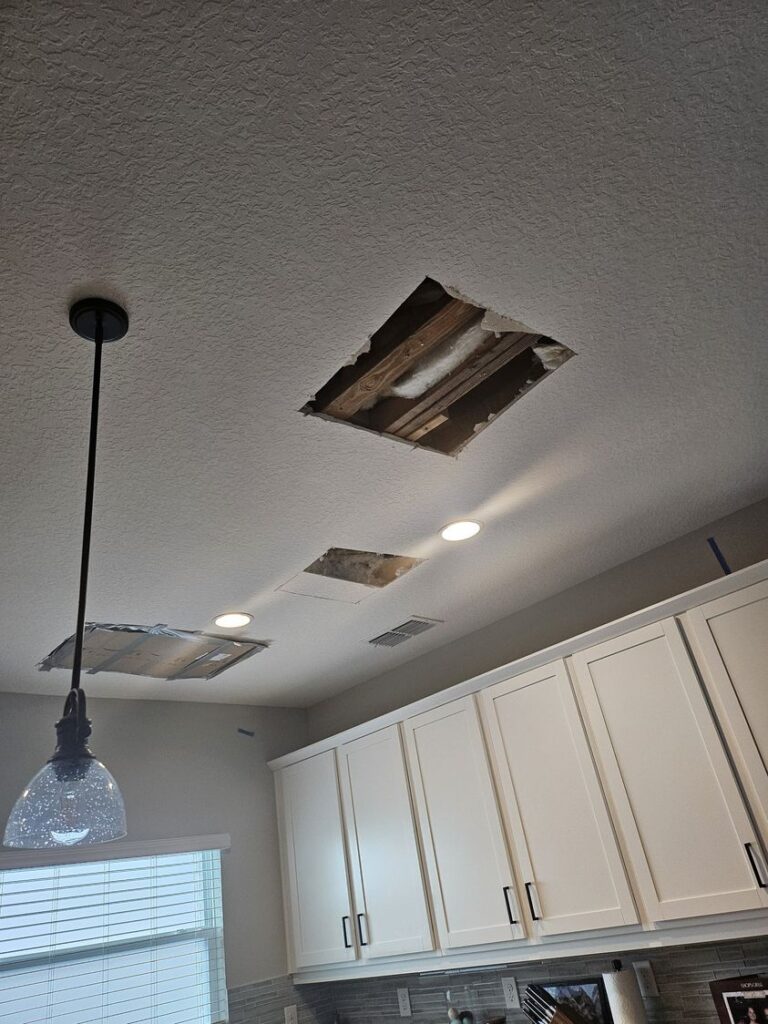
An hour later, he returned with a second plumber. They said that they would be cutting into the drywall to repipe the sink. I have a complete set of photos of what the house looks like without drywall in place. I show them where the pipes are, and they cut a 2′ square hole in the kitchen ceiling. In the wrong spot. They are mystified when they wind up under the upstairs air conditioning plenum.

I again point out to them that they are in the wrong spot. This time, they cut where I tell them the pipes are. There is the hot water pipe, and they tell me that the pipe was mislabeled during construction. They then cut a third hole so they can tap off of the bathtub’s hot water.

The sink upstairs still doesn’t have hot water at that point. They keep trying to figure it out. At this point, they have been at it for over 4 hours. There are three giant holes in my kitchen ceiling. There is insulation raining down all over the kitchen. My house is in a shambles. We can’t use the kitchen.

I asked them if they checked to see if the faucet is bad. They looked at me like I was a moron, so I continued: “What if there was some construction debris in the pipe, and it made its way to the faucet’s hot water valve, clogging the valve.” They asked how I would figure that out. I replied: turn off the cold water valve under the sink. If the faucet still works, it’s piped wrong. If the sink doesn’t work, it’s the faucet.

It was the faucet.

They plumbers apologized profusely and said that their boss would call me to figure out how to repair my ceiling. This is what it looks like.

I understand that mistakes happen, so I call the builder. He tells me that it’s a warranty issue, says he will put in a work order, and according to the warranty documents that I agreed to at closing, they have up to 15 business days to repair it. They will, he tells me, get to it “when they get to it.”

I tell him that he needs to do a better job of reading the warranty. A warranty item is described as a “defect in materials or workmanship that occurred during construction of the home.” This didn’t happen during construction. It happened because his subcontractors were incompetent morons. This means that it is a claim for their insurance, and they have exactly one week to get it fixed. If it isn’t, I am going to hire someone to fix it myself, then I will sue them to collect my costs.

I can’t use my kitchen. There is drywall dust everywhere. We are finding blown in insulation all over the house, because when the plumbers tried to clean the insulation that had fallen from the ceiling, the shop vac they used just blew it everywhere. That cardboard patch that is duct taped to the ceiling in the picture below? It fell off 15 minutes after they left.

Now every time we open a door or the air conditioner comes on, insulation falls from the holes. Bugs crawl in at night. So I got some pieces of cardboard and attached them to the ceiling using staples from my nail gun. These are essentially holes that open my house to the outside.

I am more than a bit pissed off about this. If it isn’t fixed by Monday, I will start calling my own drywall guys and an attorney. This is complete and utter bullshit. I’m not nearly as mad about the plumbers fucking up as I am about the attitude of the warranty supervisor. You handle things like this by saying “I am so sorry this happened. Let me tell you what we are going to do to fix this. It will be a priority item for us, and I will see how quickly I can get someone out to help you. In the meantime, one of us will be over right away to secure your home from the elements.”

What you don’t say is “I don’t control the drywall company’s schedule. I will put in a work order and they will get to it when they get to it.”

In the meantime, posting may or may not be sporadic as I deal with this and still have to go to work to pay the mortgage on my now trashed house.

Earthquake in NJ, just outside of NYC

An earthquake of magnitude 4.7 just hit New Jersey at about 10:30 this morning. The center is in Readington Township, about 30 miles west of New York City. My brother in law, who lives about 80 miles north of the epicenter, said that it was enough to feel the walls shake in his apartment. He lives in a two story building and said the walls were shaking.

A friend of ours who is a banking executive in NYC said he thought that the furnace in the house had exploded.

Everyone Gets Paid for Everything, or Nothing

People have lost their minds and think that they should get money because they want it. Now some stupid whore has decided that, because she got cream pied by some random dude at a college frat party kegger, that businesses or someone should pay her because she is having to care for her crotch fruit.

“I think that at the very least, stay-at-home parents should earn the equivalent of working full-time on minimum wage,” she tells Yahoo Life about what inspired her to make the video. “In Michigan, this would be about $1,600 a month. However, I think to really make this work you should offer all parents either a monthly [stay-at-home parent] stipend or a voucher for free daycare. This would allow parents to have more freedom to make the decision that will work best for their family without sacrificing their career, if they would like to continue working.”

Say what? Then she doubles down:

Whether working outside the home or inside the home, we are all raising our children. However, only the parents working outside of the home are being compensated for the time spent working.

I just can’t fight the stupidity any longer.

Hazards of Batteries

There have been people who are saying that solar is unsafe because the batteries present a safety hazard. I was trying to keep the discussion here a simple one and not get bogged down in minutiae, but there are always people who want to make a simplified discussion more involved and complicated than it needed to be. Remember when I said that there was a lot of misinformation and outright bullshit out there?

If you don’t want to read this long post, you can refer to the CPSC page on solar system fires. Or you can read my lengthy research on the subject:

A little bit on my background. First, I was a Navy Electrician’s mate. I spent six years being professionally trained on high voltage electrical systems. I didn’t work with batteries, but I did work with a lot of electricl stuff. No, I am not an engineer, but I still have the basics.

Second, I spent decades as a firefighter. I have Bachelor’s degrees in Fire Science, in Public Safety Administration, (even though it doesn’t apply here, Nursing), and am a couple of classes shy of a degree in Chemistry. I am also certified in HAZMAT to the operations level as a result of my time as a firefighter. Yeah, I was trying to become a Battalion Chief, and I was actively working towards that, so I took a lot of college.

Let’s take a look at fire incidents involving batteries. Fire departments in the United States track fires throughout the US using the National Fire Incident Reporting System (NFIRS). Every time a fire department responds to any incident, they file a report that sends data to this system. Every kind of fire is tracked, including those by batteries. This has created a huge database. The National Fire Protection Association (NFPA) is the industry group that publishes fire protection information. The NFPA sets the standards that battery manufacturers in the US must follow, and that standard is NFPA 855.

Lithium battery fires are caused by a phenomenon called thermal runaway. In these situations, the increased temperature in the battery triggers it to raise temperatures even higher. As a result, the battery may become too hot to touch, smoke, catch fire, eject gas, or explode. As with any battery, a solar battery could potentially cause a fire if it overheats. But the top brands have strict quality control and are very quick to do a recall if something is found to go wrong, which is incredibly rare.

The type of lithium-ion battery can make a difference, too. There are different chemistries that are used in lithium-ion batteries, for example lithium cobalt oxide or lithium iron phosphate, and some are better than others when it comes to the risk of overheating. The safest in this regard and least likely to experience thermal runaway, is lithium iron phosphate. LiFePO4 batteries are also the most durable.

The other key to ensuring safety is to make sure everything is installed correctly and that the various components of your solar system are compatible. In particular, the charge controller that manages the power flowing from your solar panels into the battery: an incorrectly sized charge controller won’t protect your battery from overcharging properly and could potentially lead to problems.

To ensure the safety of your solar power system and property you should only invest in dependable and tested solar lithium-ion batteries from a reputable company that are properly installed by an experienced installer in accordance with the manufacturer’s recommendations. Always research battery brands before purchasing, including their product reliability, testing processes, and reviews.

That is one of the reasons why I decided to go with Tesla Powerwalls and why I won’t install it myself. I don’t have the experience with battery systems to the point where I trust myself to avoid a redneck engineering situation where I put together a system that works, but creates a fire hazard.

The Risk

What are the odds of an installed lithium battery catching fire? While the NFIRS system doesn’t track fires in lithium batteries versus other kinds of batteries, it does have pretty good statistics involving battery fires in general. Nearly every fire that I could find involving a lithium battery was in a cell phone, e-bike, or e-cigarette. These sorts of small batteries present fire hazards because they are small batteries where space is at a premium, and they are not properly vented due to those size constraints. Different type of issue than the larger batteries seen in EVs and large scale storage batteries.

Factors in battery fires are easy to track. Overcharging these smaller lithium batteries is the cause of these fires. According to the CPSC, approximately 54% of residential fires involving batteries resulted from overcharging or charging with incompatible chargers. In other words, people charging their e-cigarette, e-scooter, or e-bike with a cheap Chinese charger that they bought at Dollar General.

The CPSC reported that 18% of battery-related residential fires were caused by physical damage to the device. Not going to be an issue with a battery that is in a sturdy enclosure that is bolted to the wall. The NFPA states that approximately 20% of battery-related home fires resulted from improper storage conditions.

That’s 92 percent of all battery related fires being caused by improper charging, improper handling, or improper storage. This simply isn’t going to be an issue with a professionally installed home battery system.

Outside of that there are a few EV fires, and one other incident in a town called Surprise, Arizona. I searched every database that I could, and found a very few fires involving large storage batteries.

So avoiding all of the media hype, just what are the statistics involving batteries and fires?

  • Each year, there are about 9,300 fires that occur in the United States.
  • Tesla alone sells about a million EVs each year. There were 44 electric vehicle fires in 2023.
  • In total, there were 390 fires, explosions, overheating, or incidents of venting involving batteries of all kinds in the US in 2023, but once you remove the smaller batteries as discussed above, that drops to less than 100.
  • Worldwide, Underwriter’s Laboratories reports that there have been 51 injuries and 4 fatalities from large storage batteries since they began tracking them in 1995.
  • Considering that there are about 2 million homes in the US with solar storage batteries in them, seeing 100 fires per year means that the risk is extremely low: about 1 in 20,000.
  • The batteries in energy storage systems (ESSs) predominantly use safer lithium-iron phosphate (LFP) chemistry, compared with the nickel-manganese-cobalt (NMC) technology found in EVs.
  • The failure rate of lithium batteries is about 1 in 40 million.
  • LFP cell failure results in less energy release and a lower probability of fire. A LFP battery that fails is more likely to smoke than it is to catch fire.

So yes, about 1 in 100 fires in the US involves a large battery of some kind, with the majority of those being EV battery fires, and one known case of a home storage battery causing a fire in the past 5 years. The risk of a solar battery fire is exceedingly low, but it is possible.

What if A Battery Does Catch Fire?

The National Fire Sprinkler Association is an industry trade group that is responsible for tracking how fire sprinklers put out fires. This is a great resource for fires involving lithium batteries. While it is true that there have been several high profile incidents involving lithium batteries, the incidence of them is rare, as discussed above. That brings us to our next point:

A second statement was that Lithium fires are impossible to put out, so fire departments don’t even waste their time with them. That’s a surprise to me, after spending more than 30 years as a firefighter. The metal fires that gave me fits were magnesium fires. There are certain brands of cars that use magnesium in their transmissions that are hard to put out, and I hated car fires involving them.

One of the problems that I saw with vehicle fires in general is that many firefighters have trouble putting them out. The fire is usually in an area protected from water, and lobbing water on the roof or hood of a car from 30 feet away isn’t effective at putting out a fire in the engine or transmission. You need to get to the source of the fire for any sort of firefighting to be effective.

Still, let’s look at the available information. The National Fire Protection Association is the fire industry’s main source of research and information on fires and fire prevention. Here is what they have to say on the matter:

Water works just fine as a fire extinguishing medium since the lithium inside of these batteries are a lithium salt electrolyte and not pure lithium metal. Confusion on this topic stems from the fact that pure lithium (like what you see in the table of elements) is highly reactive with water, while lithium salts are non-reactive with water.

However, this is only true of small and EV batteries. I would not recommend fighting a home solar battery fire with water, because a home battery storage system will be energized with some relatively high voltages. Although there are some companies out there that are trying to sell specialized equipment for these fires, most of it looks like hogwash that is designed to steal your money. My bet will be on using dry chem and calling 911.

Conclusion

The risk of fire from solar batteries is rare, and I worry more about an ordinary electrical fire caused by the wiring in the wall or from a stove than I do from the solar or its associated battery system. The battery in my laptop is more likely to cause a fire than a solar battery.

I am not going to worry about it.