Watch the second video for a pretty funny voice over.
Anti American left
Rights Without Responsibility
Watch this video, then I will tell you my own story.
She claims to be an independent woman while at the same time wants her father to pay for her wedding, because she can’t. That doesn’t sound very independent to me.
When my daughter was 15 years old, she was dating this 20 year old loser who it turned out didn’t have a driver’s license because his had been suspended. When I told him that he couldn’t take her anywhere in a car since he had no driver’s license, he told me to mind my own business. I tried explaining to her that he was a loser who couldn’t date women his own age, so he was chasing younger girls, and all he wanted was to get laid. She told me that I was too old to understand how it is “nowadays” and that they were soulmates, and there was nothing I could do to keep them apart.
See, school taught her that she was a strong girlboss who wasn’t owned by anyone. She could decide for herself, thank you very much.
The young lad sent me an email telling me to mind my own business or he would come over with a bat and teach me a lesson. The next time he came over, I pulled a gun on his smarmy ass and told him that if I caught him coming over to my house again, I would kill his ass and produce the email as evidence in my trial.
I caught them once, having sex on my couch. I called the cops, who did exactly nothing.
Things degenerated to the point where she would just walk out whenever she pleased. Out of the house while I was taking a leak, out of school when he wanted to see her, nothing worked. I even tried getting a restraining order, but the courts denied granting it because she begged them not to. It turns out that the courts hold a teenage girl’s opinion in more regard than that of her parents.
On the day she turned 18, my daughter came out of her room and told me that she was now an adult and could do whatever she wanted. I pointed out to her that part of being an adult is understanding that adults have responsibilities, and one of those is to learn that there are consequences for every action you take, meaning that you can’t always do whatever you want.
She replied that she was done with my “bullshit rules” and she was going to live with her soulmate. I told her that, if she decided that she was an adult, then she needed to understand that, as an adult, she would have to provide everything on her own. Don’t come back here and ask for any handouts, not even a single dollar. She walked out.
I didn’t see her again for four years. That was when she came to me and asked for money for her wedding. It appears that she had broken up with her soulmate six months after moving in with him, and he stalked her to the point where she had to get a restraining order. She met this new guy, they were in love, and wanted to get married. She wanted me to pay for the wedding. I told her no.
My ex-wife (her mother) called me to tell me what an asshole I am, before telling me that I should pay for the wedding AND the honeymoon to Alaska, a bill that came to over $20,000. I said no. She is an adult, and I am not going to have her turn her back on me, only to come crawling back whenever she needed money.
The biggest lesson that she learned was just a few months after my grandson was born. Her husband ran off with an only fans porn actress, leaving my daughter and his kids high and dry. That was what she needed to grow up. The responsibility of having children of her own taught her lessons that she was unable to listen to when I tried to teach them.
Our relationship has never been the same as it once was, but we have slowly come to terms with what happened.
All because society and our kids’ schools fill these kids’ heads with ideas about the rights of being an adult, but don’t bother to teach them about the responsibilities that come with it.
You can’t be an independent adult if you need someone else’s money to pay for it.
Anti American left
Fire with Fire
The left is all butthurt because Trump apparently closed a McDonald’s so he could have a photo op of himself working there.
The thing is that they are conveniently ignoring the Astroturfing being done by the Harris campaign, where she stocked a closed restaurant with adoring fans before visiting it. The thing is that Trump is simply doing the “work an ordinary job” thing that was started by Florida’s Lawton Chiles back in 1970, then copied and repeated by Bob Graham beginning 1977. The basis of the plan was that Chiles (and later Graham) would spend a day performing the job of one of their constituents to show that they understood what ordinary working people were going through.
Me
Fall
This week has been pleasant in Florida, with temperatures being typical for a Florida Autumn. The highs have been in the high 70s to low 80s, lows in the upper 50s and low 60s. Pleasant breezes carrying air that is, for the gulf coast, rather low in humidity.
It has triggered some strong, pleasant childhood memories. I remember most vividly a fall day spent watching my mother decorate the house for fall with expanding paper pumpkins and other assorted fall and Halloween decorations, the windows open and cool fall breezes blowing through the house as dinner cooked in preparation for my father coming home from work. It is one of the more pleasant memories from my childhood. I still fondly remember those decorations to this day, 50 years later.

Now, the child is gone. My mother and father are gone, the paper pumpkins are gone. The country that I grew up in is gone. All that remains are the memories of a time that no longer exists in the head of a man who now is old enough to get free coffee at Denny’s and has grandchildren who are older than I was in those memories of an autumn long gone.
I had a tough week at work. Because the weather has been so mild, people haven’t been coming in to the ED for the stupid reasons that they usually do come in for, so we haven’t been as busy as usual. I have been in the critical zones, and my patients have been truly sick. More than half of my patients have been admitted to the ICU, and that makes for a heavy workload and a lot of thinking about life and death.
Combine the battles with death and the upcoming anniversary of my mother’s death and father’s birthday, and you have what I suppose is the reason why I am feeling a bit- nostalgic.
My wife, without even knowing the memories and thoughts in my head, has decorated the house for autumn. It makes me content. I don’t think of myself as an old man, yet. I’m not old enough to be a boomer, but I still feel older every day.
It’s a perfect metaphor. I am in what is probably the October of my life, and missing the time when I was a child. I can feel the chill of an approaching winter, can you?
Military
Mexigun National
I couldn’t resist the pun in the title. Check this out, from the US Navy:

A Mexican national, serving in the US military. Some comments claimed that it could be a joint military exercise, but that isn’t the case. The Mexican Navy doesn’t use the same rank structure as the US Navy, and would not contain a rank of “Gunner’s Mate Third Class.” No, what you have here is a military being staffed by FORN personnel.
You, my fellow Americans, are being replaced by people who will be loyal to TPTB.
Anti American left
They Will
To those who claim that the military won’t hunt down people on the right, simply because the President orders it:
and this guy.

Economy
Fair Share
The refrain from the left is that the “rich” need to pay their “fair share” as if they aren’t paying taxes. Let’s take a look at what that means.
The top 1 percent of taxpayers pay nearly double the income taxes than the bottom 90 percent. The top 1 percent of taxpayers paid more than $1 trillion in income taxes while the bottom 90 percent paid $531 billion.
The share of income taxes paid by the top 1 percent increased from 33.2 percent in 2001 to 45.8 percent in 2021. Over the same period, the share paid by the bottom 50 percent of taxpayers fell from 4.9 percent to just over 2.3 percent in 2021.
That’s right- the lowest 50% of wage earners paid just 2.3% of all income taxes, while the top 25% of wage earners pay 89.3% of them.
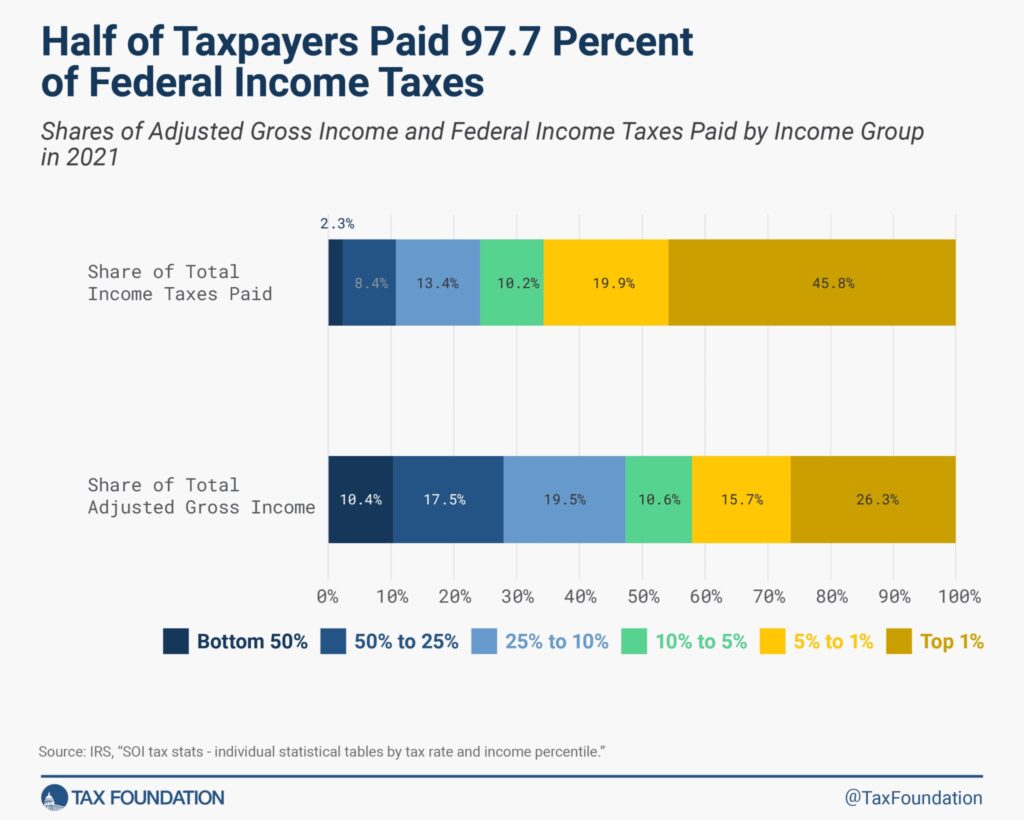
So just how much do you have to make to be in that upper 50%, or upper 25%? To be in the top 50%, a taxpayer must earn at least $46,637 per year. In order to be in the top 25%, a taxpayer would need to make $94,440. The top 25% isn’t all that rich- there are tons of people like nurses, firefighters, restaurant managers, electricians, and auto mechanics who fall into that top 25% category. The top 10% of wage earners? Those are people making $169,800 or more. Those are your doctors, chiropractors, accountants, lawyers, and many entrepreneurs. Successful, to be sure, but hardly evil people playing the part of Ebenezer Scrooge.
The left claims that they are only going to raise taxes on people making more than $400,000 per year. That is the top 3% of all wage earners, a group that is already paying more than 24% of their income on taxes, and who are already paying 60% of all Federal income taxes.
Even if we were to confiscate every penny made by the top 5% of earners, the government would only get $6.1 trillion. Since the government spends more than $6.2 trillion a year, that amount wouldn’t even be enough to run the government for the year, and I guarantee you that those wage earners wouldn’t be there to fleece next year.
No, when the left tells you that they want to increase taxes, they mean for everyone. Of course that won’t affect them, because they are getting a cut for themselves. You didn’t think that those billions going to Ukraine were all for beating Russia, did you?
Blog News
Society’s Purpose
The purpose of society, and in particular of government, is to protect the rights of others. Even more specifically, to protect those who cannot protect themselves. The person commenting from Live Oak, Florida, a commenter that I am calling Odd Poster, has been advocating sex with minors.
Yet 100 years later with better nutrition human brains are maturing more slowly now? How did that number of 10-12 get picked by the legislatures, were the majority of American voters in 1880 all pedophiles? Today some 16 and 17 year olds are more physically developed than 25 year old women, but their brain development doesn’t keep pace with their body development? Does that make medical sense?
wikipedia: Restricted by age difference: younger partner is deemed able to consent to having sex with an older one as long as their age difference does not exceed a specified amount.
Today that age is 14 in Indiana, and 13 in some other states. Because the “child” does not have a child’s immature brain if she picks another high school age person as a partner? Or you’re less pregnant if the father is under 18? Gee that makes sense.
Rule 1 of posting on this blog:
The owner of this blog (me) has the final say on what you can and cannot post. It’s my house, I make the rules. Content here is moderated, and I will not be approving any comments that I find, in my sole judgement, to be unworthy.
Then there is also Rule 10:
These rules can change with no notice, and rules may or may not apply retroactively. That’s up to me. See rule #1.
I try to support the free exchange of ideas on this website, but I cannot support people advocating sex with children as young as 12 years old. Accordingly, I am banning the entire IP address 71.29.27.11 because I will not allow comments that defend preying on children.
I do so as the owner of this blog. You want to diddle children? You aren’t going to do it on this blog, or on this server, nor will you advocate for that. The last thing I need is more of a spotlight on this blog by the Feds, especially not for pedophiles. Anyone who has a problem with that, there is the door- Go do that shit somewhere else.
My son testified in court against his best friend, a kid we had both known since he was 8 years old, because that friend was screwing children, filming it, and posting the film on the Internet. That friend is currently serving 30 years in Federal Prison, and I fully support that. I would do the same thing my son did in a heartbeat.
Government
Government
Man, I am on a roll today with the number of posts.
Normally, I don’t believe that government is the answer. However, in cases where the government has created the problem, we need to call on government to make adjustments to fix the problem that they created. Case in point:
Fake service dogs are only possible because government has made it a crime to discriminate against those with service animals, and have made it a crime to even ask them to prove that the animal is, in fact, a service animal. This is where the law needs a tweak. Service dogs cost thousands of dollars. Adding the requirement that the owners who have a service animal have a government issued ID for the service animal, proving that the animal in question is actually a service animal, would keep people like this blue haired freak from faking it to be a pain in the ass.
Tranny Insanity
Feminism: The End of Women’s Sports
Women’s sports were set up exactly because women aren’t as strong as men. Now there are many feminist women who will tell you that women are just as strong and capable as men, and you are a sexist misogynist for claiming otherwise. Of course, we know this to be false, or else the NFL and NBA would have female athletes and save money in the process, because we all know that women make 20% less than men.
Mediocre male athletes who aren’t good enough to compete against other men are taking advantage of these feminist morons by declaring themselves to be women in order to gain access to some of that sweet, sweet scholarship cash.
The left, who is busy destroying women’s sports in favor of tranny sports, is not going to let this go without a fight:
Women’s sports is now pointless. Men who can’t compete can simply declare themselves to be women, and thereby eliminate the entire field of women’s sports. Pretty soon, all women’s sports will consist of “women” sporting beards and playing the game.