It is possible with today’s technology to produce a diamond that is virtually indistinguishable from a natural diamond. Governments are rushing to force diamond sellers to call man-made diamonds “synthetic diamonds.” The choice of terms is, in my mind, selected to bring to mind “fake diamonds” in a move intended to protect diamond miners and not the consumer.
Welfare State
Mobile Home
I don’t have any problems with this. If you want to live in an area that is prone to hurricanes and flooding, either bring your house up to current standards or don’t expect government handouts.
Your house is a 75 year old trailer. Don’t expect taxpayers to give you thousands of dollars to fix it.
On the other hand, the county is taxing an ancient mobile home on an assessed value of $237,000 not counting the land. That is ridiculous
Cops
Just a Criminal Gang at This Point
In April of 2023, a Kissimmee Police officer illegally and without a warrant entered the home of a man. The cop claims that he saw the man push his father, so the cop attempted to arrest the man, using force by kneeing the man in the face and shooting him with a Taser more than 7 times. The force used did extensive damage to the man’s face, breaking his nose and requiring dental work.
When questioned about the incident, the chief of police had this to say:
The video was surprising because the knee spikes went against training. However, she said the repeated use of the taser was within what’s considered proper use to gain compliance.
“I couldn’t see it on the video, but I will take Officer Baseggio’s word that he saw what he thought was a battery,” Holland said. “And so with that being said, he doesn’t know if he was going to go arm himself.”
As a result, the cop got an 8 hour suspension. That is the end of it. Or so it seems. It turns out that there was much more to the story.
It turns out that the cop lied on his incident report, as well as intimidating witnesses to tell the story of the incident in a way that was favorable to the officer and his actions. As a result of that, he was indicted by a grand jury on charges of felony battery, misdemeanor battery, official misconduct, solicitation for perjury and two counts of tampering with a witness. He was fired as a result.
Still, that isn’t the entire story. It turns out that while the AG’s office was investigating the rogue cop, they were questioning his fellow officers, and 11 of them lied in official statements in order to protect and cover for him. Those 11 cops were also indicted, and as a result both the chief and deputy chief of police were terminated.
As I have said before, the bad cops lie, abuse their power, cheat, and steal. The so-called “good” cops will lie and cover for them, which makes them all bad cops. At this point, the only difference between most police and a criminal gang is that the cops have badges and immunity.
I repeat what I have said before- we as citizens need to demand one of two things:
- Eliminate qualified immunity and force police to get malpractice insurance
- Pass a law that any lawsuit against police for unlawful behavior against citizens be paid directly from the police pension fund.
Make cops have skin in the game.
Anti American left
Rights Without Responsibility
Watch this video, then I will tell you my own story.
She claims to be an independent woman while at the same time wants her father to pay for her wedding, because she can’t. That doesn’t sound very independent to me.
When my daughter was 15 years old, she was dating this 20 year old loser who it turned out didn’t have a driver’s license because his had been suspended. When I told him that he couldn’t take her anywhere in a car since he had no driver’s license, he told me to mind my own business. I tried explaining to her that he was a loser who couldn’t date women his own age, so he was chasing younger girls, and all he wanted was to get laid. She told me that I was too old to understand how it is “nowadays” and that they were soulmates, and there was nothing I could do to keep them apart.
See, school taught her that she was a strong girlboss who wasn’t owned by anyone. She could decide for herself, thank you very much.
The young lad sent me an email telling me to mind my own business or he would come over with a bat and teach me a lesson. The next time he came over, I pulled a gun on his smarmy ass and told him that if I caught him coming over to my house again, I would kill his ass and produce the email as evidence in my trial.
I caught them once, having sex on my couch. I called the cops, who did exactly nothing.
Things degenerated to the point where she would just walk out whenever she pleased. Out of the house while I was taking a leak, out of school when he wanted to see her, nothing worked. I even tried getting a restraining order, but the courts denied granting it because she begged them not to. It turns out that the courts hold a teenage girl’s opinion in more regard than that of her parents.
On the day she turned 18, my daughter came out of her room and told me that she was now an adult and could do whatever she wanted. I pointed out to her that part of being an adult is understanding that adults have responsibilities, and one of those is to learn that there are consequences for every action you take, meaning that you can’t always do whatever you want.
She replied that she was done with my “bullshit rules” and she was going to live with her soulmate. I told her that, if she decided that she was an adult, then she needed to understand that, as an adult, she would have to provide everything on her own. Don’t come back here and ask for any handouts, not even a single dollar. She walked out.
I didn’t see her again for four years. That was when she came to me and asked for money for her wedding. It appears that she had broken up with her soulmate six months after moving in with him, and he stalked her to the point where she had to get a restraining order. She met this new guy, they were in love, and wanted to get married. She wanted me to pay for the wedding. I told her no.
My ex-wife (her mother) called me to tell me what an asshole I am, before telling me that I should pay for the wedding AND the honeymoon to Alaska, a bill that came to over $20,000. I said no. She is an adult, and I am not going to have her turn her back on me, only to come crawling back whenever she needed money.
The biggest lesson that she learned was just a few months after my grandson was born. Her husband ran off with an only fans porn actress, leaving my daughter and his kids high and dry. That was what she needed to grow up. The responsibility of having children of her own taught her lessons that she was unable to listen to when I tried to teach them.
Our relationship has never been the same as it once was, but we have slowly come to terms with what happened.
All because society and our kids’ schools fill these kids’ heads with ideas about the rights of being an adult, but don’t bother to teach them about the responsibilities that come with it.
You can’t be an independent adult if you need someone else’s money to pay for it.
Military
Mexigun National
I couldn’t resist the pun in the title. Check this out, from the US Navy:

A Mexican national, serving in the US military. Some comments claimed that it could be a joint military exercise, but that isn’t the case. The Mexican Navy doesn’t use the same rank structure as the US Navy, and would not contain a rank of “Gunner’s Mate Third Class.” No, what you have here is a military being staffed by FORN personnel.
You, my fellow Americans, are being replaced by people who will be loyal to TPTB.
Anti American left
They Will
To those who claim that the military won’t hunt down people on the right, simply because the President orders it:
and this guy.

Economy
Fair Share
The refrain from the left is that the “rich” need to pay their “fair share” as if they aren’t paying taxes. Let’s take a look at what that means.
The top 1 percent of taxpayers pay nearly double the income taxes than the bottom 90 percent. The top 1 percent of taxpayers paid more than $1 trillion in income taxes while the bottom 90 percent paid $531 billion.
The share of income taxes paid by the top 1 percent increased from 33.2 percent in 2001 to 45.8 percent in 2021. Over the same period, the share paid by the bottom 50 percent of taxpayers fell from 4.9 percent to just over 2.3 percent in 2021.
That’s right- the lowest 50% of wage earners paid just 2.3% of all income taxes, while the top 25% of wage earners pay 89.3% of them.
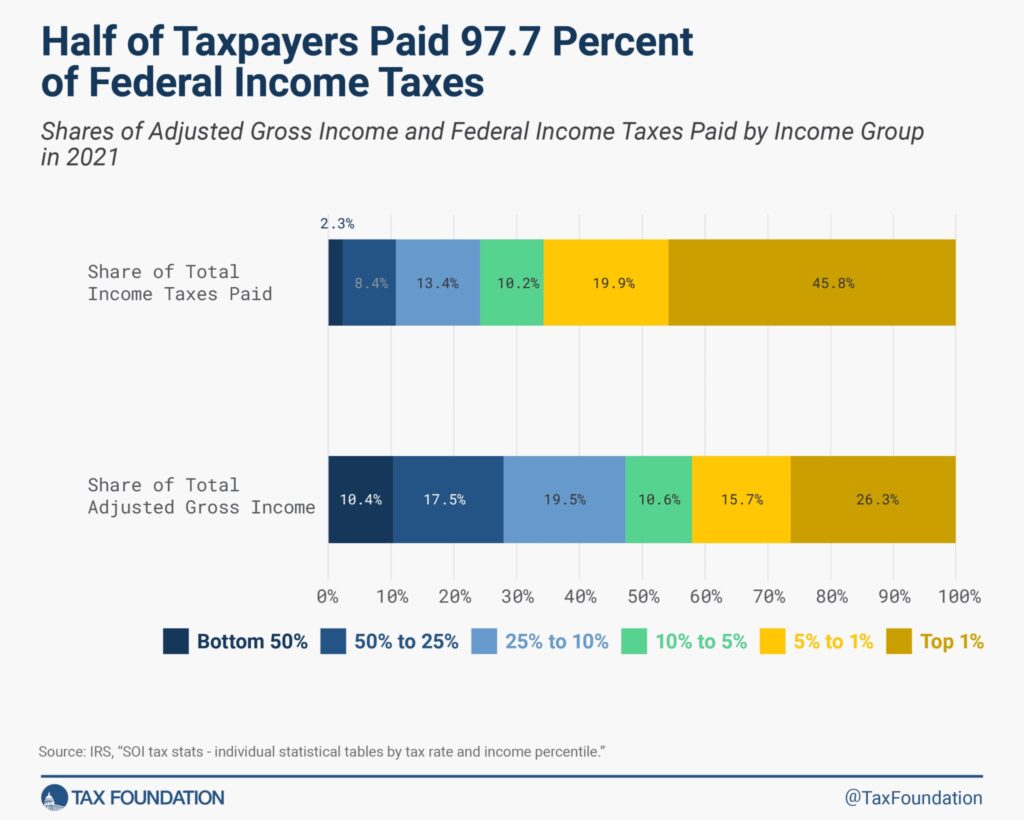
So just how much do you have to make to be in that upper 50%, or upper 25%? To be in the top 50%, a taxpayer must earn at least $46,637 per year. In order to be in the top 25%, a taxpayer would need to make $94,440. The top 25% isn’t all that rich- there are tons of people like nurses, firefighters, restaurant managers, electricians, and auto mechanics who fall into that top 25% category. The top 10% of wage earners? Those are people making $169,800 or more. Those are your doctors, chiropractors, accountants, lawyers, and many entrepreneurs. Successful, to be sure, but hardly evil people playing the part of Ebenezer Scrooge.
The left claims that they are only going to raise taxes on people making more than $400,000 per year. That is the top 3% of all wage earners, a group that is already paying more than 24% of their income on taxes, and who are already paying 60% of all Federal income taxes.
Even if we were to confiscate every penny made by the top 5% of earners, the government would only get $6.1 trillion. Since the government spends more than $6.2 trillion a year, that amount wouldn’t even be enough to run the government for the year, and I guarantee you that those wage earners wouldn’t be there to fleece next year.
No, when the left tells you that they want to increase taxes, they mean for everyone. Of course that won’t affect them, because they are getting a cut for themselves. You didn’t think that those billions going to Ukraine were all for beating Russia, did you?
Government
Government
Man, I am on a roll today with the number of posts.
Normally, I don’t believe that government is the answer. However, in cases where the government has created the problem, we need to call on government to make adjustments to fix the problem that they created. Case in point:
Fake service dogs are only possible because government has made it a crime to discriminate against those with service animals, and have made it a crime to even ask them to prove that the animal is, in fact, a service animal. This is where the law needs a tweak. Service dogs cost thousands of dollars. Adding the requirement that the owners who have a service animal have a government issued ID for the service animal, proving that the animal in question is actually a service animal, would keep people like this blue haired freak from faking it to be a pain in the ass.
tyranny
Not Murder in My Book
A man kidnaps and rapes a 14 year old girl. He is arrested and released on bond. A condition of the bond was that the man was to have no contact with the victim or her family.
That same night, the girl is again found to be missing at 1 am. The police and the girl’s father were looking for her. The father found her first. In a truck. In a park. With her rapist.
An argument ensued, shots rang out, and the rapist was dead.
The cops arrested the dad for first degree murder, and the dad is now out on bond. The cops said that there was no reason to shoot the man, because they were on the case.
“This guy that preyed upon their daughter was released on bond, and we had stopped him that night and got him with her,” the Sheriff said. “That bond would have been revoked. He would have never got out of jail. None of the bond companies would have let him out. We wouldn’t let him out.”
The mother of the child said that she and her husband were in fear that the man was going to murder their daughter.
“We absolutely called 911 during the entire event,” she wrote. “We had no idea this man was in contact with our child again. He was waiting 6-9 felonies for what he did, not 2. He was looking at the rest of his pathetic life in jail, and our daughter was the only witness.”
“Some things we will never know, but we know that the police department afforded this predator privacy they did not give our family,” she wrote. “I’m deeply offended by the way this was handled by the county sheriff’s office.”
The prosecutor has not yet filed any charges. Gofundme is not permitting the father to raise money for his defense, because they claim to not allow collections for legal defense of an alleged violent crime.
The child’s mother claims to know why the police are so determined to arrest her husband: the dead rapist was a retired police chief and former school resource officer from Indiana:
[The mother] said the Lonoke County Sheriff’s Office’s actions are proof that the sheriff “supports predators” and that he will prosecute those who are trying to protect their families.
I am not sure you will be able to assemble a jury that will find him guilty, unless the court wants to cheat the system and prevent the defense from mentioning the events that led up to the shooting.
I do know that in Florida, the law says that you can use lethal force to prevent the imminent commission of a forcible felony, which includes sexual battery and kidnapping. Of course that won’t stop a crooked cop or politically motivated prosecutor from charging you anyhow, leaving you penniless. Ask George Zimmerman how that works.
Police State
No More Qualified Immunity
Why? Because you need an ID to lie on a park bench, but you don’t need one to vote.
It’s time for qualified immunity to go. As a health care professional, I have to carry a million dollars in malpractice insurance. It’s time we make cops do the same.
Can we here in Florida get a petition to have this added to next year’s election as a State Constitutional Amendment?
Facts of this case:
On June 7, 2019, Keokuk, Iowa Police Officer Tanner Walden responded to a report that someone was sleeping in a park. Walden found Land, who was watching the sunset on a park bench. Land told Walden that he had not been sleeping and was not in distress. Walden asked for identification, and Land refused. Walden arrested Land for misdemeanor interference with official acts. During a search, officers found drug paraphernalia and added a misdemeanor charge of possession of drug paraphernalia. The incident was captured on Walden’s body-worn camera.
On August 27, 2019, a judge dismissed the charges against Land because the pretext for the stop was improper.
On June 6, 2021, Land filed a federal lawsuit against the city and Walden, claiming violations of his rights under the Fourth Amendment.
On September 20, 2021, the city claimed that Walden “exercised all due care to comply with the law and is entitled to qualified immunity” and also (in October 2022) that Walden had reasonable suspicion as required by Terry v Ohio and probable cause to arrest Land.
On October 26, 2022, the judge disagreed when he ruled that Walden’s contact with Land should have ended when it became clear that Land was not sleeping in the park or in need of assistance, and that the city was not responsible for Walden’s actions.
On November 22, 2022, the city settled the lawsuit for $30,000.