One of the things I am drawn to, and quite skilled at, is processing data. It’s why I enjoyed operating a fire truck, and it’s also why I like my job in medicine and enjoy the technical end of SCUBA. I would probably been pretty good at engineering. I love processing data and doing math in my head. I also enjoy having a good tool that will make that job easier.
Enter dive computers. These machines take all of the guesswork out of diving. Traditionally, divers would use a table where the maximum depth and total dive time were looked up on a table that would tell you the maximum time you could be underwater. This is called “square profile” diving. The table assumes you descend from the surface to a set depth, remain at that depth the entire dive, then return directly back to the surface. In reality, no one dives like that.
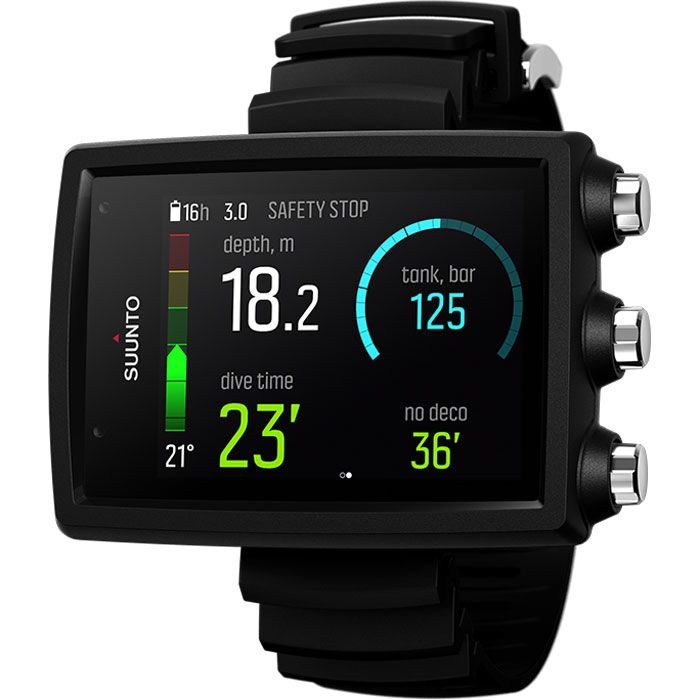
A dive computer uses a mathematical model to calculate how much Oxygen (and other gases) are in your tissues, then uses that to tell you what you need to do in order not to get the bends. It resamples the factors of the dive every 30 seconds.
That’s one of the things that I can’t understand about this diving accident. The diving computer would have warned them:
- that they were approaching the no decompression limit once they had been under for about 7 minutes at a maximum depth of 160 feet. It would beep and flash.
- When they reached 187 feet, they would have gotten another set of beeps warning them that the oxygen was at the maximum safe limit of 1.4 atmospheres of pressure
- Most computers have a depth alarm that would have warned them about exceeding depth limits
- Many computers have turnaround alarms that will warn you when you have used a third (or some other programmable amount of your air) of your breathing gas
- Many dive computers would have had their models exceeded and would go into “violation” mode. There are more alarms here, and the computer only functions as a digital set of gauges after that point.
In short, there is no way that dive was an accident, and that is not even considering the stupidity of swimming that far into a cave. It always astounds me that someone will pay a thousand dollars for an expensive piece of gear that’s designed to save your life, then will ignore that device. The cheapest dive computer can be bought for less than $100 (although I wouldn’t bet my life on cheapest.)
My dive computer cost me well over $600, but it is obsolete and no longer for sale. If I were to buy one today, I would want a gas integrated console computer that can handle multiple gas mixes on one dive. The small wrist ones aren’t readable by this old man’s eyes- the numbers are too small on the display and I don’t want to wear a prescription dive mask.
So with that being said, I would want:
- gas integrated
- nitrox capable to 100%
- multiple gases on one dive
With that, I my research settles on these:
- Apeks DSX Dive Computer:The nice thing about this one is it would let me upgrade to trimix if I decide to do that in the future. It’s pricy though: $1200. Also, the connection to your tank is wireless, and that means sometimes losing the signal and not knowing how much pressure you have left.
- Mares Genius: This one is cheaper at $800. Still has the wireless connection issue.
- Oceanic Pro Plus X: This one solves the wireless issue, but it only handles nitrox to 50% and can’t do trimix. It’s also pricy at $1200.
I’m sure there are others, but those are the ones I would consider.
The disclaimer: I don’t advertise, and receive nothing for my reviews or articles. I don’t think that I ever will. I have no relationship with any products, companies, or vendors that I review here, other than being a customer. If I ever *DO* have a financial interest, I will disclose it. Otherwise, I pay what you would pay. No discounts or other incentives here. I only post these things because I think that my readers would be interested.
7 Comments
neomunitor · May 25, 2026 at 9:00 am
You might want to check out Shearwater or give them a second look. The head of DAN’s research dive team gave them a personal endorsement and it is what I’ve used for years. Many in the tech community swear by them.
Grumpy51 · May 25, 2026 at 9:04 am
While I have NO desire to do technical diving, I do enjoy reading and watching it (video). These old eyes needed larger display. I settled on Shearwater-Research-Peregrine-Dive-Computer. Just looked it up – it can do tri-mix (for those who need it).
From everything I’ve read on this negligence (sorry, my vocabulary won’t let me call it an “accident”), including your writeup, I’m left with gross and willful negligence.
oldvet50 · May 25, 2026 at 9:27 am
For my dives, I’d rather plan them in advance and know when I need to surface and my decompressions stops along the way up. I’ve had too many electronic devices malfunction to trust my life to them. I also am very conservative in my estimates. I probably store nitrogen in my tissues at a much greater rate than others – who knows? I mean, all bodies are different; some store fat much more easily than others.
Divemedic · May 25, 2026 at 12:20 pm
Computers are more accurate than people because they take measurements twice per minute. If the computer fails, there are backup procedures for that. I even know divers who wear two computers for backup.
I had one computer fail on a dive. I knew I was nowhere near NDL that day, so I thumbed the dive, did a safety stop, and called it a day.
Most computers have a conservatism setting you can use to make the computer more or less cautious.
Lee · May 25, 2026 at 11:40 am
DM,
I bought my first computer last year, a Shearwater Perdix 2, because I wanted one that I could use for progressing into tech diving. I’m 71 now, so it remains to be seen how far I’ll be able to pursue that, but it’s still one of the things I want to do. I’m reasonably fit, working on getting better, no meds, no disabilities, so we’ll see.
The Perdix 2 can be set up for either recreational or tech, will do multiple gases, etc. Right now, I’m set up in rec, which will do three gases, and I switch between air and nitrox. I also set the third gas for 100% O2 in case I ever want to use that for a 20-ft final deco stop. It does a lot more than I’ve currently mastered, so I’m still studying the manual.
I did want the air-integrated feature so bought the transmitter. I was concerned about the possibility of losing signal, so I put it on a 6-inch HP hose off the first stage where it hangs a bit lower. To do so, I installed a HP Y-fitting so I can have the transmitter on the same port as the pressure gauge. So far, all of it is working pretty well.
I do like being able to download my dives to my laptop via the Shearwater app. That helps an administratively-challenged person like me be consistent in logging dives.
That’s all. Like you, I get nothing from endorsing it, and I know all the top-end computers are good; this is just the one I finally decided on.
Take care. I enjoy your blog and viewpoint.
Steady Steve · May 26, 2026 at 4:50 pm
It doesn’t matter how sophisticated a piece of equipment you have if it’s operated by a ‘tard. Case in point: The mate on a yacht I worked on (as engineer) would take the owner diving. He supposedly had a divemaster cert. The owner had bought one of the “wireless” dive computers, a new tech at the time. The mate packed BC vest with tank attached in a forward compartment on the tender and in doing so crushed the owners regulator which began leaking air. When they went to dive the owner ran out of air when they reached dive depth and had to buddy breathe off the mate’s tank till they reached the emergency bottle suspended over the side of the tender. I asked the mate later if he had checked the dive computer before handing the tank/BC to the owner. He said “Yes and it showed 21% oxygen”. Fucking ‘tard never checked the tank pressure.
Karl · May 28, 2026 at 4:19 pm
Growing to love your blog.
Shearwater Perdix is the go to… especially because it’s so ubiquitous that even if you forget how to program new gradient factors or need help, someone around you will know it in a heart beat.
I have 2… and use them both on all cave dives. Unless I’m on my ccr then it’s the shearwater nerd, the shearwater petrel, and then still a Perdix as well.
Comments are closed.