I asked a couple of days ago why they were making such a big deal about the police not doing their jobs. I was wondering what the end game was, and I think I have it. They are following the Alinsky “Rules for Radicals” and the CIA insurgency manual. If you are unfamiliar with them, I did a three part series on them back in 2020. You can find part one here, part two here, and part three is here.
When an attempted overthrow of a government is in the works, one of the things that needs to happen is a loss of trust in the government’s ability to run things and provide needed services to its citizens. They do this by using violence and mayhem to both make the citizens feel unsafe, and to sabotage infrastructure so that people are crying out for basic services.
Once the people don’t trust the government to do that job any more, they turn to the revolutionaries to do it for them, and the revolutionaries step in and “fix” the problem that they themselves created. I think we are seeing a variation of that. The left already hates the local and state police. Now all they have to do is get the right on board.
American Greatness thinks that this is exactly what is happening to the police, and I can’t say that I disagree with them. That is no way means that I am going to support cops who stand around and arrest parents while children are being murdered, but I see what is happening.
The police have chosen sides. They want the left to be in control. I can no longer support the police. I know what many of you are saying: “I have a friend who is a cop, and he is a good guy.”
To that I ask you: “Imagine that you were the man who was walking down this sidewalk in front of a protest and were being harassed by these leftist idiots, just like in the video below. The cops came up to you and were plainly taking the side of the leftists. You tell those cops to get lost and one of them arrests you for stalking and assaulting the protesters. Your friend the cop then approaches. Whose side will he choose? Yours? Or his fellow officers?”
Watch this and see how the cop, who is following the guy and saw the entire incident, takes the side of the leftists. Then see how the other cops arrive and immediately defer to the first cop’s judgment. That is how it ALWAYS works.
I promise you that he will choose to support the other cops 100% of the time. He will protect his pension, his job, and support the blue wall over those who think that they are his friends. Cops do not go against other cops, mostly because they want to protect their jobs and pensions.
The only exception to this is if the aggrieved party is a part of the protected minority class, and there is a public lynching in progress by the left. (Ask Derek Chauvin how much he was supported by his “brothers in blue.”)
So I asked in a previous post, what are police good for? Today we ask why mass shootings have become such a problem? The root of the problem lies with a movement that started out west in California during 1955. I am referring to deinstitutionalization.
Deinstitutionalization began in 1955 with the widespread introduction of chlorpromazine, commonly known as Thorazine, the first effective antipsychotic medication, and received a major impetus 10 years later with the enactment of federal Medicaid and Medicare. Deinstitutionalization has two parts: the moving of the severely mentally ill out of the state institutions, and the closing of part or all of those institutions.
In 1975, the Supreme court ruled that people cannot be involuntarily committed to a mental institution unless it could be proven that they were a danger to themselves or others. That high bar caused many mental patients to be released from the country’s public mental hospitals. With no patients, those facilities ceased to exist.
The entire idea was to use medications to manage mental illness and make the mentally ill well enough to live amongst the rest of society. The problem with this theory is that many people with mental illness don’t take their medications, either because they can’t afford them, or they simply don’t take them. The medications, especially first generation antipsychotics like Thorazine, carry a huge number of serious side effects, so many of those who are supposed to take them wind up self medicating with street drugs, alcohol, or both. In fact, 80 percent of the most severely mentally ill are never able to manage their illness and slowly slide into an endless cycle of prison, psychiatric facilities, halfway houses, homelessness, then back to prison.
Psychotic people often can’t maintain a job, are addicted to drugs or alcohol, and find it impossible to maintain interpersonal relationships. So they fall out of society. They wind up homeless, they cycle in and out of prison, and there are no real answers that protect society or the mentally ill.
Then you add the war on drugs with their minimum prison sentences to the mix, and mentally unstable people get tossed out of jail to make room for drug offenders. Most of those who were deinstitutionalized from the nation’s public psychiatric hospitals were severely mentally ill. Between 50 and 60 percent of them were diagnosed with schizophrenia. Because of this, deinstitutionalization has helped create the mental illness crisis we are seeing now by discharging people from public psychiatric hospitals without ensuring that they received the medication and rehabilitation services necessary for them to live successfully in the community.
Deinstitutionalization further exacerbated the situation because, once the public psychiatric beds had been closed, they were not available for people who later became mentally ill, and this situation continues up to the present. Consequently, approximately 2.2 million severely mentally ill people do not receive any psychiatric treatment.
The connection between deinstitutionalization and incarceration is all too obvious. In 1978, the prison population was about 25,000. In 1980, that had grown to 501,886. In 1995, there were 1,587,791 people in US prisons, and 30 percent of the prison population were designated as needing mental health services.
In the last several years, California engaged in mental health deinstitutionalization 2.0. This time it was Gov. Brown who pushed for sweeping new laws. Measures approved by the Legislature and voters have drastically changed the legal landscape and reduced prison and jail populations. By the end of his tenure, prison population in California had fallen by almost a third.
As the jails and prisons emptied, homelessness jumped. Now, approximately a quarter of all people experiencing homelessness in this country reside in California. And while there are fewer inmates, the prevalence and severity of the mental illness among prisoners has increased. Astonishingly, in just four years, the number of people in California who were deemed incompetent to stand trial has increased by 60 percent, straining courts and state hospitals.
It’s a serious issue. Approximately 14.8 million people in the United States have severe mental illness. We emptied out the mental hospitals, and many of the former patients wound up in prison or in homeless camps. Now they are clearing out the prisons, so we can expect to see more and more attacks by people who are mentally ill. Since there are not enough mental health services, many people who would have been identified and institutionalized before they could hurt anyone now slip through the cracks, unnoticed.
America doesn’t have a gun problem. It has a mental health problem, and it is getting worse. America is sliding into madness, a phenomenon that Heinlein referred to as “the crazy years.”
Much of this post is the research I did for a paper that I wrote for a public health class I am taking for my BSN. It was interesting enough to me that I put some of the things that are inappropriate for school into a post, and the result is what you see here. This isn’t even a rough draft of the paper, just disjointed facts that are part of my process.
The police didn’t save lives in Uvalde, because that isn’t their job. For those of us who are part of the Second Amendment family, that comes as no surprise. Ever since the riots of 2020, the rest of the US has been learning to face that reality.
The “thin blue line” does not, as cops would have you believe, separate society from violent chaos. The US Supreme Court has made it clear that law enforcement agencies are not required to provide protection to the citizens who are forced to pay the police for their “services.”
Still, we are told there is a “social contract” between the government on one hand, and tax paying citizens on the other. By the very nature of being a contract, we are led to believe that this is a two-way street. The taxpayers are required to submit to a virtual government monopoly on force and pay taxes.
In return, we are told, government agents will provide services. In the case of police agencies, these services are summed up by the phrase “to protect and serve,” a motto that is printed on the sides of police vehicles.
But what happens when those police agencies don’t protect and serve? That is, what happens when one party in this alleged social contract doesn’t keep up its end of the bargain? The Supreme court says, “not a damned thing.”
In the cases DeShaney vs. Winnebago and Town of Castle Rock vs. Gonzales, the supreme court ruled that police agencies are not obligated to provide protection to citizens. In other words, police are well within their rights to pick and choose when to intervene to protect the lives and property of others, even when a threat is apparent. This reality does belie the often-made claim, however, that police agencies deserve the tax money and obedience of local citizens because the agencies “keep us safe.”
As the public is discovering, we are our own protection. In school shooting after school shooting, it has been illustrated that the police are not going to do shit when someone is slaughtering children. That isn’t why the police are there.
3 percent dealing with the public, providing assistance or information, and attending community meetings.
The police rarely solve crimes. Only 11% of crimes in the US result in an arrest, and only 1 in 4 arrests result in prosecution and conviction. It’s called clearance rate, and shows that most crimes go unpunished. (pdf alert)
As you can see, police do a good job solving murders, which results in an 81% arrest rate. They do a horrible job with all other crime.
They don’t prevent crime. They don’t solve many crimes. They don’t protect you when you are a victim. This is why I won’t give up my guns. Ever.
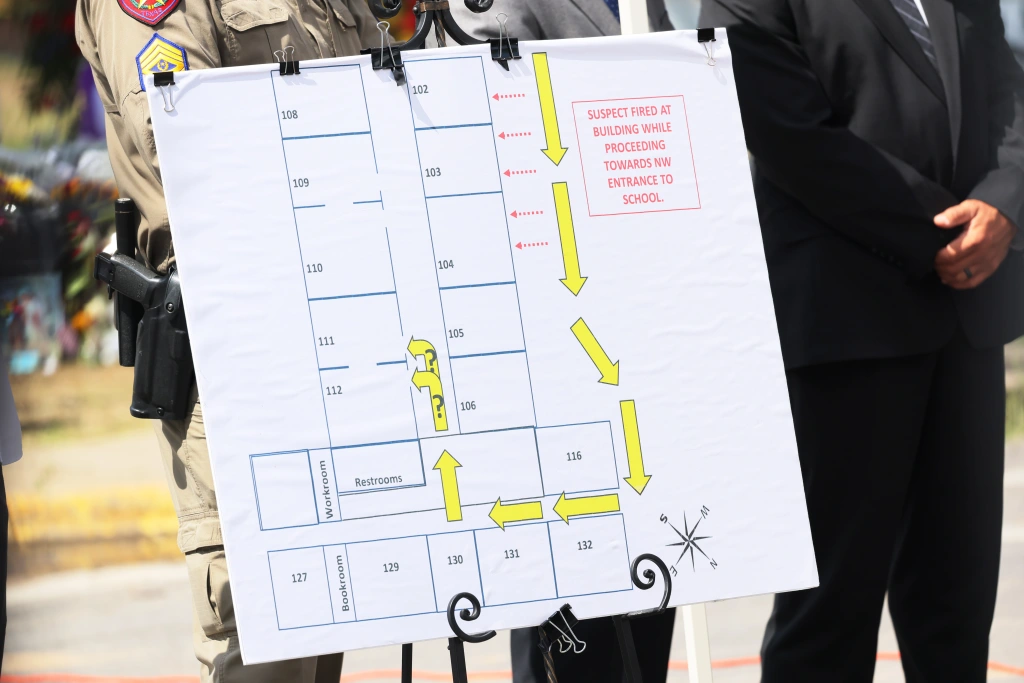
Here is a composite timeline of the Uvalde shooting. I am including a map for reference. I am sure that there are things that happened that aren’t on this timeline, but I tried only to include things I could confirm the time for. :
September 2021, the shooter asked his sister to help him buy a gun and she “flatly refused.”
February 28: The shooter was in a group chat on Instagram and there was a discussion of the suspect wanting to be a “school shooter.”
March 14,the shooter wrote in an Instagram post, “10 more days.” Another user replied, “‘are you going to shoot up a school or something?’ The shooter replied, ‘no and stop asking dumb questions and you’ll see.'”
May 17 the shooter legally purchased the first AR platform rifle at a local federal firearms licensee.
May 18 The shooter also purchased 375 rounds of ammunition
May 20,the shooter legally purchased the second AR platform rifle at a local federal firearms licensee.
May 24, the day of the shooting:
Sometime after 11 a.m. — Ramos shoots his grandmother in the face, according to Texas Public Safety Director Steve McCraw. Gilbert Gallegos, 82, who lives across the street from Ramos and his grandmother, heard a shot as he was in his yard. He runs to the front and sees Ramos speed away in a pickup truck
11:27 a.m. Authorities know from video that the exterior door, which the shooter later entered to get inside the school, was “propped open by a teacher.” The door was supposed to be locked and wasn’t supposed to be open.
11:28 a.m. The suspect vehicle crashed into a ditch. The teacher ran to room 132 to retrieve a phone. The same teacher walked back to the exit door, which remained open.
Two males at a nearby funeral home heard the crash and went to the crash scene. When they arrived at the crash scene, they saw a man with a gun exit the passenger side of the car with a backpack. They immediately began running.
Ramos began shooting at them but did not hit them. One of the males fell when he was running. Both males returned to the funeral home. Video showed a teacher reemerged from inside the school, panicked, and called 911.
11:30 a.m. A 911 call came in that there was a crash and a man with a gun.
11:31 a.m. The suspect reached the last row of vehicles in the school parking lot. He began shooting at the school while patrol vehicles got to the nearby funeral home. Multiple shots were fired outside the school. The patrol car accelerated and drove by the shooter and left the camera view.
11:32 a.m. Multiple shots were fired at the school.
11:33 a.m. The suspect entered the school at the door and began shooting into room 111 or 112. It was not possible to determine from the video angle which classroom he first fired into. He shot at least 100 rounds at that time, based on the audio evidence.
11:35 a.m. Three police officers with the Uvalde Police Department entered the same door as the suspect entered. They were later followed by another four-person team of Uvalde police officers and a deputy sheriff. Thus, there were at that point seven officers on the scene. The three initial police officers arrived and went to the door, but the door was closed. At least one officer received grazing wounds from the suspect.
11:37 a.m. There was more gunfire. Another 16 rounds were fired at 11:37, 11:38, 11:40, and 11:44.
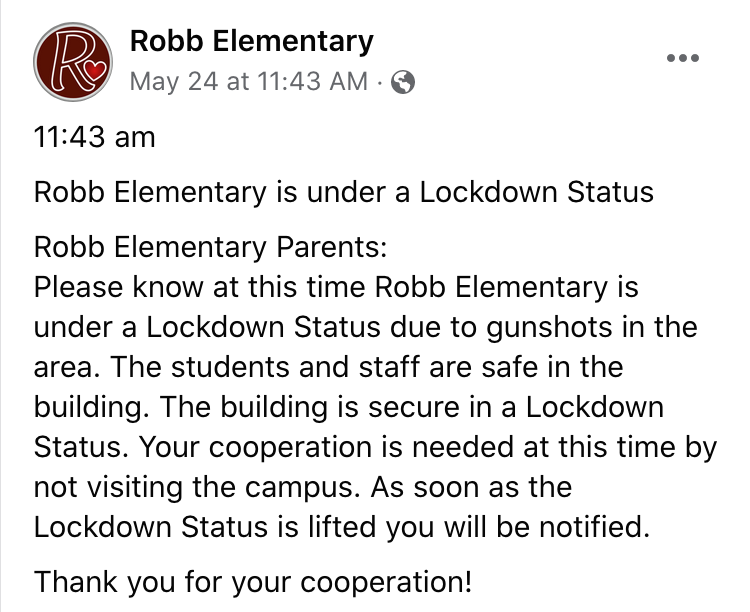
11:43 a.m. The school posts on Facebook that the school is under lockdown, and then emails parents.
11:51 a.m. The police have been inside of the building for 15 minutes.
11:51 a.m. A police sergeant and state law enforcement agents start to arrive.
11:54 a.m. People are gathering outside the school. Tension is building between parents and police.
11:56 a.m. Parents are begging cops to do something. “Our kids, that’s what we’re worried about,” one mother can be heard saying on a livestreamed video. She adds, “Our kids are there, man! My son’s right there!”
11:58 a.m. A police officer pushes a man who is making a phone call outside the school, yelling at the people gathering to move across the street. “Six-year-old kids in there, they don’t know how to defend themselves from a shooter!” yells one person.
12:03 p.m. Officers continued to arrive in the hallway. There were as many as 19 officers in that hallway. At this time, a child in room 112 called 911 and spoke to a dispatcher for 1 minute and 23 seconds. She identified herself, but police have not released her name. The caller whispered that she was in room 112.
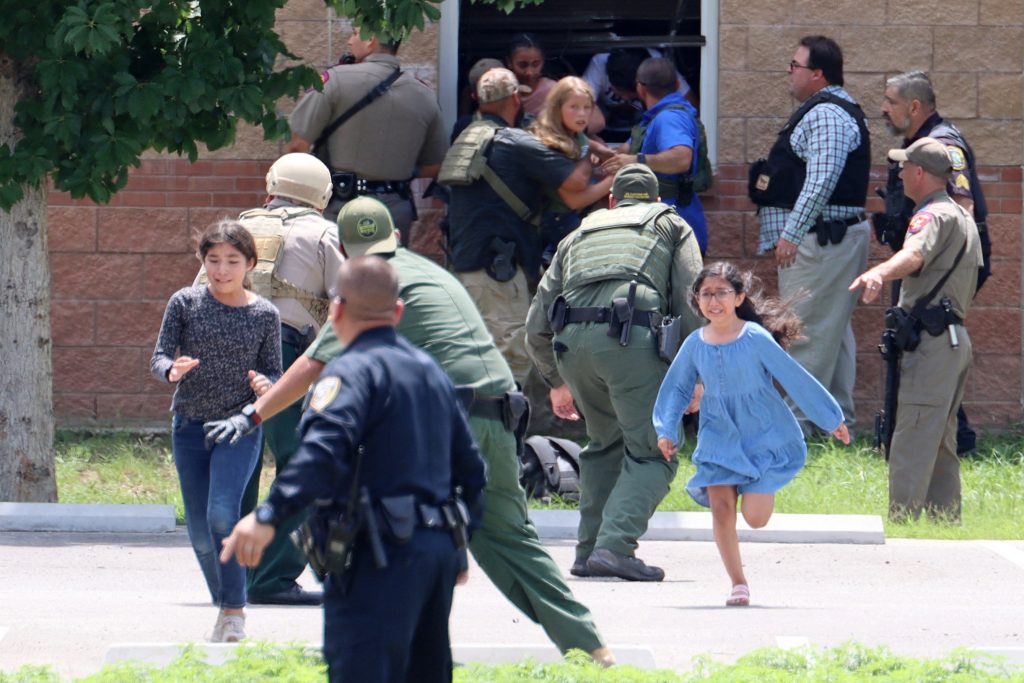
12:05 p.m. Some students and staff members who had been locked down in the cafeteria on the other side of the school are able to escape the school and flee. The police have been in the building for 30 minutes.
12:06 p.m. Some students in another classroom escape through a window.
12:09 p.m. A helicopter is now flying above the school, and people continue gathering on the streets in the area of the school.
12:10 p.m. The child from room 112 called back, and advised that multiple people in room 112 were dead.
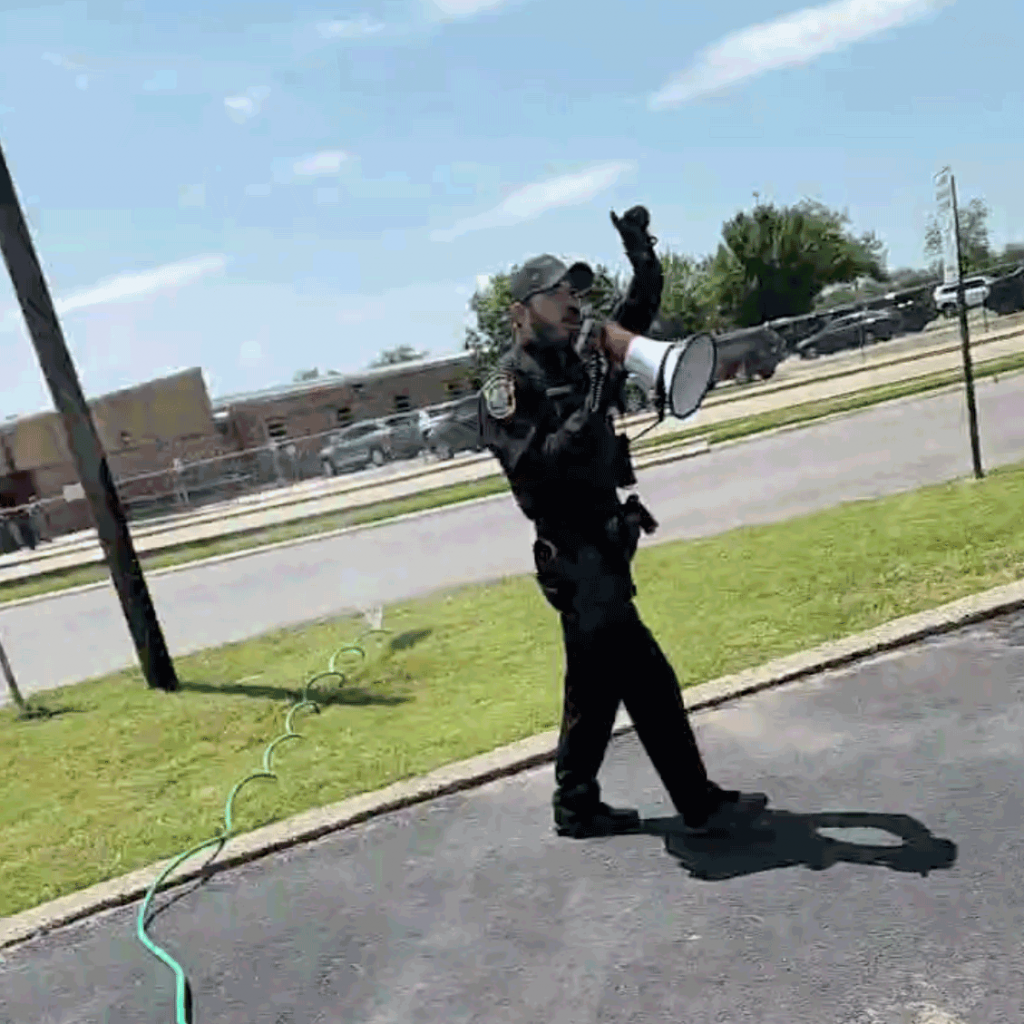
12:11 p.m. A police officer with a megaphone announces to the crowd outside that “When the kids get moved, we’re going to move them to the back of the funeral home,” referring to Hillcrest Memorial Funeral Home across the street. “That’s where we want y’all waiting at,” he says.
12:13 p.m. There was third 911 call from the child inside the school.
12:15 p.m. Border Patrol Tactical team members arrive along with ballistic shields.
12:16 p.m. Another child called 911 and told a dispatcher that 8-9 students were alive inside classroom 112.
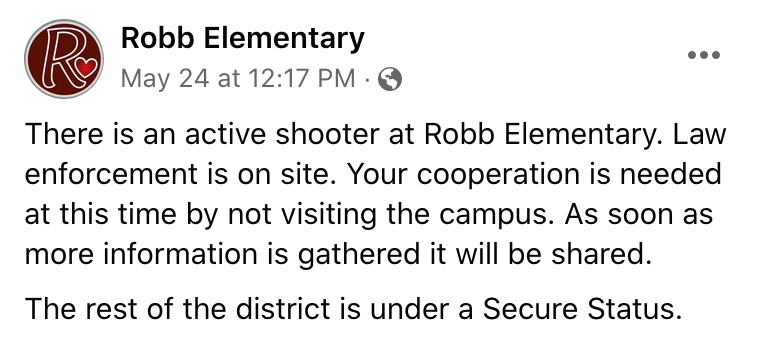
12:17 p.m. The school district posts on Facebook that there is an active shooter at the school and asks people to stay away.
12:19 p.m. Another person, this one in room 111, called 911. The person hung up when a student told her to hang up.
12:20 p.m. The police have been inside of the building for 45 minutes.
12:21 p.m. The suspect fired again, at least three shots. Dispatchers heard those shots over a 911 call that was in progress. Law enforcement moved down the hallway.
12:26 p.m. Many students are seen walking out of the school on the other side in a livestreamed video. The man recording recognizes one of the children. “Tell your mom hi. Tell her you’re OK,” he says.
12:30 p.m. The school district posts on Facebook that students who made it out of the school are being taken to an auditorium at the high school on the other side of town. The Border Patrol Tactical team has been on the scene for 15 minutes.
12:35 p.m. The police have been inside of the building for one hour.
12:36 p.m. Another 911 call came in that lasted 21 seconds. The caller, a student child, called back several seconds later. The child was told to stay on the line but be very quiet, and she said, ‘He shot the door.’
12:40 p.m. The school district edits its post on Facebook to say that the students are being taken to a civic center downtown instead of the high school to reunite with their guardians.
12:41 p.m. People continue to gather up and down the two roads that lead to school entrances.
12:42 p.m. An officer carrying a shield is seen running toward the building.
12:43 p.m. A child called 911 and asked dispatchers to ‘please send the police now.’
12:45 p.m. A man is filming the scene from outside of the school. “I’ve seen like 20 parents, maybe more, crying,” he says. “Wanting to know what’s happening to their kids. Because there’s still kids in there. And then, parents see that there’s ambulances taking the beds in.” The Border Patrol Tactical team has been on the scene for 30 minutes.
https://twitter.com/i/status/1529800986377723904
12:46 p.m. The caller said she could hear the police.
12:47 p.m. The child from 12:43 called again, begging for police to come rescue them.
12:50 p.m. Law enforcement officers breached the door using keys that they were able to get from the janitor. Both doors were locked when officers arrived. They enter the classroom and fire 27 times, killing the gunman. The sound of shots being fired could be heard over the phone. This happened 75 minutes after the police entered the building and 35 minutes after the Border Patrol SWAT team arrived.
12:51 p.m. The girl in room 112 is still on the phone with 911. Officers can be heard moving children out of the classroom, including her. When the call ends, she is outside.
As you look at this timeline, note that the police knew that there were children still alive in the classroom, because they were speaking with them on the telephone. The first seven officers were outside of the room where the shooter and the majority of the victims were located at 11:35. They were on the phone with some of those children from 12:03 throughout the rest of the incident, but cops still waited until 12:50 before entering the classroom. The first excuse was they were under fire. Then it became “we didn’t have the keys.” Once that excuse didn’t work, it became “we thought they were all dead.” It appears as though they will make the chief of the school district’s police department the scapegoat.
Let’s just start by saying that there is not one magic solution that will stop all shooters. I don’t think that it is possible to stop all mass murderers, however, even the FBI had admitted (pdf warning) that every active shooter incident since 2000 has happened in a ‘gun free zone’. It makes for interesting reading.
All you can do is make their efforts more difficult in the hope that it will greatly reduce the number of incidents, and reduce the number of victims in each incident. With that in mind, Florida went a long way in doing just that:
Every school in the state must be surrounded by a fence that is a minimum of 5 feet tall. Any opening in that fence must have security in place to ensure that unauthorized people aren’t entering campus.
Security cameras must monitor hallways so office staff can monitor them for intruders.
All schools must have armed security on campus during school hours.
All classrooms must be locked except during period changes.
That doesn’t mean that Florida is perfect. They failed in one area when they instituted a “guardian” program to allow teachers who volunteer for over 100 hours of training to carry weapons on campus. The failure was that any teacher wanting to be a guardian is subject to a requirement that they be approved by both the county sheriff and the Superintendent of the school district. This has resulted in no schools arming teachers in the entire state, with the exception of the superintendents and their chosen friends in each school district. This means that maybe a dozen or so teachers at most are approved in each district, and they are likely to be office personnel that are not present on school campuses, but rather in the district central office, where no students are present. The guardian program wound up being a waste of time, like may issue.
In summary, the only way to reduce the number of school shootings is make the school a less attractive target. Single point access control is just one of several things that need to happen.
The gunman walked around the outside of the school, firing shots for 12 minutes before entering. No one thought to lock the doors.
There was no cop on the property to defend the kids.
The cops that did arrive retreated as soon as they received incoming fire.
Then 150 cops stood around outside and defended the shooter from angry parents. Why? Because they knew that the parents were less of a threat that the shooter. It’s safer to Taser Suzie Soccermom than it is take on an 18 year old crazy man armed with a gun.
Leftists on Twitter have been saying that this shooting and the response of the cops proves that good guys with guns don’t stop bad guys with guns. Wrong. Any armed man who “takes cover” for an hour while a madman shoots children in the face isn’t a “good guy” with a gun. He’s a gutless coward who can’t even call himself a man, much less a good man.
Now the an official from the police is dodging responsibility, and frankly engaging in a coverup of the cowardice and ineptitude of his fellow officers.
Texas DPS official refuses to say why officers didn't breach the door of the classroom for the hour that the Uvalde shooter was in there shooting children. pic.twitter.com/br2fdYruty
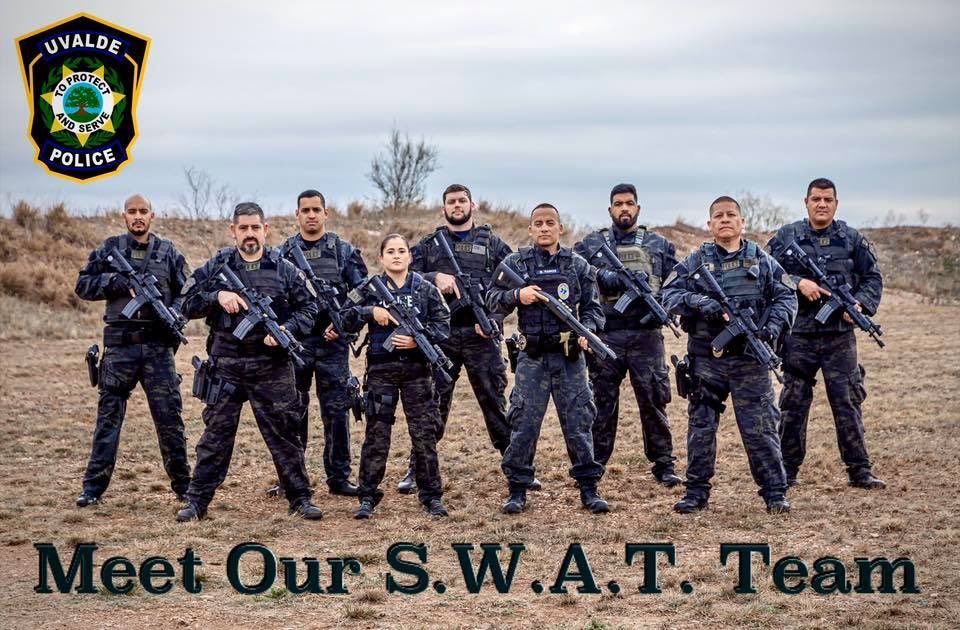
These are the cops who, armed with machine guns, body armor, stun grenades, armored shields, and a fucking armored vehicle, hid outside while children died because an 18 year old kid with mental issues and a semiautomatic rifle scared them away.
During the recent school shooting, the cops were all “pinned down” and taking cover for an hour and a half while the shooter was busy killing ten year old kids. I first saw this from JKB over at GunFreeZone. JKB was catching some flak in the comments about slamming cops over unverified reports. I actually believe that the cops waited, because it explains some inconsistencies in the shooting timeline that didn’t make sense before.
We see this all of the time in third world shitholes: the cops and military are great at abusing and bullying unarmed civilians, because they have all of the guns. This is why American cops use the SWAT unit for everything from serving warrants on grandma to arresting fugitives. It’s also why you see SWAT running around in tanks behind bulletproof shields while they toss grenades into baby cribs. It’s why they run around in groups, slashing tires and doing drive by shootings on unarmed citizens.
Initial reports were that the SRO exchanged fire with the shooter as he entered the school. That turns out to have likely been a lie.
Officials first said a school officer and the gunman exchanged fire. On Wednesday night, they said they could no longer confirm that initial report. We will stay with this to fully understand what happened.
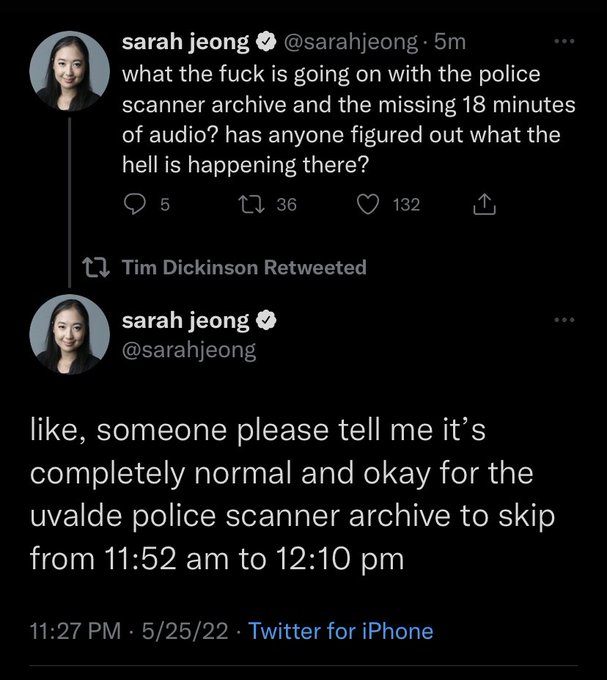
There was a huge coverup of police malfeasance. False statements and all. There is even 18 minutes of radio traffic missing from the recordings on Broadcastify, which the cops are attributing to “technical issues.”
Then the cops stood there, Tasers in hand, and not only refused to help the kids, but refused to let the parents do it, either.
— TheFamily'sSoup TV (@FamilysSoupTV) May 25, 2022
Any officer involved in this shooting who turns out to have lied about being a hero while cowering outside, listening to the sounds of ten year old children getting shot in the face needs to be fired and have his pension revoked. Then they need to put him on the Biden list of cops who can never work as cops again, and then press criminal charges against them for falsifying reports and for being a cowardly pussy, but you know, in legalese because I don’t think you can use the word “pussy” on a legal document.
Sure, there are a few upstanding cops who will run to the sound of the guns, and for them I reserve respect and admiration. It must be tough trying to do your job while surrounded by cowardly bullies and catching all of the shit that they earned but you don’t deserve.
The rest of those cops? They can eat my shit. I have less forgiveness in my heart for them than I do for the shooter himself. Those cops swore an oath, and those kids deserved more from those shitbag cops than they got.
UPDATE
It also turns out that the cops went in rescued their own kids, but were pinning fathers who weren’t cops to the ground to prevent them from doing the same.
Here’s a Texas DPS Lieutenant telling a local station that some officers breached the school to get their own children BEFORE the shooter was taken down. pic.twitter.com/BrvS4sCqp6
If my kid had been killed because one cop pinned me to the ground while another cop went in to rescue his own while leaving my kid in there to die? The cops who did that? Their lives would belong to me. I would get a list of the cops who were there, and I would hunt them down one by one. Pussies.
That would piss me off to the point where I would consider this to be martial law. So let me ask this- how many troops would it take to guard every school board, every school board member, and every school board member’s family? To create a secure bubble with a radius of 300 yards, twenty four hours a day, seven days a week?
According to their Wikipedia page, the NSBA represents 90,000 local school board members and the 3,000 attorneys that advise them. So let’s say that a security detail would require 6 personnel at a time, meaning that this would require about 20 armed security personnel per member plus their families. Assuming an average of 2.5 people per school board member, the trigger pullers alone would require that the US commit something on the order of 4,500,000 troops. By the time you add in logistical and support personnel, the entire national guard and army combined would need to be deployed. Even with all of that, some school board members are gonna get smoked, if for no other reason that to prove a point.
The dumbasses on the left have no idea what they are talking about or what kind of numbers they need to do any of this stuff.
Article 5 Clause 3: The Senators and Representatives before mentioned, and the Members of the several State Legislatures, and all executive and judicial Officers, both of the United States and of the several States, shall be bound by Oath or Affirmation, to support this Constitution; but no religious Test shall ever be required as a Qualification to any Office or public Trust under the United States.