When my son was young, he was small for his age. He came home from school one day, upset that while playing soccer, he accidentally kicked the ball through his own team’s goal. Because of this mistake, a 5th-grade kid had physically assaulted him. He told me that this kid had been hitting him and bullying him for the past several weeks, and was telling me that he no longer wanted to go to school. I called the school and was told: “Well, there are a lot of children out there for recess, so many that the teachers can’t watch everyone, all of the time.”
I told my son that the next time someone hit him, he should defend himself. He told me that he didn’t want to get in trouble. I responded by telling him to let me worry about that. I also pointed out to him that he had been playing Pop Warner football, and the kid who had hit him was no bigger than some of the other kids on his team.
A couple of days went by before he again came home from school, this time telling me that the kid had hit him, and he had done what I told him to and beat the snot out of the other kid. My son was upset, because he had a letter telling him that he was to be suspended for fighting.
I called the school and told them that I wanted a meeting immediately. I got one for the next day.
At this meeting, the answer that I got was that they had a “zero tolerance” policy for fighting, and the result of this was all kids who fight receive 3 days of out of school suspension. I pointed out that I had come to them just the previous week and was told they couldn’t watch everyone, so why now?
“Well, we saw the fight.” I told them that they have a legal duty to keep my child safe, and when they fail in that duty, even after being told that my child was being physically attacked, they were failing in that duty. To compound this by suspending my child when he defends himself from a physical attack is the height of irresponsible behavior.
I also told them, should this discipline stand, I would be back to the school the following day with an attorney, and we would see where that would take us. I had every intention of doing so- it wasn’t an idle threat.
The suspension was lifted, and the kid never touched my son again. The best part was that my son learned a couple of important lessons that day on how not to be pushed around by others.
You can’t let bullies, in this case a child and a lazy set of school staff, run roughshod over you. You exhaust your options for a peaceful solution, but once that has been seen to its completion, you have to go on to the next step. Unless you fight back, bullying behavior will always continue. The corollary to that was eloquently stated by Mike Tyson: “Everyone has a plan until they get punched in the mouth.”
That’s the lesson for today. I’m sure each of you understands where that line of thought leads.
Those of us who carry guns are often told that we don’t need guns to protect ourselves, we just need to remember that the robbers are just people trying to feed their families. If we just give them what they want, we will be fine. This assumes that robbery is merely a business transaction, and depends upon a criminal threatening violence being a moral and upstanding citizen.
What if he isn’t? What if that criminal is just someone who sees other people as mere objects who are simply standing in the way of their happiness and success? Killing you is no more problematic to such a person than stepping on a bug. That’s how things like this happen- a man in Miami is robbed, and hands over the goods. They kill him anyway.
Criminals rob a man of his gold chain and, after the victim complies and the robbers take what they want from him, they kill him for no apparent reason.
As you'd expect, no braces, suppressors, nor optics were used in the homicide.
I don’t go to places where there are violence and crime.
I avoid crowds of feral negros.
I pay attention to my surroundings. More than once, we have left an event because I didn’t like the vibe.
Last night, we went shopping and then to a swanky restaurant in an artsy district of a nearby town. I had a filet, my wife had garlic mussels. I was dressed in khaki slacks and a loose fitting Guayabera shirt. It hid my 9mm Shield Plus with microdot sight and my can of pepper spray very well. That gives me a less lethal option for boorish behavior, and also gives me 14 rounds of “I am not going to die unless you come with me.”
I’m not willing to bet my life, or the life of my spouse, on a criminal’s sense of good will and conscience.
One opinion that I have had since I was in high school is this:
I don’t care what martial art you study, what color belt you have, or how skilled you are, physical defense has limits. A 6 year old with a black belt in karate can’t beat up a full grown adult. A 100 pound woman isn’t going to beat up a 250 pound man, unless that man is in poor physical condition.
That opinion wasn’t a popular one, but it’s true. Skill can only do so much, but at the end of the day, physical strength, stamina, and size are just as important. Let me show you:
100 lbs. woman believes she can put a full grown man down by putting him into a choke hold with her 'krav-maga' skills (defending yourself). pic.twitter.com/8EEj9ZDHuo
That doesn’t mean that skill is to be ignored. It means that what skills you do have should be viewed through a realistic lens. A 100 pound woman still is far outclassed in strength. That 100 pound woman believing that taking some krav maga classes is going to enable her to take on and disarm a full sized man is going to give her the overconfidence to go places and get into situations that she is not equipped to handle.
She let her classes where she practices set moves against compliant adversaries give her the false confidence that she can take on grown men armed with weapons and prevail, when in reality, she can’t even take on a man when given a distinct advantage, and in this case, the man was holding back and trying not to hurt her.
The same is true of people who carry guns. Many people only carry in “bad neighborhoods” and allow that firearm to pull them into places where they wouldn’t go if they weren’t armed.
Have a realistic idea of what training and weapons do for you, what your capabilities are, and know how and where you should be. One thing that I have learned by taking BJJ is that I have flexibility as my advantage, but I don’t have the stamina and cardio of a 23 year old any longer. In many cases, a 22 year old will be stronger and will be in condition to outlast me in a protracted fight. In any hand to hand, I must endeavor to win the fight early, because I will lose a protracted battle.
Be realistic in your own assessment of your abilities.
Sweat, or perspiration, is the primary means that humans use to cool themselves through the use of evaporative cooling. Very few mammals actually use perspiration as a cooling mechanism: in fact, other than a few primates, horses are the only mammals that use perspiration to cool down.
Sweat is 99% water. Dissolved in each liter of this water are the following minerals:
Sodium 900mg
Potassium 200 mg
Calcium 15 mg
Magnesium 1.3 mg
This means that perspiration has a much lower concentration of electrolytes than does blood. Still, as we sweat, we are not only losing water, but a lot of key electrolytes. If you are sweating heavily, you are losing more than just water, and that needs to be replaced. If you aren’t sweating heavily, then you shouldn’t have a lot of these because too many electrolytes is just as bad as not enough of them, especially if you have high blood pressure or heart failure.
There are a ton of electrolyte drinks out there: Gatorade is perhaps the most well known, but there is also Pedialyte, as well as a plethora of others. My biggest issue with many of these drinks is that they also contain an incredible amount of sugar. That’s why I only drink the zero sugar versions of these.
Gatorade has the electrolytes, but also comes with a lot of sugar. It carries 2 grams of sugar, 13.3mg of Sodium and 4.2mg of Potassium per ounce. I only drink these when I am exerting myself, and even then, I only drink the zero sugar versions. Cost is about 65 cents for a 16 ounce serving.
Liquid IV is a powder that is mixed with 16 ounces of water. When mixed, it carries 0.7 grams of sugar, 31mg of Sodium, and 23 mg of Potassium per ounce as mixed. I haven’t tried this one, but I know a lot of people who swear by it. Cost is $1.38 per 16 ounce serving.
LMNT (pronounced “element”) is another powder. It has 0.8g of sugar,16.5 mg of Sodium, and 12.5mg of Potassium per ounce as mixed. Cost is $1.30 per 16 ounce serving. I have never tried it, but I have seen advertising for it.
Pedialyte is a powder that is designed to replace electrolytes in children. It has about 0.675g of sugar, 16.25mg of Sodium, and 11.25mg of Potassium per mixed ounce. Cost is about $2 for a 16 ounce serving. I know that there are some athletes that like this stuff, but I hear that it tastes like armpit sweat.
I drink Gatoraid zero or another drink called Propel. I think they did well for me because my electrolytes were just a tiny bit low when I was in the hospital. Had I been drinking water, they would have been much lower, due to perspiration losses.
The disclaimer: I don’t advertise, and receive nothing for my reviews or articles. I don’t think that I ever will. I have no relationship with any products, companies, or vendors that I review here, other than being a customer. If I ever *DO* have a financial interest, I will disclose it. Otherwise, I pay what you would pay. No discounts or other incentives here. I only post these things because I think that my readers would be interested.
I have posted about stupid pranks that the current generation is playing, thinking that placing people in fear for their lives to get views of their social media is funny. Two years ago, it was staging a scene where unsuspecting people came upon what looked like a person dressed as a clown that had just murdered someone then began chasing the prank victim.
Let me show you an example of the current trend in these so-called prank videos:
This idiot approaches people saying, “I am gonna burn your car up, bro” before pouring a liquid from a gas can onto the hood while holding a lighter, then compounding it by chasing the victim with the gas can and lighter.
I am going to shoot your ass just as quickly as I can clear leather. Then I am going to keep shooting you until you fall to the ground, and I am going to walk away without being convicted of a crime, AND I am going to be paid for my troubles. Let me explain:
It doesn’t matter that the liquid is not a flammable one, just like it doesn’t matter if a person robs you with a toy gun. What matters is the person defending themselves reasonably believes that the threat is a real one. The moron clearly indicated that it was his intent to set my car, and possibly me, on fire before pouring what appears to be a flammable liquid on my car. It’s clearly his intent to make the person being “pranked” to believe they are imminently going to be the victim of arson. After all, if that belief didn’t exist, the prank wouldn’t work as a prank. Therefore, it is reasonable for a person to believe that an arson is imminent.
(1) Any person who willfully and unlawfully, or while in the commission of any felony, by fire or explosion, damages or causes to be damaged:
(a) Any dwelling, whether occupied or not, or its contents;
<snip irrelevant legalese>
(3) As used in this chapter, “structure” means any building of any kind, any enclosed area with a roof over it, any real property and appurtenances thereto, any tent or other portable building, and any vehicle, vessel, watercraft, or aircraft.
Not only that, but arson is also a forcible felony. In Florida, I can use deadly force to stop the imminent commission of a forcible felony. I could even argue that pouring a flammable liquid on a vehicle where I am in close proximity is a deadly threat upon my person. It doesn’t even have to be my car. It can be a car that I am standing close to. That isn’t even considering that this rocket scientist was chasing people with the gas can and lighter in his hand.
(2) A person is justified in using or threatening to use deadly force if he or she reasonably believes that using or threatening to use such force is necessary to prevent imminent death or great bodily harm to himself or herself or another or to prevent the imminent commission of a forcible felony. A person who uses or threatens to use deadly force in accordance with this subsection does not have a duty to retreat and has the right to stand his or her ground if the person using or threatening to use the deadly force is not engaged in a criminal activity and is in a place where he or she has a right to be.
It isn’t just vehicles. Now they have progressed to pouring a liquid from a gas can onto people.
The morons even brag about how “epic” it is that so many people were fooled.
After I shoot and kill you in self defense, every person involved in this production is now guilty of felony murder. They are also liable to me when I sue everyone involved in this so-called prank for the “emotional trauma” and PTSD I now have experienced because I had to shoot someone.
and yeah, I am going to include Youtube in the lawsuit because they allow these videos to be monetized.
Aaron Carbo began speaking to me about the incident, where he informed me that he was approached by [REDACTED] in an aggressive manner, being asked to hurry up as he was holding other golfers up.
A “heated” argument ensued, causing Carbo to push the other person to the ground.
Carbo stated he then stood over [REDACTED] and called him a ‘pussy,’ at which time Carbo’s girlfriend pulled him away.
As Carbo was being pulled away by his girlfriend, Scott Throne ran over and punched Carbo in the face, which caused Carbo’s mouth to bleed.
Throne was arrested for battery for striking Carbo, and Carbo was arrested for battery on a person 65 years or older for striking [REDACTED]
I did a bit of editing on the original story to make it more readable, but the details are the same. Now let’s discuss my logic here:
So to me, this all comes down to the timing of the above events. If Cabo’s girlfriend had already pulled Cabo away from the altercation, and the altercation was over, then Throne was not justified in using force. If Cabo was still engaged in fighting with the elderly victim, or was attempting to do so then the altercation was not over, and Throne was legally justified in using force to stop his felonious attack on [REDACTED}.
No matter what, this case is a mess and is going to cost Throne a lot of money in legal bills.
EDITED TO ADD: So I pulled the case file from the court record, and the elderly victim was a 79 year old man. The report also reads:
Had [Scott] Throne punched him before the fight was over, then Throne would not have been arrested. As it is, getting involved is going to result in some trouble with the law. Again, better to mind your own business, especially if you aren’t sure of the law or the situation.
On a side note, Cabo is listed with the state as being a habitual felony offender.
I saw this story in the New York Times and was amazed that there was a prepper movement that I hadn’t heard of, that it appears to be centered on Central Florida, and also that a branch of the MSM would do a positive story about prepping.
I wonder how many Feds are associated with the two groups in the story. Remember, the Fed is the one urging you to do something illegal.
When it comes to the gun world, there are few things that cause disagreements more often than brand wars. I have said before, and I continue to say that there is no such thing as a brand that is perfect for everyone. There are, in my opinion, models or even brands that are too unreliable to be good for anyone.
Grip angle
The angle of a handgun’s grip to the plane of the barrel can vary from the 55 degrees of the Luger P08, to the 18 degrees of the 1911 and Smith and Wesson’s M&P autoloaders, or even 17 degrees of the old Ruger P95. Glocks have a grip angle of 22.5 degrees. Each person will have an opinion as to which one fits their and and shooting style.
Whichever grip angle is right for you will see the pistol pointing at the target without any conscious effort on your part. Here is how to check yours:
Set up a target in a safe area (even if you shot it, the bullets wouldn’t go through and hit someone or something important).
Unload your pistol.
Present your gun at the target as though you were going to shoot it. Get a good sight picture.
Lower the gun (or holster it, if you have one).
Close your eyes. Present the gun again at your target.
Open your eyes. Are your sights on target? If they’re too high, the grip angle may be too steep. If they’re too low, the grip angle may be too shallow.
Repeat this at least 5 times to be sure you get consistent results.
If all your pistols have about the same grip angle, you won’t have to adjust your aim when switching pistols. That is why all of my carry handguns are of the M&P line. You will get the same results if all of your carry pistols are Glocks, or Springfield, etc. As log as your grip angle is consistent, you can change handguns without a problem. If you change to a new grip angle, you can figure about 1,000 rounds to adjust to the new one. Pick a grip angle you are OK with and stick with it.
Bore Axis
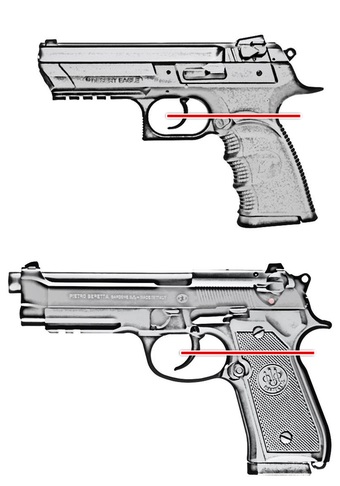
Another thing that matters is bore axis. The bore axis is the distance between the top of the shooter’s gripping hand and the center of the barrel. In a pistol with a hammer, this distance can be quite large.
Note that the line of where the gripping hand is is located quite a bit below the center of the barrel. This forms a lever, with the fulcrum being where the web of the thumb grips the backstrap of the pistol, and the force being applied down the center of the barrel. This force causes two types of recoil- backwards through the barrel, and a bit of muzzle flip. The larger the bore axis, the more pronounced the muzzle flip. The greater the muzzle flip, the more time it takes to get your sights back on the target for a follow up shot. For most people, this won’t really be noticeable beyond a perceived increase in recoil.
The bore axis for the following handguns is:
The 1911 has a bore axis of 1.75
Glock 17 Gen 4 is 1.26 inches.
Smith and Wesson M&P 2.0 is 1.41 inches
Sig 320 is 1.78″
Sig P226 is 1.80
As a general rule, striker fired pistols will have a lower bore axis than do pistols with a hammer, because the fire control group of a striker fired pistol takes up less room.
Grip Size
I have large hands and a pretty good grip strength. That means I can handle full powered handguns and double stack magazines. Not everyone funds this comfortable. Make sure that the grip of the firearm fits your hand. and easy way to do that is see if you can push in the magazine release with your gripping hand’s thumb without shifting your grip. If you can’t, that particular handgun may be to fat for your hand.
Another consideration is grip length. If you are gripping the handgun and your pinky finger is hanging in the breeze, maybe your hand is too large for that pistol. One solution is an extended magazine with a boot on it, like the ones they have on the Taurus Millenium.
Conclusion
There is a lot that goes into handgun design- the grip angle, the bore axis, the size and power of the cartridge, the weight of the handgun, and many other factors go into the perceived recoil, accuracy, and the speed of follow up shots. Combine that with the ergonomics, style, and skill of each shooter, and the interplay makes a virtual unlimited number of possible combinations, making a determination of the “best” pistol impossible.
If you don’t yet have a handgun, find a gun range that rents firearms. See if a gun owning friend will take you to the range and let you shoot a few of his guns. In short, don’t let someone else tell you what gun you should buy. The only things that should matter are:
Is it reliable enough to go bang every time you squeeze the trigger?
Can you reliably get multiple hits with it?
Does it fire a cartridge that passes the FBI test of 12-18 inches of gel penetration? (This generally means 300 or more foot pounds of energy)
Is it small enough to do what you want to do with it? (Carry, home defense, etc.)
Pick a gun maker that offers a lifetime warranty. The pistols that they sell are generally pretty reliable.
If you are a more experienced shooter, make sure that you can pass the 5 test with it- Draw and get 5 hits in a 5 inch circle at 5 yards in less than 5 seconds.
I have seen far too many gun store employees try to sell people guns that are obviously not right for them. For example, selling a small woman a tiny pink colored .357 magnum. Don’t let someone else tell you what you like and what you need. You are the only one who can determine that. Others can only guide you there, but at the end of the day, it is your decision to make.
In my continuing research of 10mm defense loads: Let me start this post by pointing out that pistols are a compromise, in that they all suck for self defense. We carry them because it is easier and gets you fewer sideways looks than does carrying a long gun. Better the handgun on your hip than the firearm at home in the safe.
The current 10mm that I have is a full sized M&P10mm and I am unlikely to carry it. I find that I don’t even carry any of my full sized handguns on a regular basis. What I find myself carrying most often is a J frame .38 or a Shield Plus in 9mm. Still, buying and shooting guns is fun, so what the hell?
Even though I won’t carry it much, I always keep plenty of magazines and ammo on hand for every firearm. Five magazines for every pistol is the minimum I am comfortable with. For ammo, the minimum is 500 rounds for semi auto handguns, 100 rounds for revolvers, and 1000 rounds for semi-auto rifles of “war shots” that I like to keep on hand. That doesn’t count whatever range ammo that I have.
Of course I am going to research this, because it’s what I do. See the months of research I did before going with solar as a backup power system.
In looking at defensive ammo, the most important criteria is that it functions well in my firearm. It needs to go bang every time I intend it to. I will accept no more than one failure for every 500 rounds. (That’s why I no longer carry and have sold most of my 1911’s. They jam far too often. See this post here about the suckage that was my experiment with that platform.) Going along with that, the ammo must also be somewhat accurate for my handgun. That means passing a 5×5 test- I have to be able to put 5 rounds into a 5 inch circle at 5 yards in 5 seconds or less while drawing from a holster. I would rather hit with a .22 than miss with a .44.
The next criteria is that it has solid performance. There is no point in reinventing the wheel- I use the FBI criteria that states a bullet should penetrate between 12 and 18 inches of ballistic gelatin and a bullet that expands to at least 1.5 times its diameter. With handguns being poor performers, I want to maximize what performance I *do* get, so I try to only buy and stock ammo that meets this standard. I expected that my research will find more full power 10mm that goes beyond the 18 inches than falls short.
In 1983, Whit Collins, John Adams, Irving Stone, and Jeff Cooper worked with Norma AB to design the 10mm Automatic cartridge. Their goal was to create the a handgun cartridge that fired a heavier and larger caliber bullet than the 9mm Luger at a higher velocity and magazine capacity than the .45 ACP. This would create a handgun cartridge that combined the best of both platforms.
They did this by cutting a .30 Remington case down and loading it with .40 caliber bullets from the .38-40 Winchester. they not only achieved that objective but exceeded it by a healthy margin. The original 10mm Auto load shot a 200 grain projectile at 1,200 feet per second for 640 ft-lbs of muzzle energy, which was a significant step up in performance compared to the 9mm Luger and the .45 ACP. The new round nearly doubled the energy of the 9mm Parabellum and off the shelf .45 ACP ammunition.
Dornaus & Dixon Enterprises worked in parallel with Jeff Cooper and the rest of the 10mm Auto team to build a handgun designed specifically to shoot the new cartridge: the Bren Ten pistol. Similar in appearance to the CZ-75, Sonny Crockett in the television show Miami Vice helped make the Bren Ten famous. For this reason, demand for the pistol and the cartridge exploded in the mid-1980s. Unfortunately, the Bren Ten was rushed into production and the pistol’s reputation suffered due to early issues with reliability, quality control, and a shortage of magazines. The company was never quite able to regain its footing after those initial missteps and declared bankruptcy in 1986 after only making 1500 of the pistols. Shortly after the passing of the Bren Ten, Colt rolled out a Model 1911 modified to use the cartridge that they named the Delta Elite.
Then came a fateful day in US law enforcement. The 10mm Auto piqued the interest of the FBI during their search for a more powerful service round in the aftermath of the disastrous 1986 shootout with two bank robbers in Miami.
The FBI liked the 10mm and originally wanted to switch to that platform, but the fact that they had a lot of limp wristed agents who were recoil sensitive, they wanted something with less recoil. The FBI test report on the cartridge was apparently labeled:
CAUTION: Velocities, pressures and recoil are extreme, vary greatly, and damage weapons with extended use. Control for multiple shots extremely difficult.
They downloaded the 10mm to reduce power by about 30% and issued a request for handgun makers to bid on a new cartridge/handgun combination for FBI use. This loading became known as the “10mm FBI load.” This load was several hundred feet per second slower than the original 10mm Auto, but the FBI was still satisfied with its penetration and terminal performance. The winner of this competition would get a lucrative contract to supply most of US law enforcement.
Enter Smith and Wesson. They developed a cartridge that was shorter than the 10mm and met the FBI standard, and the .40 S&W was born. Derisively, it is said that S&W in this case stands for “Short and Weak.” Many of the advantages of the powerful 10mm cartridge disappeared with this downloaded cartridge. Instead of getting all of the combined advantages of the 9mm and .45ACP, you got none of them. That’s why the .40S&W has largely fallen out of favor- there is no advantage of having it.
To be completely honest, I own several .40S&W pistols, but I can’t remember the last time I carried or even shot one of them. Less capacity and slower bullets than a 9mm, lighter bullets than a .45ACP. What’s nice is that I can swap a barrel and change my S&W40 to .357Sig or 9mm.
I don’t want to simply buy 10mm ammo that is loaded to 40 caliber specs. If I wanted to do that, I would just carry one of my 40 calibers. I was looking for an ammo manufacturer that was loading ammo that really took advantage of the 10mm cartridge. After some searching, I like Underwood ammo as well as Fenix ammunition. Both of them are loading to the full 10mm capabilities. Buffalo Bore does as well, but their bullets are overpenetrating and seem better for large animals than for self defense.
Fenix makes one self defense loading for 10mm, and that is a 180 grain JHP moving along at 1250 feet per second, giving us a muzzle energy of 624 foot pounds. They are currently out of stock, so let’s look at our next contestant.
Underwood has quite a few loadings for 10mm. I selected the Tools & Targets YouTube channel because the guy clearly loves his 10mm and does a decent job in testing the bullets he looks at. The loadings that I am most interested in:
200 grain XTP moving along at 1250 feet per second with 694 ft/lb of energy. This round got 1100 fps out of that 4.6 inch barrel, delivering 537 ft/lb. The bullet penetrated 24 inches. That velocity isn’t great, but it’s the overpenetration that concerns me. Any energy that the bullet has when it leaves the backside of your target is wasted energy.
180 grain XTP at 1300 feet per second and 676 ft/lb. This channel saw the ammo come in right at 1242 fps for 616 ft/lb from a 4.6 inch barrel. He got a full 16 inches of penetration with the bullets retaining 150-179 grains of their mass, even though they expanded to more than .640 inches in diameter. Impressive performance.
155 grain XTP at 1500 feet per second and 775 ft/lb. The guy in this video found that it hit 1500 fps from a 4.6 inch barrel, just like the box claimed. That means it was right about 800 foot pounds of energy. The bullet gave 12.5″ to 13″ of penetration, with or without the clothing barrier.
135 grain JHP at 1600 feet per second and 768 ft/lb. The guy here got an average of about 1450 feet per second out of a 4.6 inch barrel. The wound cavity looks great, but it is only penetrating to 12.25″ and I just don’t see me wanting to use this one. I think the combination of slower than advertised speed along with the Nosler hollow point means suboptimal performance.
Overall, it looks like I will be selecting the Underwood 180 grain XTP for our initial reliability testing. I will order some, and once the reflex sight comes in, we will take a couple of hundred rounds to the range and see how it works. At $1.25 a round, it is actually cheaper than Gold Dots ($1.75) or Hornady Critical Duty ammo ($1.50). I just ordered 500 rounds for testing. If that round doesn’t work out, I will try the 155gr loading.
The disclaimer: I don’t advertise, and receive nothing for my reviews or articles. I have no relationship with any products, companies, or vendors that I review here, other than being a customer. If I ever *DO* have a financial interest, I will disclose it. Otherwise, I pay what you would pay. No discounts or other incentives here. I only post these things because I think that my readers would be interested.