Either participants in the conversation are informants, or the Fed’s are reading encrypted mail.
Assume that all communications methods are compromised. Don’t discuss sensitive issues in the clear, even on an encrypted network. Use code words and phrases.
Any code can be broken, given enough money and computer power.
The easiest way to break a code is to break someone with the decryption key. Everyone has a weakness and this weakness WILL be used to break them.
In any organization, the chances of an informant increase exponentially with the size of that organization. Keep things small, close knit, and organized in cells of no more than 8 people. That way, potential informants only compromise the members of their cell.
Big brother is watching. For now, those who fail to learn go to jail. Soon, slow learners will be killed by government agents.
As regular readers know, I recently completed project Gaston– an 80 percent Glock compatible pistol frame. Today was the day that I finally got to take it out to turn some money into noise.
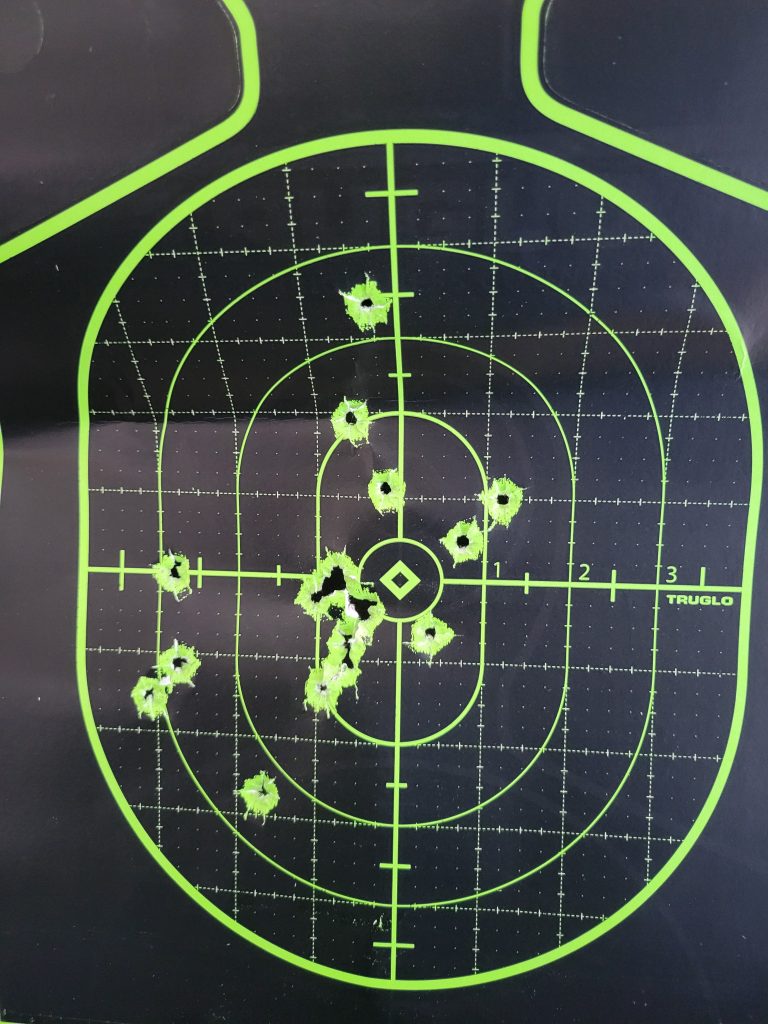
I got to put a single magazine through it. Accuracy was fine. Here is the target from 10 yards, rapid fire.
The problem was reliability. Out of 16 rounds, there was one stove pipe, three failures to feed, one round with a dented primer but no PEW!, and one where the fire control group didn’t reset.
I didn’t even get a chance to troubleshoot before the RSO came over and forced me to stop shooting because my ammo was steel cased.
I am wondering if the problems were caused by too heavy of a recoil spring. The slide is a lightweight one, and perhaps changing out the standard 15 pound spring with a 13 pound one will work.
In the meantime, I need to buy some brass cased ammo and save the steel cased stuff for the outdoor range. More on this later.
Several days ago, I posted about an active cell of Antifa operating in and around the Tampa Bay area of Florida. I have been doing some research and as much of a threat assessment of this as I can. I would have posted sooner on this, but I had several employees get COVID and have just worked a pair of 16 hour days covering their shifts. This is the first chance I’ve had to sit down and write this all out.
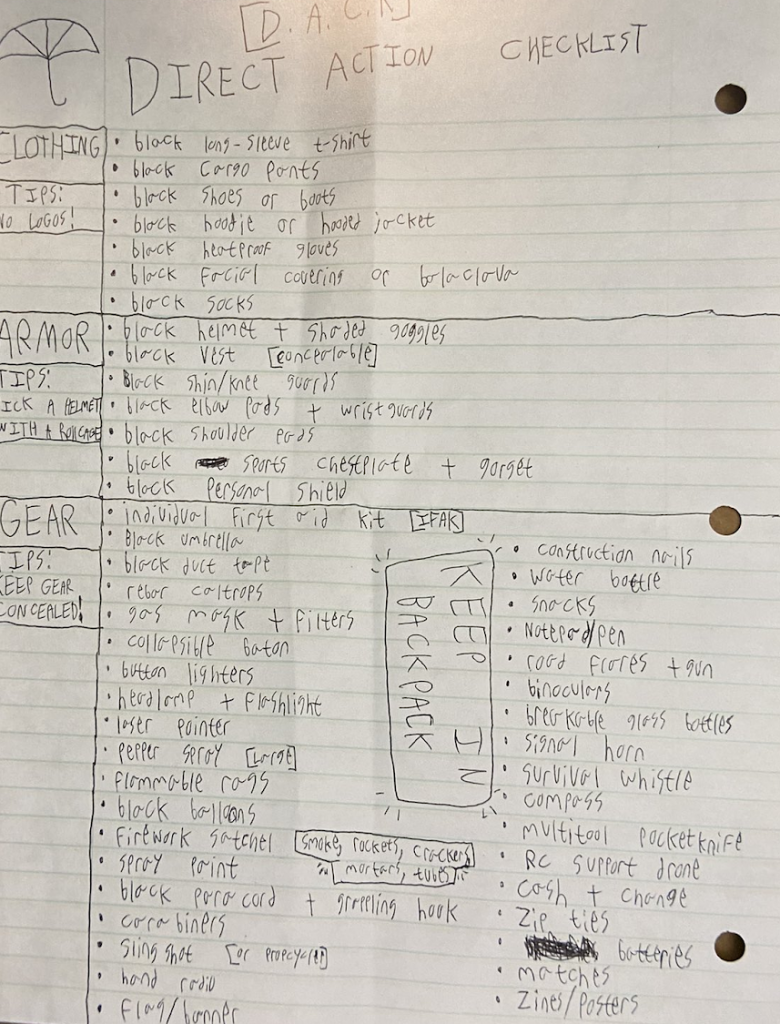
When the guy was caught, he had a checklist in his possession. The list itself shows that someone is training these guys to be good little insurgents. Read it for yourself, and you can see that they are being taught how to do this.
This also gives you an idea of the basic load carried by these guys. Note that they do not (yet) have firearms on the list, but as you will see below, many people in this group DO carry weapons as well as firearms.
Using this list and news articles on the arrestee, I was able to find quite a bit of information.
Here is the intel that I have on the cell he was operating with:
Command, Control, Communications
The particular unit he seems to have been affiliated with is the Florida Youth Liberation Front. The Front claims to have chapters in Oregon, Washington, California, Florida, Tennessee, Missouri, Illinois, New York, and Washington, DC, as well as in Canada. The Washington state version of the Front is known to have been around since 2018. The Florida chapter was formed in 2020.
They appear to be centrally controlled at the national level, and the different chapters coordinate their actions. The Portland chapter provides training for members of other chapters.
Their online presence is hosted by noblogs.org. This webpage is set up for insurgent groups. This platform caters to far-left causes, stating that it exists for the purpose of “connecting radical people.”
Their Twitter feed is not open to the public, but Twitter seems to have no problem allowing a group that advocates for violence, as long as that group is on the left.
One common theme I found on every site is the desire for the violent overthrow of government. I don’t understand how these guys’ meetings aren’t attended by a dozen cops. Every other criminal enterprise in the nation has been infiltrated to the point where they have more cops than real members, but these guys? This HAS to indicate some kind of government support. Reading the group’s website, and especially their “ezine” is fairly instructive.
Organization
The Front is broken down into smaller “affinity groups,” who operate at the local level. These groups participate in sabotage, vandalism, and other violent acts, which they call “direct actions.” This is a classic cell structure that has proven to be quite effective.
Other Antifa-affiliated groups claim they are not connected to YLF, but other left-wing extremist groups have shared the Front’s propaganda on social media, and YLF shares their propaganda and event announcements. The wording, images, and tactics are similar enough to indicate a common controlling entity at some level.
Violent Actions
The Front explicitly discourages peaceful protest. In June 2020, the Front advised protesters that they “can never be peaceful” if it means complying with police demands. Journalist Andy Ngo says that the Front “openly advocate[s] for violent uprisings.” In his testimony to Congress in August 2020, he identified YLF as the organizers of riots in Portland and other cities during the summer of 2020.
Their members are known to frequently carry loaded firearms, as well as use destructive devices such as Molotov cocktails, as well as commercial fireworks, which they sometimes modify into antipersonnel IEDs by wrapping them in duct tape and nails.
The Front is known to have carried out several violent acts:
The Front recently sued Andy Ngo for “stealing” their comments and photos. They dropped the suit when it was pointed out that Ngo was covered by “fair use.”
What is the threat?
It would be fairly easy to dismiss this group as a bunch of 20 something soyboy cucks who are cosplaying the revolutionary role while still living at home with mom and dad. That would be a mistake. While it is accurate that they are a bunch of man-children who still live at home and have no real career, this group is much more than that.
They have organization, a decent command and control network, funding enough for travel, attorneys, equipment, and an extensive propaganda network. Their members are motivated and becoming better equipped and trained by the minute.
Judge them by the fact that they are brazen and have no problem breaking the law. They have little to lose, and are out there carrying out violent attacks while the government sits on its hands, and those of us on the right largely sit around and complain on the Internet. Those on the right who DO stand up and say something are declared to be the terrorists and wind up being tortured for over a year in Federal prison, without trial and without bail.
They are dangerous and effective by the only metric that matters: they are succeeding, especially in Democrat controlled areas.
What can you do?
The best thing that we have going for us in Florida is our governor and our legal climate. So, the best thing we can do is stay right here in Florida.
I recently became aware of a Supreme Court case from 1994, Staples v. United States. This case involved a man who had been arrested for having an AR-15 with more than a few components of an M-16 fire control group installed inside of it including the selector, hammer, disconnector, and trigger.
Suspecting that the AR-15 had been modified to be capable of fully automatic fire, BATF agents seized the weapon. The defendant was indicted for unlawful possession of an unregistered machinegun in violation of the NFA.
At trial, BATF agents testified that when the AR-15 was tested, it fired more than one shot with a single pull of the trigger. It was undisputed that the weapon was not registered as required by the NFA. The defendant testified that the rifle had never fired automatically when it was in his possession. He insisted that the AR-15 had operated only semiautomatically, and even then often requiring manual ejection of the spent casing and chambering of the next round. According to the defendant, his alleged ignorance of any automatic firing capability should have shielded him from criminal liability for his failure to register the weapon.
The trial court disagreed, and the man was convicted and sentenced to five years’ probation and a $5,000 fine. He appealed the conviction, and the appeals court agreed with the trial court, affirming his conviction. It was appealed and wound up at the SCOTUS level. Justice Thomas wrote the majority opinion, and let me tell you, there are some great quotes in that opinion.
The opnion says that the language of the statute provides little in the way of guidance in this case. The NFA is silent concerning the mens rea (intent) required for a violation. It states simply that “[i]t shall be unlawful for any person . . . to receive or possess a firearm which is not registered to him in the National Firearms Registration and Transfer Record.”
Nevertheless, silence on this point by itself does not necessarily suggest that Congress intended to dispense with a conventional mens rea element, which would require that the defendant know the facts that make his conduct illegal.
Staples v. United States, 1984
The Government argued in that case that Congress intended the NFA to regulate and restrict the circulation of dangerous weapons. Consequently, in the ATF’s view, this case fits in a line of precedent termed “public welfare” or “regulatory” offenses, in which SCOTUS understood that Congress sought to impose a form of strict criminal liability through statutes that do not require the defendant to know his conduct was illegal.
One money quote that I saw was this one:
The Government does not dispute the contention that virtually any semiautomatic weapon may be converted, either by internal modification or, in some cases, simply by wear and tear, into a machinegun within the meaning of the Act.
A city worker was injured after being struck by debris from a blank that had been fired during active shooter simulation training. Did we learn nothing from the Alec Baldwin disaster? Even with blanks, projectiles still leave the barrel, and using real firearms to fire blanks is just asking for live ammo to work its way into the training scenario. All it takes is one forgotten spare magazine in an officer’s pouch, and tragedy results.
When engaging in gunfire simulation, there are a few rules, the first of which is that you don’t use real firearms. There are plenty of alternatives. From high realism/low danger like simunition, to Airsoft, paintballs, blue guns, or even simply fireworks.
There is no need EVER for pointing real firearms capable of firing actual bullets at people in a training situation. You have set yourself up for a scenario where a single point of failure is all that stands between safety and serious injury.
Slide lock, magazine inserted, in holster? Don’t get me started on the flimsy belt or the bunch of fabric that can get caught in the safetyless Glock trigger.
There is a radio repeater network that allows you to send radio traffic from your UHF HAM radio to the entire state of Florida. Send a radio message to any of these microwave nodes, and it will be instantly retransmitted by every one of them, to nearly every corner of the state.
The system is monitored by every EOC in the state, so it is a way to call for help in an emergency.
I have watched nearly every minute of the Rittenhouse trial. With my understanding of the law, I think that this was a legitimate case of self defense. With that being said, I don’t think that the law today (especially in politically charged cases like this one) is being practiced in anything close to the manner in which it is intended.
If Rittenhouse is convicted of those killings, we can be sure that self defense in particular, and the justice system in general, are no longer operating in this nation. The best thing to do from that point forward is to run if you are ever involved in a use of force incident. The Ritttenhouse defense fund is in the millions of dollars. If that isn’t sufficient to win a case that is this clear cut, there is no hope for those of us who only have concealed carry insurance.
Watch this video. 28 seconds into the video, look closely at the right side of the frame.
How close was that guy to the line of fire from the shots taken at 19 seconds? This makes my heart beat faster just watching it.
If the guy who was down there had been shot, who would have been at fault?
The designer of the stage who designed a stage where the ENTIRE stage wasn’t visible to the RSO
The RSO who didn’t make sure the down range area was clear before calling “hot range”
The shooter for taking the shot without verifying what was behind his target
The guy who was downrange for being where he was
The bystanders who didn’t keep an eye out and speak up
My answer? All of the above. We as shooters are ALL collectively responsible when things like this happened. There is a lesson to be learned from every incident. If we are unwilling to look at it with an honest eye towards safety, things like this will happen more often.
Safety isn’t just the responsibility of the RSO. Nor the shooter. It is everyone’s responsibility.
Design the environment so the RSO can see the entire shooting area. As the RSO, make sure that you are aware of the environment. The shooter needs to follow the four rules. The bystanders should keep an eye out for each other to make sure that every one of those who go down range to paste targets come back.
I have supervised people in all sorts of environments. SCUBA Diving, firefighting, HAZMAT, all sorts of things. Safety incidents are rarely the result of one thing that went wrong. It is often the result of a list of minor things that each went wrong. Each of us is responsible for what happens.
Like many shooters, I have had an ND myself. Two, in fact. I was much younger, and not as experienced as now. The first happened when I was 20 years old. I was at the range and pulled the trigger on my S&W 4506. I pulled the trigger, and nothing happened. I pointed the gun at a 45 degree angle, sort of down range, and sort of in the air. I pulled the trigger again. I was surprised when it went bang the second time. Luckily, the weapon wasn’t pointed at anyone.
The second was entirely my fault. I was doing dry fire practice. After being done with that, I reloaded the pistol. For some reason, I forgot what I had done, dry fired again, and blew a hole in the front of my dresser. Again, at least I wasn’t pointing it at a person. A violation of Rules 1 and 2.
Both of those incidents were more than 30 years ago. I have never forgotten them.
Your communications. The way that we communicate with the outside world. Think for a moment how you do that and how important that is. How robust are your communications? What would your life look like, if it was all taken from you? Once you realize that, you can look at your own situation and plan for the loss of some or most of your communications.
The PACE acronym is a great way to remember your communications plan. Let me explain: PACE is an acronym for Primary, Alternate, Contingency, and Emergency. Whenever communications between two parties are important, that line of communications will progress through those four stages until communications are reestablished. PACE is how we designate the order in which the parties move through available communications systems until contact can be established between the two parties.
Just how critical the line of communications is between those two parties will dictate how many steps are used. Ideally each method will be completely separate and independent of the other systems of communication. As an example, let’s look at a sample of communications between two parties:
Primary: This is the primary means that contact is made. It is monitored continuously. In our example, we know that the two parties constantly carry cell phones, so they have chosen to primarily communicate using cell phones to send text messages and/or phone calls.
Alternate: This is a secondary means of communication that is monitored nearly continuously. It uses, but does not require, cell phones. In this case, our two parties use email sent over the Internet.
Contingency: This method will not be as fast, easy, or convenient as the first two methods, but is capable of accomplishing the task. The parties rarely monitor this method. In this case, our two parties have agreed that they will reach each other by using radios. They have also agreed upon a channel/frequency plan that will be used to communicate.
Emergency: This is a method of reestablishing contact of last resort and typically has significant delays, costs, and/or impacts. Often only monitored when the other means fail. In the case of our two individuals, they have agreed to communicate by means of messages that will be left with at known trusted location (think geo caching, or a dead drop) A message might read: “Hey Skunk: I’m doing well. I will be at drop 6 in three days. Meet me in three days by arriving at point Chevy and calling on Channel Green. Booger sends”
Make sure that you have a way to reach those important to you. Make sure those communication paths are redundant. Make sure that they are secure. The time to plan is now. Hat tip to Aesop for the post idea.