Congressional testimony. Americans use firearms in self defense between 500,000 to several million times a year, with an estimate from 2021 being 1.5 million times per year.
Crime
Defense
Many people don’t understand the ins and outs of self defense. My wife, who has attended classes in self defense and actually has a CWP even has problems with the concept.
A couple in Sanford were checking out at WaWa when they noticed that a bottle of wine had been added to their order. They told the clerk that it wasn’t theirs, and the clerk took it off the bill. The woman behind them in line told the couple that it was her wine, then demanded that they pay for it. When they refused, she began beating them with the bottle, and knocked the male unconscious. The woman with the wine bottle was subsequently arrested for aggravated battery with a deadly weapon.
I was reading that story to my wife, and I made the comment that, should someone do something like that to me, her ass would be shot long before she was able to hit me with the bottle and knock me out. My wife’s reply was, “I don’t think a jury would agree that shooting an unarmed woman is self defense.”
I pointed out to her that the wine bottle was definitely a weapon, and not only was there a risk of serious bodily injury, the man actually DID suffer serious bodily injury, as any blow to the head that results in unconsciousness is at least a concussion, and has a fair chance of resulting in death.
My wife is from New York State. The attitude that is fostered there when it comes to guns in pretty well known to those of us in the gun community. When we were first dating, she questioned why I felt the need to carry a gun and said that she had never needed one. She was open to listening, so I took her to the range. She eventually took some classes and got her CWP.
Still, she is a pacifist at heart. When we were first dating, we were at a baseball game (the Rays v the Yankees- she is a Yankees fan) and a fight broke out in the crowd. One of the trouble makers was being escorted out by a cop, and he decided to punch the cop in the face. The cop took the guy down hard with a leg sweep. The assailant landed on his face hard enough that I heard his face hit the concrete from 30 feet away. After it was over, she was visibly shaken, and told me that she doesn’t like violence, and it makes her sick to her stomach.
The terrorist attacks in Paris were a turning point. We were on vacation in France when the attacks took place. When we saw the news of the shooting, she turned to me and said, “When we get home, I want to take the concealed weapons safety course, so I can apply for a concealed weapons permit.”
Still, even though she has the CWP, she isn’t thrilled about using force.
I get it- she is a girl, and I am not married to the Sara Conner from Terminator 2. The reason I relate this story is that you will be tried by a jury of soccer moms who are likely less gun friendly than my wife is. Remember that when you are in a situation that may require you to use force. You also need to have a lawyer who is good enough to explain your shooting in a way that will get the jury to understand why you felt the need to use force.
Self Defense
Disparity of Force
There was a fight that occurred in a Raleigh, NC high school. The fight was nearly 30 students jumping one solitary student. They knocked him to the ground, kicking and jumping on his head. You can see in the video that he produces a knife then stabs one of his largest attackers. Police arrested the kid, 14 years old, and charged him with murder.
Unless I am really missing something, I think that this is textbook self defense, unless there was something that happened before the video began. It was 30 against 1, the suspect was on the ground, and they were taking actions that would likely result in serious bodily harm. He clearly stabbed and then, rather than push the attack, he used it to escape the mob. The minute he was able to exit he did. The choice was to be killed or seriously injured or stab back.
Sure, he had a knife at school, but that will at most result in him being charged with illegally carrying a weapon at school, but that doesn’t make his defending himself with it into a murder case.
Another odd occurrence. At about 15 seconds, you can see what appears to be a gun that was dropped by one of the attackers.
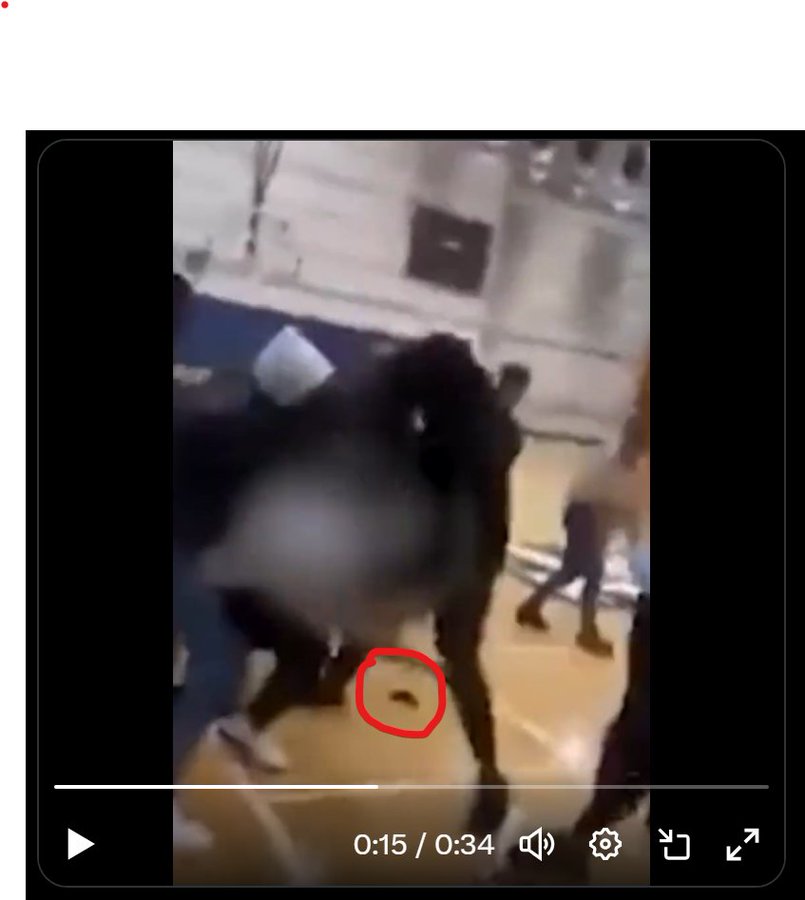
This brings another piece to the puzzle. This illustrates a few issues.
- You don’t fight one of them. There is always a gang.
- Blacks are largely violent when in large enough groups.
- Our schools are failures. For most Americans, the only place they experience being attacked is in our schools.
Self Defense
I’m Not Your Punching Bag
When I got a Bachelor’s Degree in EMS administration, my capstone research project was about violence against healthcare workers. Emergency medical workers are the victims of workplace violence more often than any other profession: more than police, prison guards, and convenience store clerks. I don’t know why, but people generally have no problem attacking EMS and emergency room workers. Scenes like the one in this post are actually more common than you would think.
I have always taken the position that no one should have to be a complacent target of someone else’s misplaced intoxicated rage. Many employers view self defense as a form of violence. I have even had coworkers (nurses, EMTs, and paramedics) tell me that “we are held to a higher standard, and shouldn’t succumb to the instinct of defending ourselves.”
Bullshit.
I don’t care what profession I am in- I should not have to be, and refuse to be, someone’s punching bag. That doesn’t mean that my response shouldn’t be proportional to the level of the attack. A woman hitting me like that is going to be put in a wrist lock. If you have an effective wrist lock, you can work against the joint just a bit to cause pain compliance. If they struggle more, twist a bit harder, and they will bend away from you. It’s an amazingly effective technique in controlling a violent patient without causing injury. Just don’t overdo it, or you will wind up having to explain and treat a broken bone.
If you couple it with pressure on the ulnar nerve, forcing it to be compressed between your fingers and the olecranon, it causes a good bit of pain without causing permanent injury. It’s essentially compressing “the funny bone” and, properly applied causes the same sort of pain you feel when you hit your elbow and feel the fire sensation running down your arm.
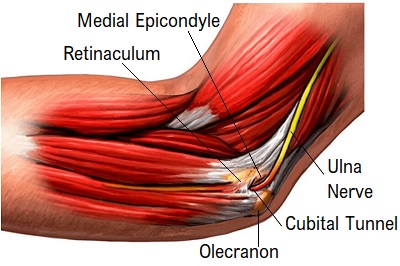
It’s a skill worth learning to subdue people without permanently hurting them.
Cops
Not Hate
There are those who say that I “hate cops” because I disagree with their actions when they screw up. Well, here is a time when I think that the police were completely justified in their use of force:
I don’t care that she is a girl. I don’t care that she is, at 16 years of age, still legally a child. She entered into a fight with a police officer and attacked him in an attempt to disarm him and acquire possession of his weapon. The police must presume that, should she gain control of this weapon, it will be used against them.
For that reason, the officer was entirely within the bounds of being reasonable when he threw her to the ground. This is a clear case of self defense.
Police State
SERE training
We have talked about how you should never talk to the cops. In the video at the end of this post, a heroin addict who is under arrest because he was found near the scene of a robbery conducts a master class in applying this tactic:
- Cop1: Reads Miranda Warning, and says “Do you understand your rights?”
- Heroin Addict: Remains Silent
- Cop 2: If you have something to show you didn’t do it, this is your time to talk
- HA: Are you the good cop?
- Cop 2: No, I’m the prick
- HA: You look like a prick.
- Cop 1: I’m not asking you to talk to me at this point. I just want to know if you understand your rights.
- HA: Am I under arrest?
- Cop1: Yes
- HA: Then take me back to my cell, because I don’t talk to you motherfuckers.
They took him back to his cell, but questioned him again two hours later, and this time they brought him sodas. Still he didn’t talk.
- Cop 1: Talk to me.
- HA: You’re not my friend. You’re just trying to get some stupid ass confession from me.
The video talks about cops using the Reid technique. It is a trick used by cops, especially the FBI, to trick people into confessing. This technique is a form of psychological manipulation that is designed to trick people into agreeing to a set of facts that is a confession.
The best way to avoid this technique is not to say anything beyond:
- Am I being detained?
- Am I free to go?
- I don’t wish to make a statement
- I want to call my attorney, or I want to be provided with an attorney.
That’s it. I’m guessing that psychological games and manipulation are why the J6 supporters are being held in the deplorable conditions that they are. A person who has been denied nutrition, sleep, and social interaction is easier to manipulate. At this point, they are political prisoners or even POWs.
Anyhow, the video is below:
Account and INFO Security
More On Safes
Here is a continuation of my research on gun safes. I finally heard back from another company, Steelwater Gun Safes. This is what they had to say in response to my question about backdoor passwords:
Steelwater Gun Safes digital locks do not have a bypass code due to the bypass key lock. There is no need for a bypass code as the bypass key will allow access if the keypad fails or if the codes have been lost or forgotten. If a key is needed, the original purchaser on file must send us proper identification before a key can be purchased from us.
Their safes are much cheaper than the Champion that I was looking at in my earlier post, but since they are claiming that there is no back door, I will recommend them as a cheaper alternative for those who are looking for a new safe. From their literature, it looks to be a better product than the other safes in the midlevel price range ($2k-5k). The 42 inch safe costs around $3700. I will stress that I don’t have one, but it does look promising and the company says the right things.
I talked to a safe guy today. He suggested an even cheaper alternative: you can change the lock. Your choices are to buy a new lock, or you can simply swap locks with another person who has a safe with a compatible lock. As long as the backdoor that your safe company may have installed is particular to YOUR safe, and not every similar lock, it’s a cheap alternative. Or you can purchase a mechanical lock and do it that way. A new mechanical lock costs in the neighborhood of $140.
Disclaimer: I don’t advertise, and receive nothing for my reviews or articles. I have no relationship with any products, companies, or vendors that I review here, other than being a customer. If I ever *DO* have a financial interest, I will disclose it. Otherwise, I pay what you would pay. No discounts or other incentives here. I only post these things because I think that my readers would be interested.
Account and INFO Security
Securing Your Money
Francis Porretto over there at Liberty’s Torch (I read them every day, don’t you?) asks a great question about the security of checks versus the security of credit cards. Since I do stories on information security, I thought it would make a good topic for a post here. Let me start by saying that I ran this by my wife, who actually teaches banking and finance, which was the topic of her Masters degree. She’s way smarter than I am on this topic. Here is our take:
Check Security
Those numbers that are on the bottom of your check are the routing and account numbers that tell the check processing companies (called the automated clearing house, or ACH) where to go in order to get paid. When a scammer has your bank account and routing numbers, they could set up bill payments for services you’re not using or transfer money out of your bank account. Getting those numbers is easy, because they are printed right there on your check, and most companies store that information on their computers, you know- the same computers that keep having data breaches. Scammers can create fake checks using your numbers and then use those fake checks to pay for purchases — or simply cash them. Know, too, that with technology scammers could digitally scan the check (called a “demand draft”) and deposit the amount into their bank account. Many banks now allow you to deposit a picture of a check. How and why does this happen?
It used to be that physical, paper checks had to be exchanged in order for banks to get paid. Shipping paper checks all over the country was costing them quite a bit of money, so they lobbied the government for a solution. Enter the Check Clearing for the 21st Century Act (Check 21 Act), which became effective on October 28, 2004. The Check 21 Act authorizes a new negotiable instrument called a “substitute check,” which is a reproduction of an original check, is the legal equivalent of an original check. In other words, all someone must do is have those numbers on the bottom of your check, and they now have access to your money. There is no way to password protect your account from this sort of scam, because Check 21 doesn’t mandate that the banks secure you from this sort of scam. Some banks will for PR reasons, but they mostly do not. It’s expensive to monitor fraud, and there is no real financial incentive for banks to do so with this sort of scam.
So a thief gets ahold of your checking and routing numbers, what next? The only defense is closing your bank account and getting another one. That’s a inconvenience, for sure. The bank may or may not be able to reverse the fraudulent transactions, but don’t count on it. Check 21 doesn’t say that they have to. While it doesn’t happen often, when scammers get those numbers, you frequently lose everything, and there is nothing that the bank can do. One charity I found fell victim to this and lost over $10,000.
Credit Card Security
Credit cards have a bit more legal protection. The law here is called the Fair Credit Billing Act, which requires creditors to give consumers 60 days to challenge certain disputed charges over $50 such as wrong amounts, inaccurate statements, undelivered or unacceptable goods, and transactions by unauthorized users. Also, the Act limits liability of consumers for transactions by unauthorized users to $50. Since this law forces banks to absorb losses for fraudulent charges over $50, banks have a financial incentive to monitor for fraud, and they do. In fact, if you report fraud, most banks don’t even worry about the $50.
Note that this law only applies to credit cards, not debit cards. Debit cards are treated the same as checks from the perspective of the law. I don’t EVER use my debit cards to pay for anything. I use them at bank owned ATMs only, and I keep my debit cards locked in the safe most of the time.
I myself have had my credit card numbers compromised on a few occasions. The last time was over two years ago, when someone was using my Barclay’s card to make unauthorized charges. The bank was telling me that the charges were legit because IMO, they didn’t want to eat the cost. The $845 that was stolen from me wasn’t worth the cost to hire a lawyer, but luckily the bank finally saw it my way and reversed the charges. I no longer use that card because Barclays was too difficult to deal with in the matter. I shouldn’t have to fight that hard to get a bank to follow the law.
Still, it was easier to switch credit cards than it would be to get a new checking account.
Conclusion
All forms of payment are vulnerable to electronic fraud, even though it’s relatively rare. You have more legal protections, and banks have a more robust fraud detection plan, when you use credit cards than when you use checks. Whenever possible, use credit cards to do business online. In fact, I have a couple of cashback cards that give me great benefits. One that I have gives me 5% cashback on all Amazon purchases, and another gives me 2% cashback on all purchases. I pay for everything with them, and pay them off at the end of each month. Stay disciplined and don’t spend more in a month than you can pay, and it’s a great way to give yourself a 2% raise and keep your money secure.
Training
Two More Training Manuals
From Uncle Ragnar: I am adding Homemade C4: A Recipe for Survival, and Homebuilt Claymore Mines to the training library. Of course, they are put there purely for educational purposes, and no one should try to actually make that stuff, because not only is it dangerous, it’s illegal.
Self Defense
Pictures
I don’t know where people get the idea from that taking pictures of or looking at others without their permission is illegal. It isn’t. If it was, shooting the video below would be just as illegal as taking a picture of some random whore’s ass.
Still, this happens periodically. For some reason, some muscle head always decides that he is going to be a freelance cop and use force to defend some skank’s honor. It happened to me a few years ago.
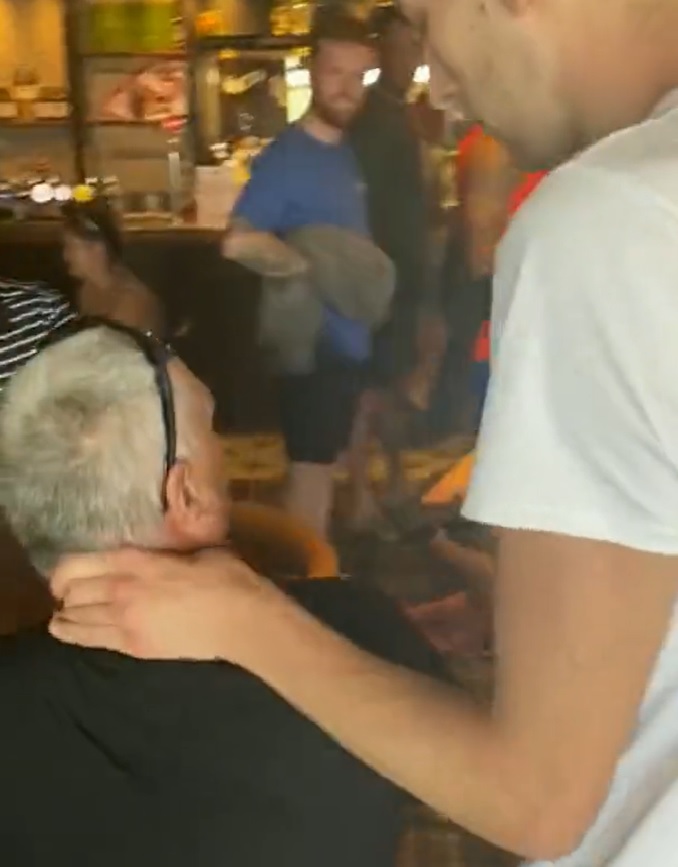
In this case, someone grabbing me by the back of the neck is about to become a cautionary tale at someone else’s concealed carry class. At the very least, there will be a bar clearing discharge of some tactical spices, and there is a distinct possibility of you having a cool cast for the skank to sign later.